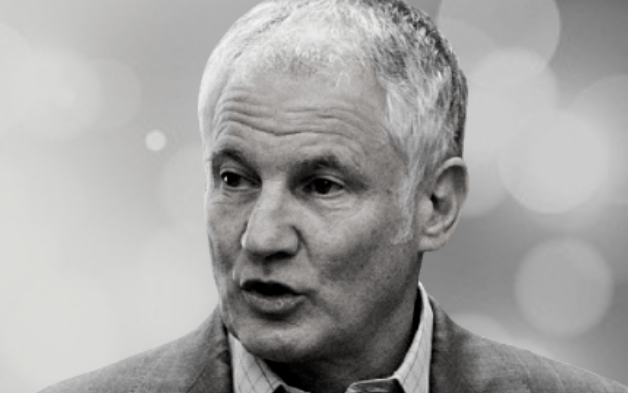

Coronavirus: Is this the end of globalisation?

In this Fiduciary Investors series podcast Amanda White talks to Princeton University’s Professor Stephen Kotkin about the fragility of the global political economy and the potential end of globalisation.

The podcast discusses the limitations of risk management systems used by many investors and the need for a new risk framework that looks beyond a linear construct to enable investors to better grasp the complexity of investing.

It discusses the fragility of the environment and the economy due to:

  • The underlying paradox of globalisation
  • The lack of recognition of adaptive complex systems
  • And a stagnant political organising framework.

About Stephen Kotkin
Stephen Kotkin is the John P Birkelund Professor in History and International Affairs at Princeton University.
He is the co-director of the program in history and the practice of diplomacy and the director of the Princeton Institute for International and Regional Studies. He established the Princeton department’s Global History initiative and workshop, and teaches the graduate seminar on global history since the 1950s.
He also holds a joint appointment in the Woodrow Wilson School for Public and International Affairs at Princeton and is a research scholar at the Hoover Institution at Stanford University.
He has authored many books including his latest Stalin: Waiting for Hitler.

About Amanda White
Amanda White is responsible for the content across all Conexus Financial’s institutional media and events. In addition to being the editor of Top1000funds.com, she is responsible for directing the global bi-annual Fiduciary Investors Symposium which challenges global investors on investment best practice and aims to place the responsibilities of investors in wider societal, and political contexts.  She holds a Bachelor of Economics and a Masters of Art in Journalism and has been an investment journalist for more than 25 years. She is currently a fellow in the Finance Leaders Fellowship at the Aspen Institute. The two-year program seeks to develop the next generation of responsible, community-spirited leaders in the global finance industry.

Suggested reading:

Sponsored Content

Spillover: Animal Infections and the Next Human Pandemic (2012). David Quammen

The Butterfly Defect: How Globalization Creates Systemic Risks, and What to Do About It (2014). Ian Goldin and Mike Mariathasan,

The Rules of Contagion (2020): a mix of biology, mathematics, history, behavioural science, and anecdote, exploring how disease, ideas and behaviours move about and then cascade. Adam Kucharski.

Leave a Comment

Why Asian equities’ growth will outlast the AI-driven semiconductor cycle

Why Asian equities’ growth will outlast the AI-driven semiconductor cycle

In the latest episode of the Fiduciary Investors Series, Liao spoke with Top1000funds.com Asia Pacific correspondent Darcy Song on why the convergence of innovation, demographics and improving shareholder returns makes Asian equities an increasingly compelling diversification trade for asset owners navigating a geopolitically fractured world.

Sort content by

A post-COVID economy

The big difference between the vaccine rollouts and the scale of the stimulus measures across the world could result in a K-shaped global economic recovery, with much of the developed world booming but poorer countries continuing to struggle. However the

The year ahead at CalPERS: Marcie Frost on the ALM study and hiring a new CIO

The CEO of CalPERS Marcie Frost has a big year ahead. Not only is the fund still searching for a CIO, but it will also conduct its four-yearly asset liability study this year. In this Fiduciary Investors Series episode, Marcie Frost speaks to Amanda White

Steinem calls for urgent action on diversity

Speaking at the Top1000funds.com event, Sustainability: A planet in trouble, renowned feminist Gloria Steinem tells institutional investors it is time to ditch the labels that describe our gender, class or ethnicity and urged the investment community to l

The spirit of green: how corporates can reduce externalities at no cost to shareholders

Nobel Prize winner Professor William Nordhaus, Sterling Professor of Economics and Professor of Forestry and Environmental Studies at Yale University, explains his theory of ‘No Regrets’ whereby companies can integrate ESG at a level that brings real bene

The labour market is broken: why investors should care

Sharan Burrow is calling on investors to do more to fix what she calls a broken labour market. In an impassioned call to delegates at “Sustainability Digital; A Planet in Trouble,” Sharan Burrow, general secretary of the International Trade Union Confeder

Climate change impacts already here: investors need to act now

The impact of climate change is already material, said Woodwell Climate Research Center’s president and executive director, Philip Duffy. Speaking at the Top1000funds.com event, Sustainability: A planet in trouble, he warns that thawing permafrost could m



