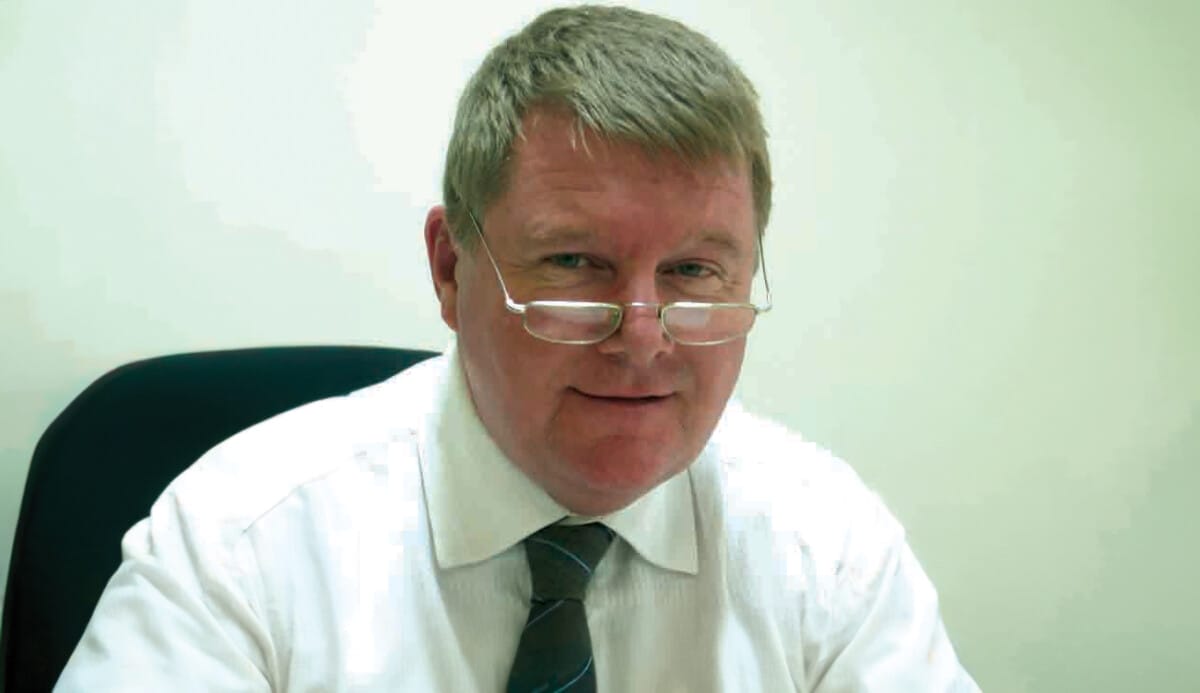

Reflections on a media mentor

Veteran Australian journalist, publisher and entrepreneur Greg Bright died today aged 70. Among his huge contributions, he was a founder of Conexus Financial, publisher of Top1000funds.com. Editor Amanda White reflects on two decades of collaboration with the respected journalist who gave so much to the industry and all who worked in it.

Top1000funds.com was Greg Bright’s idea. He argued that we already knew everything about, and everyone in, the Australian institutional investment industry; how hard could it be to conquer the world? Large asset owners all face similar risks and opportunities and investment collaboration was only going to become more important, so let’s create a global community to share ideas and opportunities. It was ambitious, bold and visionary. Why wouldn’t we? I was in, I was always all in when it came to Greg’s ideas.

Greg made work fun because of his innovative brain and the amazing people he collected, often the less obvious hires and marginal souls, people that would remain close friends over many decades. He taught so many people to embrace change, be constantly evolving ideas, to create, and back yourself.

Being bold enough to put your energy, your whole self, into invention with the informed knowledge it might not work takes courage. He didn’t care about failure, creating was the point. Not that he failed much, he had too much instinct for the industry, where it was going and how the media could play a role. He invented publications, careers and companies and then he’d do it all again multiple times. I can’t think of any financial trade publication, or any financial journalist, in Australia who has not been touched by Greg’s creative hand.

Greg had so many ideas they just oozed out of him and I worked with him on dozens of them over what seems like a lifetime. Under Greg’s publishing prowess I was the first editor of Investor Weekly (after him) and the launch editor of Master Funds Quarterly, Investment Magazine, and then Top1000funds.com. It wasn’t for the faint hearted, for he was a god (is working in the shadow of a god genius or foolish?) and he had high expectations. Not that he explicitly said that, but you could feel it. Also, he had an old-school approach that meant the deep-end was something I had to get comfortable with pretty quickly.

Greg wasn’t just a journalist he was an entrepreneur in the truest sense, visualising an invented future, balancing commercial and editorial priorities, a nonchalance for risk, a ridiculous eye for talent and a true understanding of what motivated every individual, conceiving of their careers before they knew it. He never stopped working and throughout the sharing of each other’s weddings, children, grandchildren and divorce (which he described as being like a bankruptcy) we always talked business. There was no separation of family and work or friends and weekends. He lived in one fluid motion of love and interest and conflict.

Sponsored Content

Greg was the writer’s writer. The story came first and that was the best ethos to have instilled in so many young journalists he employed. What is the angle? What’s another angle? What do we know that no one else knows? What does it mean for the industry? Importantly he encouraged us to ask hard questions when the flurry of US fund managers would come through our crappy offices hungry for a piece of the growing superannuation pie; or as union-appointed fund secretaries grew in stature and prominence in a cottage industry mandated to grow. The Australian superannuation industry could have developed in a very different direction without his probing, forcing answers and accountability.

Greg was hands-on and loved his craft. He’d often quiz us randomly asking what was the biggest mutual fund in Australia (it was the 1990s), what’s the most recent mandate to be awarded for small cap equities, who is SunSuper’s transition manager? It kept us on our toes and hungry for more information, young as we were, with little concept of the power and inspiration this time would have on our lives (for a long time our wages would come in the form of a cheque, wedged into our keyboard every Friday afternoon, a signal of the tenuous link between our work and the very subsistence of the business).

But competing for stories with Greg was a waste of energy. Every time he left the office – in those days we had to leave the office, meet with people and get the story on the street – he came back with something juicy. He knew everyone and they trusted him. He was so quick and so funny, people liked spending time with him listening to his jokes and trading gossip. Greg loved to trade gossip. Being witness to his detailed stories was like being in the inner-circle, and so many in the industry will have memories of Greg sharing a piece of information or asking an opinion. His hunger for a story and his glee in discovery was infectious.

Greg could write. He’d write and write, so quickly, so accurately and with so much depth. He had a huge memory for facts and history but was nuanced in his delivery. His stories were lovely to read. Are lovely to read.

As a young journalist under his wing it was daunting. I didn’t even know what institutional investment was when I first started working for Greg in my early 20s. But I grew under his wing for one main reason: he trusted people. He knew we would make mistakes, but he didn’t micro-manage, he trusted. He would just give more and more rope, more responsibility, and I grew into that, I grew because of that. He was so smart with people. And he gave so much of his time to teach young people what he knew.

Much later, in a world where I was a lot more confident in my ability, had my own international contacts, and some good stories under my belt, every time I saw him he’d say to me: “Who do you think is the best funds management journalist in Australia?”.

It was typical Greg, pushing someone out of their comfort zone, being emotionally provocative, deliberately ambiguous, making you think. Was he challenging me, complimenting me? Whatever it was I never answered him. I just looked at him in awe, my constant mentor, unable to shift my adoration for him. Of course it was you, Greg.

The last time I saw him was a joyous occasion. A celebration for his retirement – from the industry he led, that he created, surrounded by so many journalists who had worked for him – and I turned to him and I said: “Who do you think is the best funds management journalist in Australia?”

We both laughed and hugged each other. And I thanked him. For everything.

Leave a Comment

The future belongs to investors who can adapt

The future belongs to investors who can adapt

Canada's HOOPP has officially adopted the total portfolio approach since the start of 2026. Unpacking the move, the fund's managing director and head of total portfolio group Jacky Lee writes that while the approach doesn't magically make the return better, the fact that it frees the investment team from outdated processes and gives investment leaders the flexibility to act is what gives it an edge.

Sort content by

Long-termism, the problems with capitalism and other holiday reading

The holiday season is a good time to catch up on the reading you may have put off throughout the year. To make it easy for you here is a choice of articles that speak to some of the key themes for investors – long-termism, economic growth, climate risk and capitalism. Long-termism is one of

How to hedge long-term inflation-linked liabilities without inflation-linked instruments

Given the capacity constraints on local inflation-linked bond markets, what are other options for hedging long-term inflation-linked liabilities? This is a question Ontario Teachers’ Pension Plan has been deliberating on as it supports an academic chair at EDHEC-Risk Institute with a focus on analysing the design of novel forms of liability-hedging portfolios that do not

What, really, are your pension liabilities?

Liabilities in UK pension schemes are grossly under-estimated with the current valuation system not recognising  the perilous funding position in both corporate and public systems. The implications for not addressing this include huge financial costs borne unfairly by younger members of the schemes. Stefan Lundbergh, head of innovation, and Andrew Stewart, client manager at Cardano,

Towards a new generation of pension funds in Australia

Numerous surveys suggest that Australians are not completely satisfied with superannuation as it exists today. First, fund members tend to think that they will not have enough to retire and second, that investment plan providers are not necessarily acting in their best interest. In this context, we asked in a recent study supported by AXA

Are your managers as active as you think they are?

Measuring how active managers actually are is a useful tool for investors. A metric called “active share” can be used by institutional investors to assess active fees, measure and monitor managers styles and maintain portfolio diversification. By Thusith I. Mahanama, chief executive of Assette. Seven years ago, professors Martijn Cremers and Antti Petajisto introduced a

Is chasing lower taxes really a strategy for value creation?

Investors are just beginning to understand global tax issues and the risks associated with aggressive tax planning by the companies int their portfolios, Fiona Reynolds, managing director of PRI says there are a number of common-sense measures that companies should begin to put in place.   The 2014 G20 Summit to be held in Australia

Previous



