
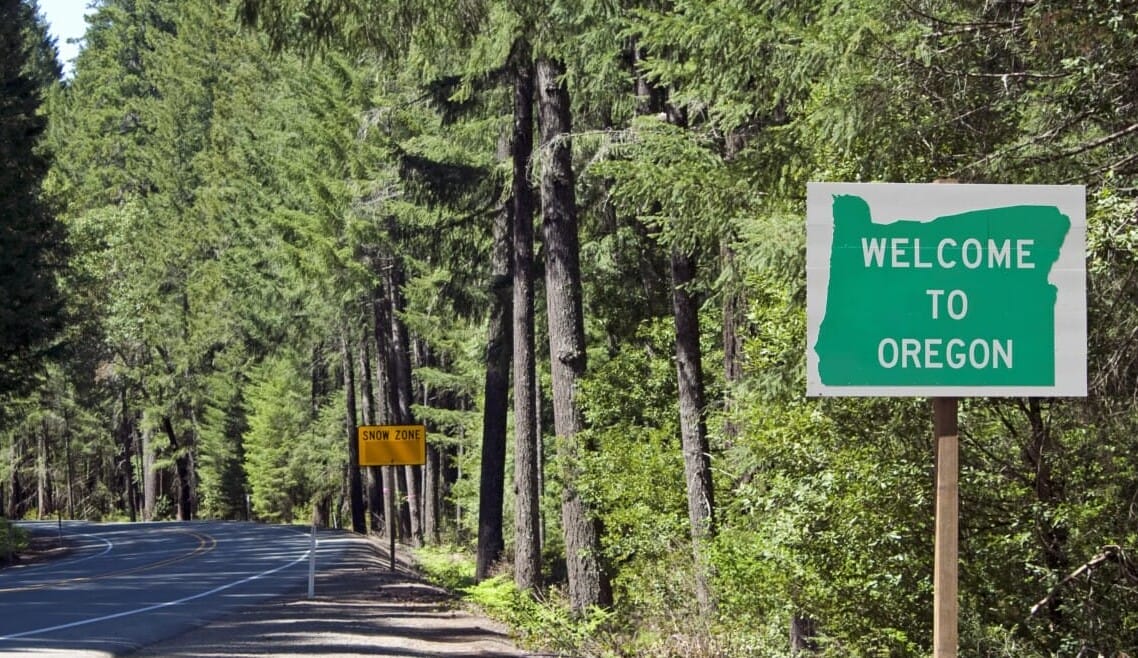

The US state of Oregon is on the cusp of passing legislation that will require the $100 billion Oregon Public Employees Retirement System to invest in clean energy wherever possible as it aims for a net-zero portfolio by 2050. The state’s treasury previously directed the fund to engage more with private markets fund managers on emission reduction goals, but identified public equities as the area where it can have the most impact on the carbon footprint.
The US state of Oregon is on the cusp of passing legislation that will require the $100 billion Oregon Public Employees Retirement System (OPERS) to invest in clean energy wherever possible and slash its carbon footprint, bucking the anti-ESG trend elsewhere in the country.
HB 2081A, or Climate Resilience Investment Act, passed the Senate this Tuesday with an 18-10 vote, including the support from one Republican Senator Dick Anderson. The bill still needs the signature from state governor Tina Kotek to become law.
OPERS wants to achieve a net-zero portfolio by 2050, with an interim target of a 60 per cent reduction in portfolio emissions by 2035 compared to a 2022 baseline. The fund is already changing how it works with private markets fund managers to realise these objectives.
In a 97-page net-zero plan published in 2024, the Oregon state treasury directed OPERS to incorporate a portfolio’s emission reduction goals into fund manager due diligence in private markets and increase the share of impact fund investments.
The report identified real assets, such as infrastructure, but not including real estate, will be one of the biggest roadblocks to a net-zero portfolio. It represents 10.1 per cent of the overall allocation at the end of June 2024, but 30 per cent of its emissions according to the 2022 baseline as reported at the end of 2023.
OPERS’ real assets investments consist of some 70 per cent in airports and bridges, and 30 per cent in natural resources such as commodities, timber, energy, and agriculture – all hard-to-decarbonise industries, the treasury said.
The fund also has an outsized private equity allocation which came to 26.9 per cent in 2024, compared to the 14 per cent US public pension peer average, according to figures from the American Investment Council. While it is not as emission-intensive nor as hard to decarbonise as real assets, the treasury highlighted some difficulties in controlling the sectors it invests in.
“We are not choosing companies; we are choosing strategies and the right people to implement those strategies. The managers then go on to select companies based on those strategies, criteria, and their own best judgment,” the report said.
Changes to public equities management
However, public equity is where the treasury believes the fund can make the most impact because of its high “emission intensity” – calculated by dividing financed emissions by the capital invested. The asset class accounted for 23 per cent of total allocation in 2024 and 47 per cent of portfolio emissions based on the 2022 baseline, 36 per cent of which is caused by active strategies.
Specifically, OPERS discovered that it has a higher level of fossil fuel exposure than the MSCI ACWI index due to its investment process and selection of risk factors. A low volatility strategy in public equity has led to a higher allocation to utility companies, for example.
The treasury wants to bring OPERS’ active portfolio emission intensity in line with the MSCI ACWI benchmark, increase active “climate-positive investments” and switch passive investments to climate-aligned index, in addition to ongoing engagements and stewardship efforts.
Progress
OPERS is making headway in achieving its net-zero goals. In an annual update 10 months after the initial report, the treasury said OPERS has committed capital to two climate-focused real asset projects in 2024 in green hydrogen and battery storage. In private equity, it invested in a company that provides ESG data and benchmarks for real assets, as well as an outdoor living product manufacturer that uses recyclable plastics.
Commenting on the Climate Resilience Investment Act’s passage, state treasurer Elizabeth Steiner said it “is a clean energy investment law, not a divestment mandate”. Under the act, OPERS will need to “actively analyse and manage the risks of climate change”, including reporting on scope 1 and scope 2 emissions of fossil fuel investments, and reduce its carbon intensity through “a preference for investments that reduce net greenhouse gas emissions”.
The treasury established an advisory group in 2024, comprised of representatives from public employee unions and OPERS retirees, which meets at least semi-annually and provides feedback on the fund’s net-zero progress.
Another bill introduced this year, SB 681, is seeking to enact a five-year pause that bans the Oregon treasurer and Oregon Investment Council from investing OPERS and other state capital in private funds that deal heavily in fossil fuels. The bill has not been progressed from the Senate since March but received overwhelming support in its first public hearing.








Leave a Comment
You must be logged in to post a comment.
Login