
Ilmarinen sheds bonds for real value

Ilmarinen, Finland’s third-largest pension fund, will continue to decrease its allocation to government bonds and investment-grade credit, primarily in Europe, in a strategy designed to protect the fund’s fixed income allocation from any interest rate move.

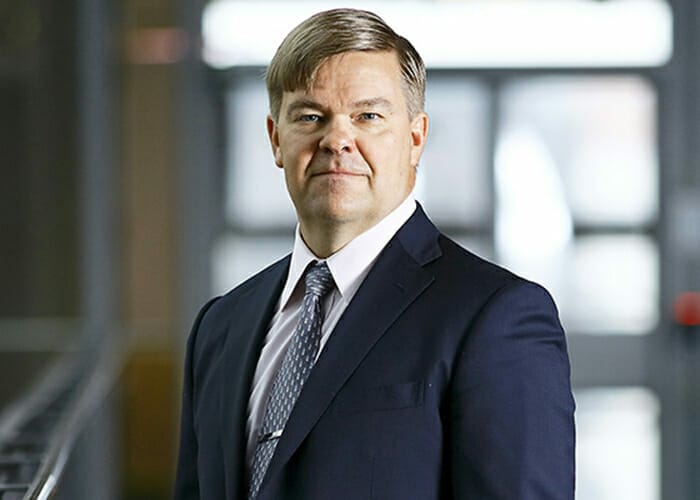
“I don’t see any value here at the moment,” Ilmarinen chief investment officer Mikko Mursula explains. “If interest rates begin to move up, it will mean capital losses for the longer maturity government bond portfolio. We have had quite a short duration in our fixed income portfolio for some years already.”

The €37 billion ($39 billion) fund now allocates 42 per cent of assets to fixed income. Its investment-grade credit comprises allocations that fall between government and corporate bonds and includes investment in state-owned enterprises and local government debt.

Ilmarinen has just posted a 4.8 per cent return for 2016, in a year marked by two distinct cycles: share prices fell initially, yet picked up towards the end of the year, helping to lift the whole portfolio.

“The market is not the easiest at the moment. But then, we always say this. It is never easy,” Mursula says.

He first joined Ilmarinen in 2000 and has held roles as head of equities, listed securities and tactical asset allocation. In 2010, he left to spend five years working for a Finnish asset manager before returning to Ilmarinen as CIO.

Sponsored Content

“It was good to go and see the world from an asset manager’s perspective. Being back on the buy-side is a bigger responsibility,” he says.

Looking outside of Finland

The plan is for assets taken out of fixed income to go into diversified equity and real assets instead. The bulk of Ilmarinen’s real-asset portfolio lies in real estate, which returned 6.4 per cent in 2016.

Most of the fund’s real estate assets (80 per cent) are in Finland, primarily in Helsinki’s metropolitan area. Efforts to increase the real estate portfolio from today’s 11 per cent of total fund assets will primarily target foreign opportunities.

“The current ratio is 80/20 local vs foreign real estate and this will change to 70/30 or even 65/35,” Mursula says.

Investments will focus on office space in Central European cities, including Brussels, Berlin and Frankfurt, as well as the US, where he favours residential and office properties.

He will continue to avoid the UK market, having put investment in UK real estate “on hold” after Brexit. The plunge in sterling, “pressure” on the market and uncertainty going forward are reasons to be wary.

“There are so many open questions about Brexit for investors,” he says. “We don’t know the time schedule or what will happen in the end.”

Less exposure to European equity

Mursula is also reducing the fund’s exposure to the European equity market as he works to boost equity overall.

Ilmarinen has a home bias in this asset class, with 30 per cent of its listed-equity portfolio in Finnish companies. The remaining 70 per cent is diversified between the US, Japan and Europe but the fund has already begun diversifying equity risk from Europe to the US and emerging markets. About a third of the overall portfolio is in listed equity.

“We used to be heavily concentrated in European listed equity and have been moving more investment to the US to diversify our risk. We will continue doing this,” Mursula says.

The majority of US equity investment is passive, using index funds and exchange-traded funds. In emerging markets, Mursula prefers active managers.

“In the past couple of years, there have been more index funds in emerging markets but we still believe the more undeveloped a market is, [the greater the] need for active investment.”

Eighty per cent of Illmarinen’s assets are managed in-house. The 20 per cent that is outsourced includes a portion of the active listed equity allocation in emerging markets, but also in Japan and the US.

Private equity, which accounts for about 5 per cent of assets, and the fund’s small allocation to alternative credit, are also managed externally. The fund uses more than 100 managers or funds across equities, fixed income and alternatives but doesn’t use consultants to manage its managers.

“We have a dedicated in-house team doing manager selection. This includes performance analysis in a strict and real-time process,” Mursula explains.

Fee negotiation becomes critical

He says fees are more important than ever in today’s low-yielding environment, and he carries out “case by case” fee negotiation with each manager.

Listed long-only equity managers tend to be flexible about fees, particularly if investors consider a large ticket size, he observes.

Fee negotiation with hedge funds and private equity managers is more challenging and he thinks many managers in these asset classes are struggling to justify high fees with poor performance.

“With convincing long track records, managers can stick to their existing fee structures,” he explains. “Now, lots of private equity and hedge funds are suffering from a lack of performance and track record and we are seeing the fees come down. But it is not just about fees. Managers struggling with performance are also finding it impossible to get new investors on board.”

Hedge funds account for 2.9 per cent of assets at Ilmarinen. Most of the allocation is managed in-house by “a significant hedge fund team” in a strategy that brings transparency and cost-effectiveness. The team focuses on catching market inefficiencies and mispricing in equities, foreign exchange, commodities, volatility and illiquidity premiums.

“There are some sub-asset classes or risk premiums that it is difficult to access in-house, one example of this is insurance risk,” Mursula says.

He says his investment team prides itself on a “flexible and fast” decision-making process shaped around the freedom to act decisively, within a framework the board sets annually.


Leave a Comment

Long term lens shields Colorado from private credit jitters

Long term lens shields Colorado from private credit jitters

As concerns in private credit mount, Colorado PERA CIO and COO Amy McGarrity says the pension fund isn’t seeing any strains in its growing allocation to the asset class, arguing that long-term investors are shielded from the risks because they can lock up their capital to weather market cycles.

Sort content by

France’s FRR ups risk in line with longer term investment horizon

Fonds de reserve pour les retraites (FRR), France’s €21 billion ($24 billion) pension reserve fund, has increased its weighting to equity in line with a new strategic asset allocation to reflect the investor's longer return horizon. It is also eyeing more unlisted assets including private equity, private debt and infrastructure.

University of California: Less is more and simple is better in investing

Jagdeep Singh Bachher, the CIO who oversees the University of California's $198 billion in pension and endowment assets, says that he wants to keep investment simple as the fund removed its hedge fund allocation completely, conceding "it’s not one of the things we are good at doing".

CalPERS finds continuity in climate of uncertainty

Investors are grappling with a multi-regime change that is manifesting in trade and geopolitical upheaval and a rise in real interest rates. But at a recent meeting, the CalPERS board heard that US equities remain top performers and the dollar, though weaker, is still historically strong and wil remain so.

GPIF pins active equity overhaul on ‘scientific’ manager selection

A quest for manager and fund strategy diversification has led the world's largest pension fund, Japan’s Government Pension Investment Fund, to reach a decade-high allocation to active global stocks. Its active equity portfolio now consists of 103 funds, increasing fivefold compared to 2020 when it only invested in 20.

UPP: Canadian investor looks outside US markets

Canada's University Pension Plan is eyeing new risks and opportunities triggered by policies from the Trump administration, like additional taxes for US investments and a surge of public spending on defence and infrastructure in Germany. It is also fine-tuning its roster of active managers.

Alpha at North Dakota: Tracking error key to portfolio construction

The $8 billion North Dakota Department of Trust Lands is rolling out a core-satellite approach to portfolio construction in a bid to control tracking errors. But CIO Frank Mihail explains that in some asset classes like infrastructure, the process is more complicated.

Previous



