


New Zealand Super’s new chief executive Jo Townsend inherits an organisation with a strong culture but facing some challenges posed by rapid growth. An internal project aims to reduce complexity and focus on simplicity for a fund already rated by WTW as operating at global best practice levels.
New chief executive of New Zealand Super, Jo Townsend, is aware of the fine balancing act her role requires: managing organisational change, as an aftermath of growth, in an organisation that has grown up with an embedded and very particular culture.
At 20 years old New Zealand Super is a young organisation, and for 10 of those years the partnership of Adrian Orr and Matt Whineray was the backbone of the organisation, growing a culture and investment process from the ground up.
With a great legacy to work with, including record five-year returns, Townsend inherits an organisation of 200+ staff (with 55 appointments made in 2023 alone) and assets of $79 billion with all the complexity of fast-paced growth and capital market headwinds.
“As a new CEO one observation of the organisation is it has grown quickly in the last five years in headcount, and complexity can be a function of rapid growth in an organisation,” she says in an interview with Top1000funds.com.
“I understand the importance of culture and it is a key area of focus in the organisation. As a new CEO top of mind is how to maintain that through a period of change.”
Townsend, who started as CEO in April this year, is taking a considered approach to understanding the organisation, involving staff in the evolution but also bringing a new perspective.
“I am looking at processes with a fresh set of eyes. I’m asking everyone ‘why do we do it that way?’ And having good chats about what the change challenge is in the organisation, and getting people to think about ‘how and why’, not ‘what we need to…’.”
While she says it is still early days there is a common realisation and acceptance there needs to be change to be successful.
An internal project, with the grand Oscars-like name of Guardians of the Future, focuses on key initiatives for continuous improvement.
“It is internal language we use when talk about continuous improvement and what we need to do to be able to be successful over the next 20 as we have for last 20 years,” Townsend says.
Key areas of focus include reducing complexity and focusing on simplicity; strengthening the investment approach through evolving the total portfolio approach and sustainability; and maximising the organisation and focusing on culture and a learning mindset.
The successful evolution of these three key elements of the organisation – culture, technology and the total portfolio approach – were also reflected as areas of improvement in the fund’s recent independent review, as required by law, with the fund receiving a WTW Global Best Practice rating.
The review was very complimentary in its report, including an acknowledgment that New Zealand Super is operating at global best practice in its activities, a state it has maintained for the past five years, and that WTW has the view the “investment process is completely exceptional among the asset owner community”.
But it also said a focus on new leadership, improving system design, maintaining a strong culture in a more complex organisation, and undergoing a technology transition, were all factors that can make the organisation more resilient.
CIO hire
One of the principal challenges for the organisation is filling the vacant CIO position, following Stephen Gilmore’s defection to CalPERS. Chair of the fund, John Williamson, has only been in the role since February this year, so how the three key individuals, all new to their roles, interact will be crucial to the future of the culture.
Townsend says there has been a huge amount of interest both internally and externally in the CIO position, but she is taking her time with the process.
“I want to make sure we are doing the most thorough process we can,” she says. “We are trying to conclude as soon as possible but we won’t rush.”
One of the consequences of the CIO vacancy is a 12-month delay in the usual five-year review of the reference portfolio.
“We will do a full review of how we do that strategic setting of our risk appetite and objectives and how to achieve that through our total portfolio approach,” she says.
Townsend says one of the WTW recommendations was to incorporate more horizon-scanning of systemic risks in the lead up to the review of the reference portfolio.
“We have a long lead time in that reference portfolio review, and will start with some of that scenario planning,” she says.
“We take that on board and are working with the asset allocation team and economics team to work out the best way to produce that information for board.”
Technology transition
For a couple of years the fund has been conducting a strategic project, dually supported by the technology and investment teams, to build and strengthen investment data.
“We are migrating away from legacy systems and putting a Snowflake database in,” Townsend says.
“This is a big investment data program, that will be foundational and extremely important to deliver. We are hoping to move out of project phase into BAU in mid next year.”
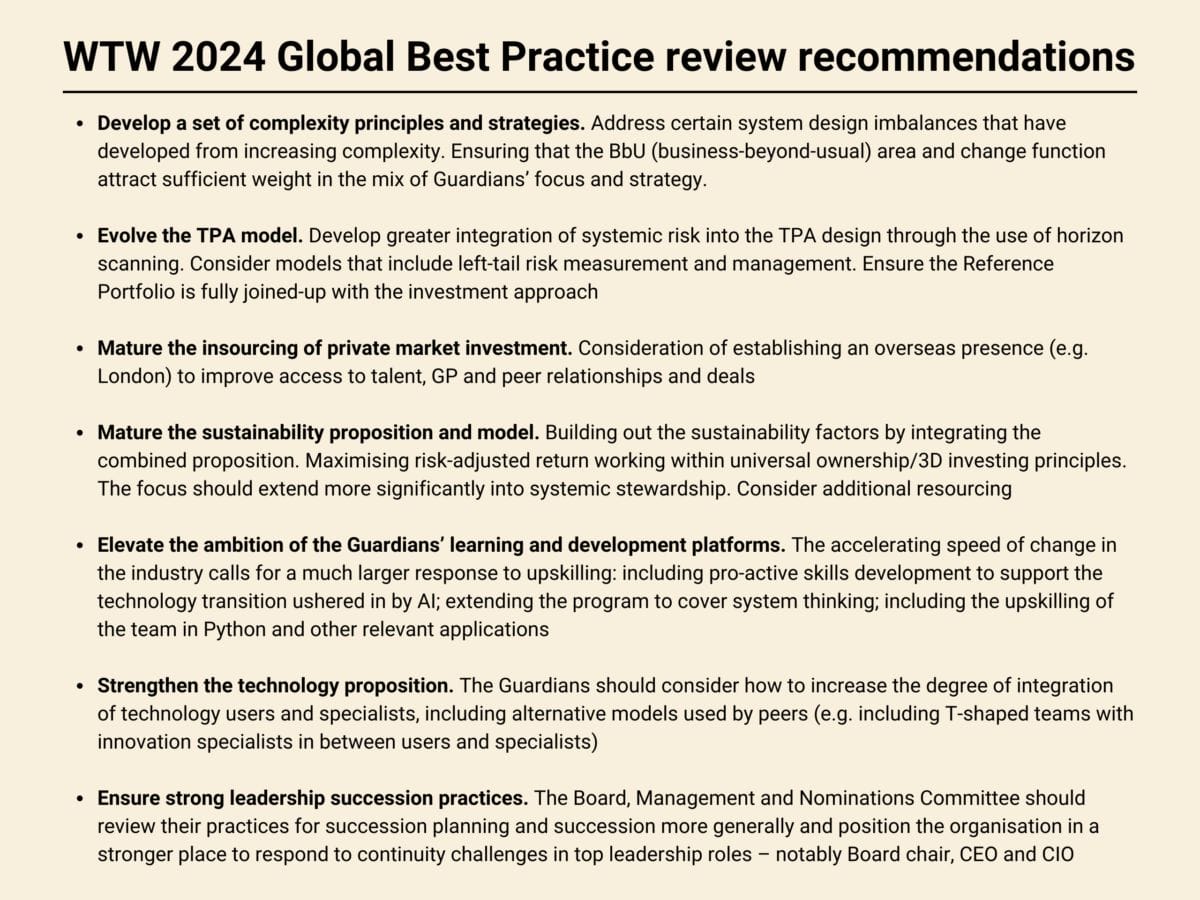
As part of this, staff are being upskilled in certain areas of technological ability, including Python.
Overall Townsend says the WTW reviews have been beneficial to the fund as a guidepost or health check that it is heading in the right direction.
The last review in 2019 also provided recommendations including a review of beliefs; a review of the compensation structure; making greater use of a risk factor framework and allocating more resources to focus on responsible investment; and greater use of stress testing. All of these have been addressed by NZ Super in the time between reviews, with various responses by the fund. A review of investment beliefs and a remuneration review were both completed in 2020.
Townsend says she entered the CEO role knowing this process, which is a co-creation with WTW and sharing of views and drafts going back and forth, was underway.
“It’s been a very useful process. WTW could get a full picture with the co-creation, and it was helpful for me in getting up to speed as new CEO,” she says.
“The process overall was extremely valuable, and there have been strong levels of involvement from Treasury which was fantastic. Overall, the process has added benefit to the Guardians, giving assurance to the government that the path we are on is solid and robust.”








Leave a Comment
You must be logged in to post a comment.
Login