
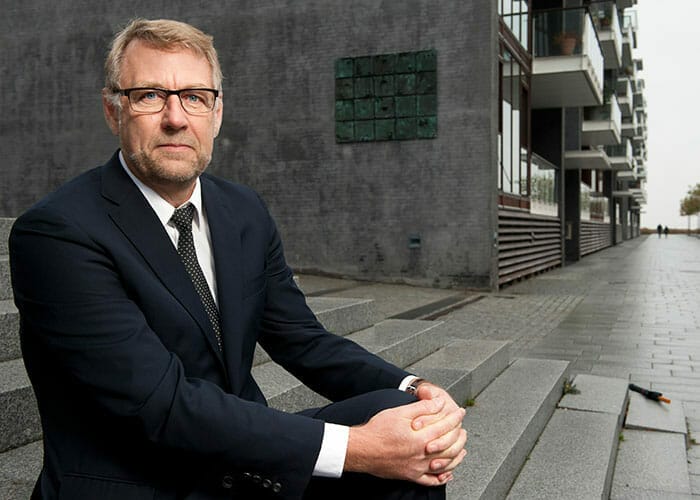

Pensionskassernes Administration A/S, PKA, the multi-employer DKK235 billion ($35.6 billion) Danish pension fund for the country’s healthcare professionals, nurses and social workers, returned a 5.7 per cent return in the first half of this year, boosted by strong performances from private equity and alternatives.
“We are quite satisfied,” says Peter Damgaard Jensen, chief executive officer, speaking from the fund’s Hellerup headquarters outside Copenhagen.
“Particularly because of market volatility and Brexit.”
The fund has posted an 8 per cent average annual return over the past five years from a portfolio primarily invested in bonds, shares, real assets and absolute return.
The fund is split 50:50 between external and internal management, with investment ideas and themes typically developed in-house with external mangers brought in to execute them.
PKA has grown its alternatives portfolio to account for 25 per cent of assets under management, in one of the biggest allocations among the fund’s Danish and European peers.
“There are still some allocations in the pipeline to real estate and infrastructure, but in private equity we are where we want to be,” he says.
All the alternatives allocation – bar real estate – is run through PKA AIP, an offshoot responsible for investing and monitoring PKA’s alternative investments in private funds, co-investments and direct infrastructure based out of Copenhagen.
Current alternative strategies include diversifying the portfolio away from its concentrated exposure to offshore wind, as well as diversifying infrastructure investments into North America and different European markets from its current northern European bias.
Damgaard Jensen also likes solar, arguing: “Solar costs have fallen so much it is now possible to invest without subsidies and this is less risky.” He’s also got an eye on the UK energy market following a decision by the new, post Brexit government to pause planned nuclear investment.
“If the UK doesn’t invest in nuclear there will be a huge energy deficit. This could be a significant opportunity. It will be interesting to see what they do.”
Deep local knowledge
The bulk of the real estate portfolio is invested in Denmark, which Damgaard Jensen prefers to forays into foreign markets because of PKA’s deep local knowledge and the ability and cost advantages of investing direct.
Going forward he plans to develop the portfolio to invest in “whole areas” within cities alongside other investors, rather than confine investment to individual buildings.
“The Danish economy is promising; we are seeing more investors coming in to Copenhagen from the outside,” he says.
Only 2 per cent of the real estate portfolio is invested overseas and all investments here are with funds.
Cutting costs through direct investment in private equity is more challenging however. Only 30 per cent of the private equity portfolio lies in co-investments, which does reduce the cost “considerably” but still leaves private equity “expensive.” The fund has made eight private equity co-investments in the past two years..
The fund also plans to increase its allocation to corporate debt. Its current allocation stands at a tiny 1 per cent of the portfolio, but as banks shed debt to comply with new BASEL regulations, Damgaard Jensen believes this will grow.
So far all PKA’s investment in the asset has been alongside banks because of PKA’s reliance on their expertise in the asset class.
“We are building up our competence here but at the moment the banks still have all the experience in this area.”
Membership ‘very active’ on coal
Low carbon investment is becoming increasingly important across the portfolio with PKA’s most recent green infrastructure investment coming via a 50 per cent stake in a new UK biomass plant, expected to be completed by 2020.
The fund aims to have 10 per cent of the real estate allocation in sustainable properties by 2020. In another initiative launched after the Paris agreement on climate change last year, the fund is divesting from all its holdings in “coal-reliant” companies like mines and utilities, spurred on by its membership, which Damgaard Jensen describes as “very active” on the subject of coal.
The fund has also asked companies that generate between 25 and 50 per cent of their revenues from coal to provide plans on how they will reduce their exposure to the fossil fuel.
“We engage with companies on policy and how they can change to have less reliance on coal,” says Damgaard Jensen, adding that looking at low carbon indexes within the equity portfolio is “on the to-do list.”
Equities remain the biggest single risk at the fund, responsible for 50 per cent of PKA’s entire risk.
In 2012 it restructured the equities portfolio to invest in risk premia strategies, building exposure to factors like value and momentum, as well as systematic risk exposures typically found in hedge fund strategies, via a robust absolute return portfolio that Damgaard Jensen believes is a crucial defensive play.
“During any market crash, it is the absolute return portfolio that performs much better than the equity portfolio. History shows there will be another equity crash.”
Ongoing efforts to tamper equity risk – and costs – include increasing passive strategies, he concludes.








Leave a Comment
You must be logged in to post a comment.
Login