
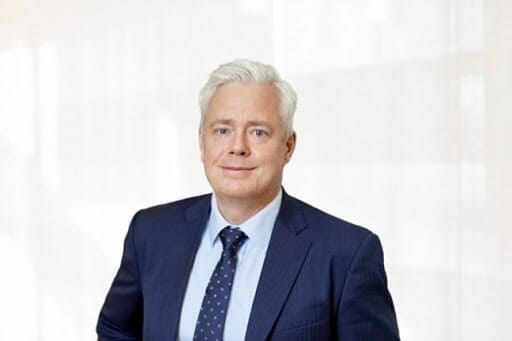

Driven by active return, AP4 produced a stellar 9.6 per cent in 2020. But its chief executive, Niklas Ekvall remains cautious about the economic outlook and its impact on the portfolio, especially with regard to inflation.
AP4, the SEK449.4 billion Swedish fund, returned 9.6 per cent in 2020, a figure that included 2.4 per cent of active return.
The fund does not have one source of active risk but has a broad asset allocation and engages in active stock picking and tilting to drive returns.
This active return from a broad base has served the fund well in the past 12 months but also historically, with 10 and five year returns also well above the benchmark. Over the past five years it has added an active profit contribution of SEK30.8 billion.
“We have a number of different mandates and take active risk on different dimensions,” says Niklas Ekvall the fund’s chief executive.
But in particular he points to two areas that have done well in the past 12 months: Swedish equities and fixed income.
“In Swedish equities we have a very strong team who are bottom-up stock pickers and very long term. We’ve had very strong results,” he says.
More than half of the fund’s assets are invested in Swedish and global equities, and an asset liability matching analysis in 2020 maintained the equities allocation at 50-70 per cent of the portfolio. Interest-bearing investments account for a third of the capital and real estate, and other alternative investments (real assets) make up 13 per cent of the portfolio.
Last year the decision was also made to lower the fund’s 40-year long-term real return target from 4 to 3.5 per cent, effective from 2021.
The return for Swedish equities in 2020 was 30.2 per cent with excess return of 15.3 percentage points. The SEK 75 billion Swedish equities is entirely managed in house with a simple investment philosophy based on knowledge about the companies it invests in. It seeks out long-term sustainable business models built on structural trends such as efficiency in healthcare, energy and food production.
An example of this long-term approach is the turnover in the portfolio, or lack of. Per Colleen who is head of fundamental equities and manages the Swedish equity portfolio joined AP4 in 2013 and in that time has invested in just under 40 companies. Of these, AP4 still has holdings in 30 (with five being bought out from the stock exchange).
The fixed income portfolio is liquid and creditworthy with AAA bonds accounting for slightly nearly 70 per cent. The excess return for fixed income investments in 2020 was 0.7 percentage points and an average of 0.2 percentage points per year over a five-year evaluation horizon.
Tactical moves
According to Ekvall the fund was an active buyer of risk last year, once it recovered from the shock of the market fall and short-term illiquidity.
“As a manager early in the Spring we were buying risk into the portfolio and bought as much equities and credit bonds as we could. Credit we bought quite early and we also did some private debt investments in the spring and summer,” he says.
“We started quite early started to buy equities as well as credit risk but we couldn’t buy as much as we wanted. But we acted in a way that makes me very proud, how the staff behaved, they were very focused and doing things that were right. Strong and good things.”
While the return for the year was robust, Ekvall is quick to point out that it doesn’t reflect the activity and pressure that investors faced.
“Just looking at the numbers you can get the feeling the year was very easy, but it was not. It was a very volatile year and what happened in the Spring… no one has experienced that fall in the market and the poor liquidity. We couldn’t buy or sell anything for a few weeks there. Then from mid April there was a very sharp rise which was almost as surprising as the fall. It was an interesting year for sure but, we are very pleased,” he says. “We proved as well that we were able to utilise our long term mandate – we had the possibility to carry risk and poor liquidity.-
Forward looking outlook
In the ALM study last year, AP4’s basic presumption was the global economy is successively adapting to a re-emerging trend of economic activity following a turbulent downturn and rebound.
“In general when we look at the economy as it is today we are fairly surprised at its resilience given the restrictions put in place,” Ekvall says. “But the lockdowns are not preventing industry from being up and running and people working so the economy is developing fairly ok.”
His view is the pandemic didn’t create any completely new trends but has strengthened trends already underway. He’s interested to see the impact on travel and hospitality and what the future of work might be.
But while the economy might be humming away for now, Ekvall says the larger question mark is what will happen in years to come given the stimulus.
“Will stimulus support the economy long term? Debt is building up and will need to be dealt with somehow. We are constructive on our outlook for 2021 but question whether risk is coming in 2022.”
Similarly while AP4’s outlook for inflation is relatively unchanged in the short term, it says it obscures relatively large underlying risks.
The assessment is that inflation will remain a good bit below target levels in emerging and developed markets during the 10-year period, after which it is expected to lie slightly above the target levels for a couple of years before stabilising around the target level. But AP4 believes that going forward there is latent inflation risk.
“Owing to the combination that the response to the Covid-19 pandemic has not only been greater but also was put into action faster while the economic downturn may be relatively short-term – albeit deep – there is reason to fear that inflation will pick up within the course of a few years,” it says in its annual report.
Against this background AP4 has decided to continue increasing the strategic weight of real assets to 15 per cent, with a corresponding decrease in global fixed income investments.
New legislation has come into play which allows the fund to invest more capital and with more flexibility in unlisted assets. Together with AP1 and AP3 the fund can now also invest in infrastructure.
For the past few years AP4 has focused on strengthening the team in alternative assets with more people in private equity, private debt and infrastructure in particular.
Ekvall expects the fund to increase allocations to assets with stable real cash flows in the coming years, and divest in nominal bonds which are not as attractive.
Other areas of focus include modernising and upgrading the portfolio IT system; and increasing the focus on sustainability.
Sustainability leadership
AP4 has been a leader in sustainability for a long time, pioneering decarbonisation in 2021 and co-founding the portfolio decarbonisation coalition in 2014.
In 2020 it cut its carbon footprint by an additional 15 per cent in 2020, which it had already halved since 2010.
The fund has an aim to be net zero in 2040 and Ekvall says this year will see it get more explicit in its aims around that.
“We will have more clear targets with how to decrease carbon emissions from our investments in years to come,” he says. “We have also improved our low carbon strategies substantially, using more forward looking measures. Data is quite tricky with regard to sustainability not least in carbon emissions and can be old. In the last year we looked into new possibilities in more forward looking data focused on company’s plans for aligning with Paris. We’ve integrated into the low carbon strategies how robust companies will be with an increase in the carbon price.”
That low-carbon lens was also expanded from 40 per cent of the global equities portfolio to all of the portfolio last year.
The global equities portfolio has typically been more quant oriented, but Ekvall said that presented a gap in analysis for the most carbon intense sectors. So a small fundamental stock picking team was recruited for fundamental stock picking in the most intense sectors starting with the energy sector, and then utilities.
Fundamental thematic management is an active investment strategy that combines thematic analysis of long-term societal and sustainability trends with quant and fundamental equities selection. An important starting point is AP4’s thematic analysis, which identifies sectors and value chains based on the climate transition. The fundamental thematic management then focuses on identifying specific companies within these themes that are either winners or losers in these long-term trends. During 2020 an analysis of the climate transition and its impact on fossil-based companies was conducted. As a consequence of this, companies whose plans and goals are not considered to be aligned with the Paris Agreement have been divested from the portfolio.
This has resulted in quite a change in the holdings in the energy sector – of 55 energy companies in the MSCI the fund only holds nine. This same analysis will be done in the materials and utilities sectors next year.
Ekvall says because the process has resulted in a more concentrated portfolio the engagement efforts will also be increased.
“We have larger investments in fewer companies so there is larger potential to impact them. The issues will depend on company by company, but it will be to support and ensure they are progressing with plans for Paris and efforts into renewable energy sources – climate and transition to carbon free society.”








Leave a Comment
You must be logged in to post a comment.
Login