
Pension CIOs re-evaluate China exposure

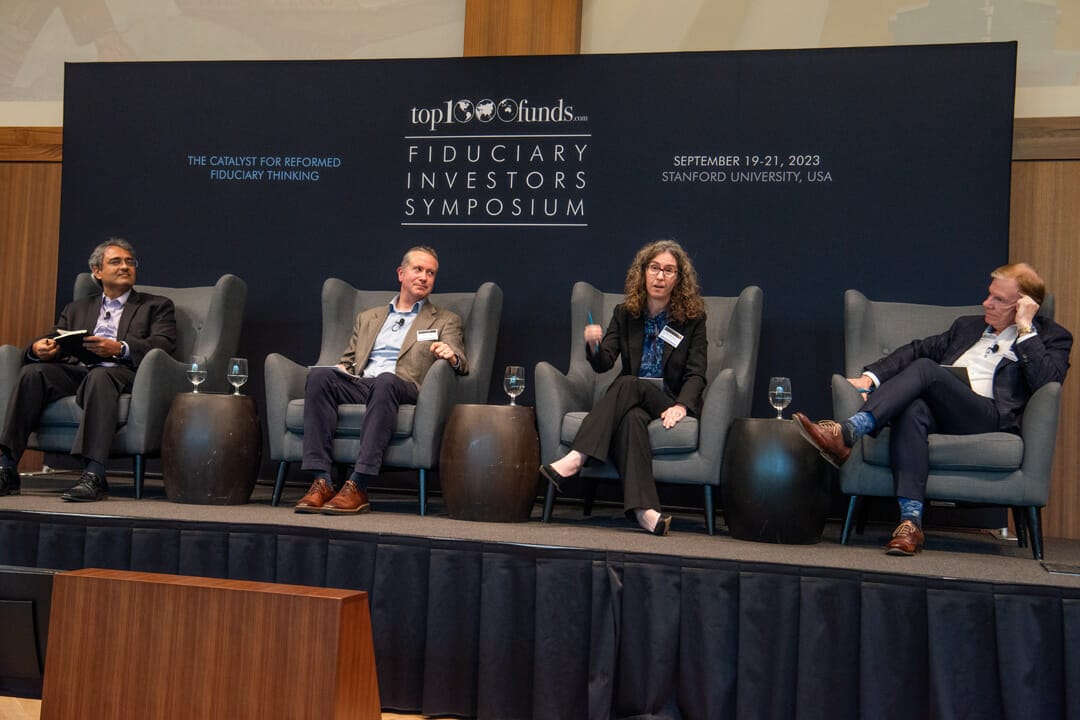
The chief investment officers of three global pension schemes have told the 2023 Fiduciary Investors Symposium at Stanford University they are re-evaluating or reducing their exposure to the world’s second largest economy as tensions between the US and China escalate. But they are resisting total divestment to a country that still dominates emerging markets benchmarks. 

The chief investment officers of three global pension schemes say they are re-evaluating or reducing their exposure to China as tensions between the world’s largest and second-largest economies escalates.

Alison Romano, CEO and CIO of the San Francisco Employees’ Retirement System, told the Fiduciary Investors Symposium at Stanford University on Tuesday that exposure to the Chinese market had been a meaningful contributor to performance over recent years.

“When I joined [SFERS in June last year] the performance was very strong, based on a number of strategic bets,” she told the symposium, hosted by Top1000funds.com.

“We leaned into growth, we leaned into innovation, we leaned into China.”

But she said increased geopolitical risk attached to the market meant she is now re-assessing that portfolio exposure, which she described as overweight.

Sponsored Content

“Let me be very clear – we’re not throwing in the towel. But we are evaluating our risk-reward basis, there is increased risk,” Romano said. “We want to be very careful who they partner with to invest there, that they have on the ground knowledge or connections.”

She said analysts, experts and industry peers held a wide range of views on China, which made it difficult to come to a position on the appropriateness of its inclusion and weight in a well diversified portfolio.

The comments come amid heightened tensions between Washington and Beijing, with reports of diplomatic communications having faltered between the two world powers and conflict over maritime disputes and alleged espionage, most notably the incident of a suspected Chinese spy balloon over US territory earlier this year.

Mark Walker, CIO of the UK’s Coal Pension Trustees, told the symposium the fund had reduced its Chinese exposure from 15 per cent to 10 per cent of its public equities portfolio, under “pressure” from trustees and concerns about geopolitical risk. He said it would likely also reduce its private equity exposure to China going forward, but added that the country was too big to ignore or divest entirely.

He said he and his team were considering how to remain a neutral position in the escalating US-China tension, while also looking to burgeoning Southeast Asian economies that have large or growing populations and can provide alternative emerging markets exposure.

“We’ve absolutely not eliminated it, but we have downplayed,” said Walker, whose fund represents UK-based mining sector workers.

James Davis, CIO of $25 billion Canadian fund OPTrust, said the China challenge was symptomatic of a broader concern around pricing geopolitical risk, especially in developing economies.

“I am not sure I am being adequately rewarded for being exposed to China,” Davis said. But he said he had resisted eliminating the fund’s exposure to China because it still accounts for at least a third of most emerging market benchmarks.

He said divesting China would be difficult for that reason, arguing the case showed some of the flaws of an index-hugging approach to emerging markets investment. “Benchmarks are constraining; I personally don’t like them,” he said. “We follow the total portfolio approach, so we try to avoid getting caught in the benchmark trap.”

Table discussions of delegates to the symposium centred on geopolitical risk, with some attendees questioning whether China should be split out from other emerging markets when making asset allocation decisions.


Leave a Comment

Macquarie: Deglobalisation the next inflection point in real assets

Macquarie: Deglobalisation the next inflection point in real assets

Global governments are partnering with private investors to boost their domestic infrastructure and become more self-sufficient in a geopolitically fragmented world, according to Ben Way, global head of Macquarie Asset Management, who said that constrained public balance sheets are increasingly reliant on private capital to meet their infrastructure needs.

Sort content by

What global asset owners should do beyond International Women’s Day

International Women’s Day has come around again and still the stats are not good. The pay gap still exists, there are still too few women in C-suite positions and women have less savings in retirement. So what are you going to do about it?

CalPERS board set to take back control of discount rate

The CalPERS board is likely to wrestle back control of setting the pension fund’s discount rate, a process that has been done automatically since 2015. Board member David Miller amongst others said this investment rate of return shouldn’t "just happen" as a matter of course, without them stepping in.

Illinois Treasurer Frerichs: Why a sole fiduciary model works

Illinois Treasurer Michael Frerichs bats away criticism that the sole fiduciary model is outdated, arguing it is possible to wear a fiduciary and political hat if your sole purpose is to serve the people of the state.

The value of diversification at Finland’s Varma

Markus Aho, chief investment officer of the €57.4 billion Finnish pension fund, Varma, explains how the fund’s diversification with a large equity allocation balanced by hedge funds, fixed income and real assets has meant it has been resilient to the increasing investment challenges.

NY Common makes further divestments, ups commitment to climate solutions 

The $260 billion New York State Common Retirement Fund will divest and restrict approximately $26.8 million of corporate bonds and actively traded public equities in eight integrated oil and gas companies, including ExxonMobil; and is doubling its commitment to the Sustainable Investments and Climate Solutions program.

Korea Investment Corporation focuses on alternatives push

KIC is looking to boost its alternatives allocation - particularly private credit - both directly and through managers. Influenced by what it sees as an unfolding AI-led industrial revolution it is looking for opportunities in fast-developing sectors including AI, semiconductors and healthcare, and has opened an office in Mumbai.

Previous



