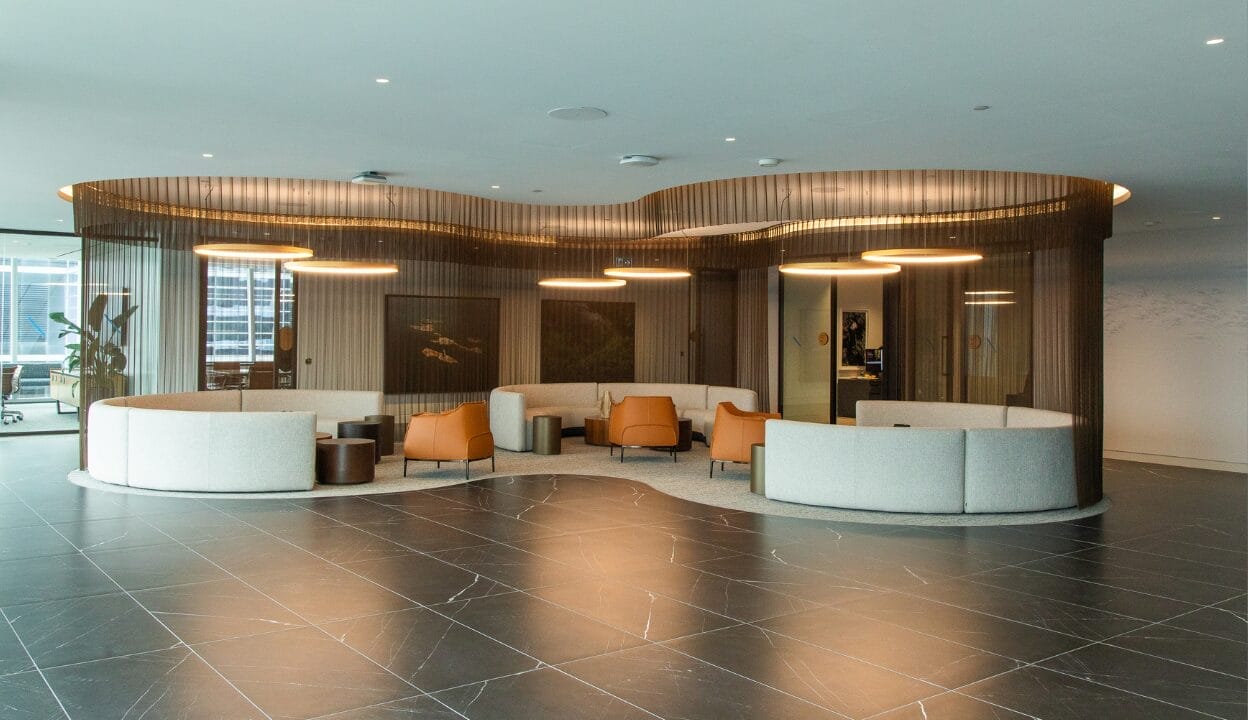

How collaboration and creativity come together in OTPP’s new offices

Staff at Ontario Teachers’ Pension Plan Board, the $247.5 billion global asset owner, come into the office at least three days a week. Although some come in four, or even five days, the investor hopes its new downtown Toronto offices will encourage people to spend more time on site.

It is also the type of premises that will help lure top talent to the pension fund, explains George Konidis, managing director, Real Estate & Workplace Transformation, OTPP, who led the dramatic renovation of the landmark building.

Since the pandemic, we have proved we can work effectively from home. And mandates that compel staff to show up more regularly at the office are often unpopular – although banks are taking a much tougher stance, stepping up enforcement of days required in the office.

Konidis believes OTPP’s new offices will boost human connection and creativity and show the office in a new light, bringing people together in a different way.

“Our new workplace experience fosters the need for collaboration, networking, mentoring and productivity,” he says.

“We have invested in our teams by providing a space that enables a successful workplace experience while also giving people the flexibility to work from anywhere.  We’re pleased with what we’ve achieved.”

Sponsored Content

Flexibility and choice

The emphasis on flexibility and choice in work styles stand out as one of the building’s key features. OTPP’s new offices have tech-enabled work seats, lounge seating, collaboration seating, meeting rooms, cafés, lounges, quiet rooms, focused workspaces and amenities to support individual needs in the workplace.

Staff can work in different workspaces to suit their individual business needs and workstyle preferences, he explains. “The aim is to further elevate well-being and productivity by providing spaces that match how people want to work and the type of work that they will be doing.”

A suite of technology tools and solutions give employees the ability to work effortlessly from anywhere in the office and the range of rooms are designed to improve meeting equity by making the experience the same for participants in person and online via new, hybrid first meeting experiences, says Konidis.

“When we made the decision to create a brand-new workspace and head office, we were looking at and planning how we could drive an elevated workplace experience. We are proud to have created a space that reflects our culture and emphasizes sustainability, inclusion and well-being and one that, we see, will motivate employees and increase productivity.”

The investment teams can use the conference level floor and meeting space “to dial-up the experience when they are hosting meetings and events,” says Konidis. “Having the ability to elevate the in-person experience, coupled with being centrally located in downtown Toronto, will certainly be beneficial.”

He adds that the new office will also help attract top talent.

“We see the in-office experience – especially when a physical space can reflect an organization’s culture and draw-in priority elements to our teams like wellness, sustainability, and amenities – playing a vital role in attracting and retaining talent.

We took the time to speak with employees and understand what they were looking for in a workspace. The outcome was an amenity-rich space with sustainability, inclusivity, wellness and flexibility embedded in its design.”


Leave a Comment

TPA to usher in clearer accountability at CalPERS

TPA to usher in clearer accountability at CalPERS

CalPERS chief investment officer Stephen Gilmore said the $650 billion fund’s upcoming shift to a total portfolio approach will sharpen investment accountability and help it focus capital allocation decisions on fund-level objectives.

Sort content by

Crisis the real test of LP-GP relationships

When Blue Owl Capital came under sustained media pressure over redemptions to its private credit funds, Michael Hitchcock, chief executive of the South Carolina Retirement System Investment Commission (RSIC), didn’t waver. He thinks that what allocators learn from their managers in a period of crisis tells them more than any official due diligence could.

Fed independence a key US inflation variable: Former CEA chair

The path of US inflation hinges on the future of the Federal Reserve, with leading Harvard economist and former Obama administration Council of Economic Advisers chair Jason Furman warning that another variable for inflation is whether the central bank can remain independent.

Public equity manager challenges the case for private

Loomis Sayles’ Aziz Hamzaogullari has questioned whether asset allocators are giving private equity more credit than it is worth, saying the case for investing in PE rests on flawed return measurement, hidden risks and high fees and that public equities should be treated with the same “patience” that PE receives.

Macquarie: Deglobalisation the next inflection point in real assets

Global governments are partnering with private investors to boost their domestic infrastructure and become more self-sufficient in a geopolitically fragmented world, according to Ben Way, global head of Macquarie Asset Management, who said that constrained public balance sheets are increasingly reliant on private capital to meet their infrastructure needs.

Investors put private equity performance under the microscope

Investors are seeking better performance attribution in private markets to better understand underlying return drivers – especially in private equity, where metrics such as IRR or multiples are increasingly criticised for being opaque. HarbourVest made the case for an alternative attribution method at FIS Harvard.

The ‘space economy’ is a legal and literal vacuum for investors

The looming SpaceX IPO has put the spotlight firmly on the so-called ‘space economy’, but asset owners have been urged to exercise caution about investing in a sector that still resembles the wild west, with no legal or governance framework to protect capital. That’s not to say money will not be made, but it might not be in the areas investors first expect.



