
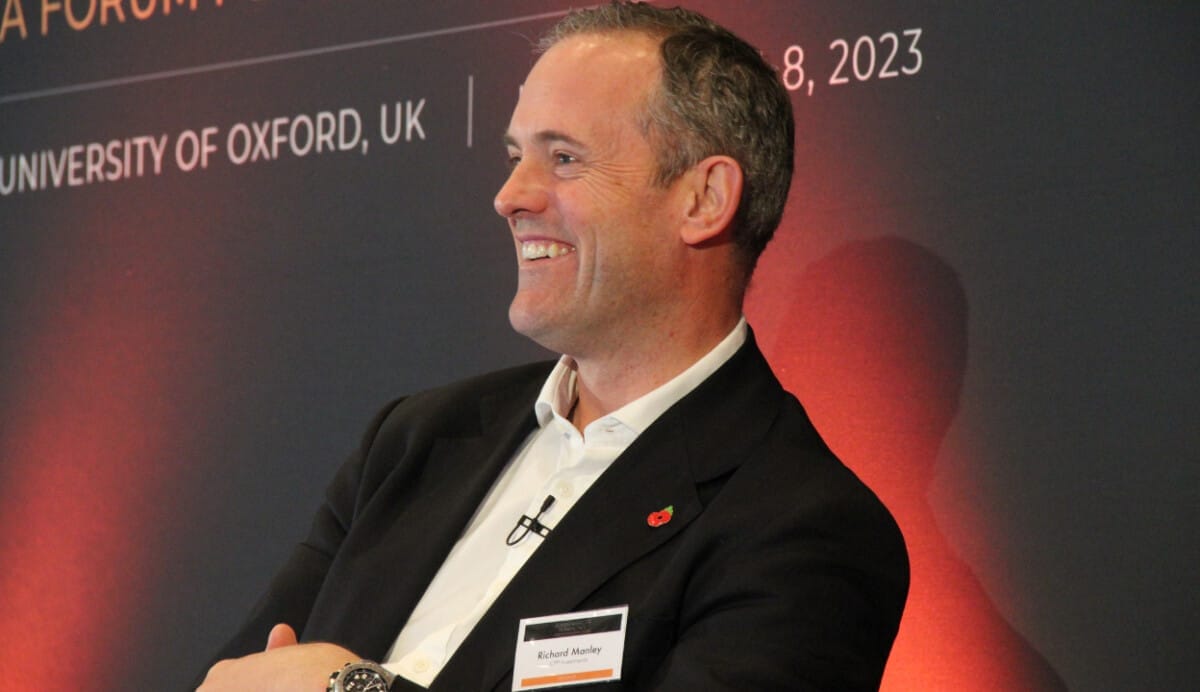

CPP Investments has produced a framework and standardised template to measure the capacity of organisations to remove or abate GHG emissions. Speaking at Sustainability in Practice at the University of Oxford, Richard Manley, the Canadian fund’s chief sustainability officer, managing director and head of sustainable investing, explains how investors can encourage corporate efforts to decarbonize.
Given around one quarter of companies in CPP Investments’ public equity allocation still don’t report Scope 1 and 2 emissions — one of the most fundamental indicators of whether a corporate board is engaging on the climate emergency — there is much to do.
Manley argued that rather than focus on what must be done to reduce emissions, companies should start by looking at what they can do, and what they can do today. He suggested companies look at corners of their business where they have a technically proven ability to decarbonise and told delegates that helping corporates prioritize the highest impact and economic opportunities of decarbonization will give them confidence in their progress on the path to net zero.
Investors can support companies transition by encouraging them to put the details in their business plans, and take possible steps regardless of uncertainties around the carbon price or regulation; unknowns around moonshot technology and offsets.
“It is about the technically feasible stuff. If companies are going to provide forward looking statements they must provide the market with data to show if it is either a slam dunk, or just speculative,” he said.
Manley said companies have an ability to decarbonize their businesses that many don’t realise. A study by CPP Investments explored transition plans at 12 portfolio companies, and found a playbook from a firm baseline for each. “It’s difficult to chart a course if you don’t know where you are today,” he said. From a firm baseline, it is possible to calculate abatement capacity by, for example, starting with efficiencies and changing the how rather than the what.
“The price on the screen does not reflect the climate risk of businesses we own,” he said, echoing comments shared by other conference delegates that climate risk is systematically undervalued.
Businesses should understand that if they don’t decarbonise, they will lose market share and see their value deteriorate, he continued. Once a company understands it has a value at risk that it can protect through decarbonization, it reframes the discussion. He urged investors to engage with corporates and their consultants on that basis.
Investors can also add pressure for change by reminding corporates that operate in markets where governments will regulate to decarbonize the economy that executives need to act. “It sits with the responsibility of the director to ensure it gets done.”
Shorter-term goals are more rigorous and provide a more solid foundation. He added that investors can also withhold support for directors if the companies they oversee don’t begin on a journey of identifying and quantifying climate risk.
“We expect boards to provide oversight and counsel to ensure all business risk is covered,” he said. He said investors are frustrated they haven’t seen more action and linked it to poor governance.
Investors can’t control regulation, but he said CPP responds to most public consultations. On another note, he said engagement is easier than divestment. To divest, investors need to believe the company won’t respond to calls for change, and that that if they do, those responses will fail.
Manley added that investment opportunity in so-called grey assets is growing and said the pension will continue to finance the transition. He noted a shortage of potential bids on some grey assets creating an opportunity. “We have an increased conviction in the opportunity to invest in and capitalise on decarbonization.”
Manley concluded with a note on the importance of investors doing themselves what they are asking companies to do. In one initiative, CPP Investments is reducing business travel, aware that not every flight has a business rationale.








Leave a Comment
You must be logged in to post a comment.
Login