[vc_empty_space height=”10px”]
The climate emergency is so large it requires a rewiring of the whole economic and financial system. But to do this new risk models are required and old paradigms must be abandoned to make way for a better way of understanding complex systems.
View Professor Hepburn’s presentations slides here[vc_quotes layout=”accordion” quotes=”%5B%7B%22name%22%3A%22Professor%20Cameron%20Hepburn%22%2C%22job_role%22%3A%22Professor%20of%20Environmental%20Economics%2C%20University%20of%20Oxford%20(United%20Kingdom)%22%2C%22content%22%3A%22Cameron%20Hepburn%20is%20the%20director%20of%20the%20economics%20of%20sustainability%20programme%2C%20based%20at%20the%20Institute%20for%20New%20Economic%20Thinking%20at%20the%20Oxford%20Martin%20School.%20He%20is%20also%20director%20and%20Professor%20of%20Environmental%20Economics%20at%20the%20Smith%20School%20of%20Enterprise%20and%20the%20Environment%2C%20a%20Fellow%20at%20New%20College%2C%20Oxford%2C%20and%20a%20Professorial%20Research%20Fellow%20at%20the%20Grantham%20Research%20Institute%20at%20the%20London%20School%20of%20Economics.%5CnHe%20has%20published%20widely%20on%20energy%2C%20resources%20and%20environmental%20challenges%20across%20a%20range%20of%20disciplines%2C%20including%20engineering%2C%20biology%2C%20philosophy%2C%20economics%2C%20public%20policy%20and%20law%2C%20drawing%20on%20his%20degrees%20in%20law%2C%20engineering%20and%20doctorate%20in%20economics.%20He%20is%20on%20the%20editorial%20board%20of%20Environmental%20Research%20Letters%20and%20is%20the%20managing%20editor%20of%20the%20Oxford%20Review%20of%20Economic%20Policy.%20His%20research%20is%20often%20referred%20to%20in%20the%20printed%20press%2C%20and%20he%20has%20been%20interviewed%20on%20television%20and%20radio%20in%20many%20countries.%5CnHepburn%20provides%20advice%20on%20energy%20and%20climate%20policy%20to%20government%20ministers%20(e.g.%20China%2C%20India%2C%20UK%20and%20Australia)%20and%20international%20institutions%20(e.g.%20OECD%2C%20UN%20organisations)%20around%20the%20world.%20He%20began%20his%20professional%20life%20with%20McKinsey%2C%20and%20has%20since%20had%20an%20entrepreneurial%20career%2C%20co-founding%20three%20successful%20businesses%20%E2%80%93%20Aurora%20Energy%20Research%2C%20Climate%20Bridge%20and%20Vivid%20Economics%20%E2%80%93%20and%20investing%20in%20several%20other%20social%20enterprises%2C%20such%20as%20Purpose%20and%20Apolitical.%20He%20also%20serves%20as%20a%20trustee%20for%20Schola%20Cantorum%20of%20Oxford.%5Cn%22%2C%22image%22%3A%2233617%22%2C%22linkedin%22%3A%22%22%7D%5D” title=”Speaker” el_class=””][vc_quotes layout=”accordion” quotes=”%5B%7B%22name%22%3A%22Amanda%20White%22%2C%22job_role%22%3A%22Director%2C%20institutional%20content%2C%20Conexus%20Financial%20(Australia)%22%2C%22content%22%3A%22White%20is%20responsible%20for%20the%20content%20across%20all%20Conexus%20Financial%E2%80%99s%20institutional%20media%20and%20events.%20She%20is%20responsible%20for%20directing%20the%20bi-annual%20Fiduciary%20Investors%20Symposium%20which%20challenges%20global%20investors%20on%20investment%20best%20practice%20and%20aims%20to%20place%20the%20responsibilities%20of%20investors%20in%20wider%20societal%2C%20and%20political%20contexts%2C%20as%20well%20as%20promote%20the%20long-term%20stability%20of%20markets%20and%20sustainable%20retirement%20incomes.%20She%20is%20the%20editor%20of%20conexust1f.flywheelstaging.com%2C%20the%20online%20news%20and%20analysis%20site%20for%20the%20world%E2%80%99s%20largest%20institutional%20investors.%20White%20has%20been%20an%20investment%20journalist%20for%20more%20than%2020%20years%20and%20has%20edited%20industry%20journals%20including%20Investment%20%26%20Technology%2C%20Investor%20Weekly%20and%20MasterFunds%20Quarterly.%20She%20was%20previously%20editorial%20director%20of%20InvestorInfo%20and%20has%20worked%20as%20a%20freelance%20journalist%20for%20the%20Australian%20Financial%20Review%2C%20CFO%2C%20Asset%20and%20Asia%20Asset%20Management.%20She%20has%20a%20Bachelor%20of%20Economics%20from%20Sydney%20University%20and%20a%20Master%20of%20Arts%20in%20Journalism%20from%20the%20University%20of%20Technology%2C%20Sydney.%20She%20was%20previously%20a%20columnist%20for%20the%20Canadian%20publication%2C%20Corporate%20Knights%2C%20which%20is%20distributed%20by%20the%20Globe%20and%20Mail%20and%20The%20Washington%20Post.%20White%20is%20currently%20a%20fellow%20in%20the%20Finance%20Leaders%20Fellowship%20at%20the%20Aspen%20Institute.%20The%20two-year%20program%20consists%20of%2022%20fellows%20and%20seeks%20to%20develop%20the%20next%20generation%20of%20responsible%2C%20community-spirited%20leaders%20in%20the%20global%20finance%20industry.%22%2C%22image%22%3A%2233531%22%2C%22linkedin%22%3A%22https%3A%2F%2Fwww.linkedin.com%2Fin%2Famanda-white-101a7515%2F%3ForiginalSubdomain%3Dau%22%7D%5D” title=”Moderator” el_class=””][vc_empty_space height=”10px”]
We need to piece together what nasties might be lurking ahead.
We are pouring trillions into the rescue and recovery. Let’s make sure these trillions are directed into assets that are fit for the future.
80 per cent of people in China, Mexico and India want a green recovery. There is overwhelming appetite for a different and better future.
We must achieve net zero. It is a question of when, not if.
What theoretical ‘surgical interventions’ – legal cases or geopolitical actions – would accelerate the move to net zero?
Government is a key actor in the system as it can potentially enforce mandatory initiatives.
A carbon tax might be useful, but it is probably not the most important of effective tool. We have to paint on a broader canvas.
[vc_empty_space height=”10px”]
Poll results
What percentage reduction in emissions from today’s levels is ultimately required to stabilise temperatures at 3°C[vc_line_chart x_values=”” values=”%5B%7B%22title%22%3A%220-20%25%22%2C%22y_values%22%3A%2217%22%2C%22color%22%3A%22blue%22%7D%2C%7B%22title%22%3A%2220-80%25%22%2C%22y_values%22%3A%2233%22%2C%22color%22%3A%22pink%22%7D%2C%7B%22title%22%3A%2280-100%25%22%2C%22y_values%22%3A%2250%22%2C%22color%22%3A%22chino%22%2C%22custom_color%22%3A%22%234cadc9%22%7D%5D”]
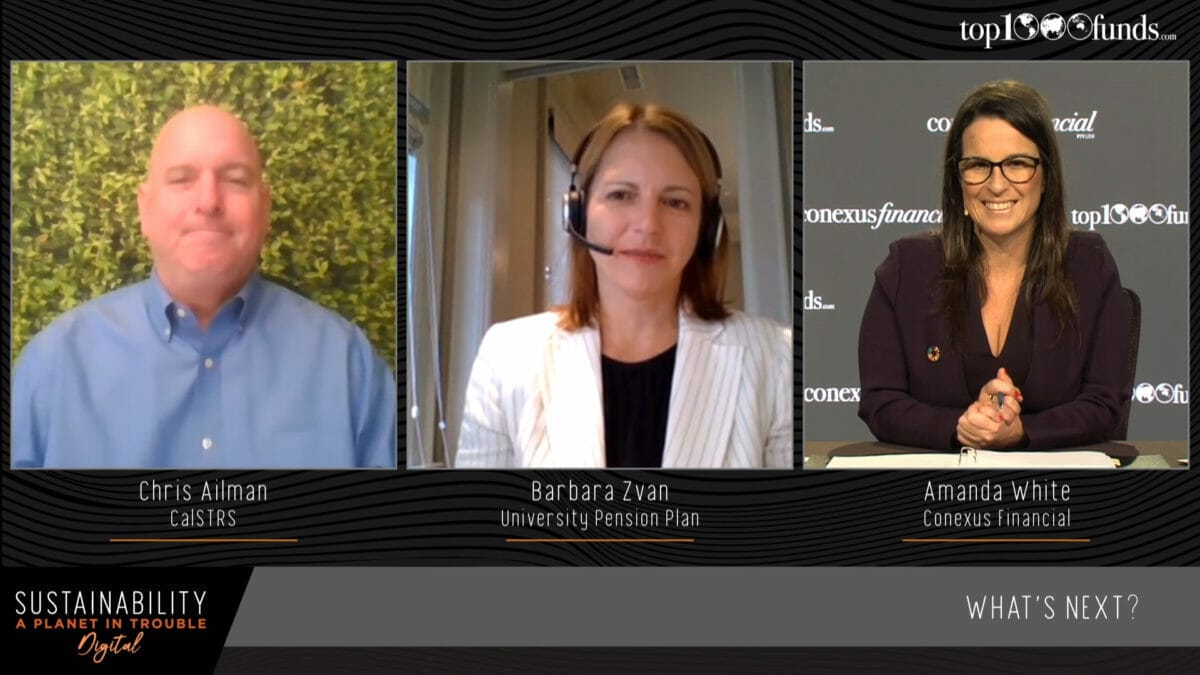
One of the most important, upcoming challenges at CalSTRS is how the fund should evaluate Chinese investments from a human capital and environmental standpoint, says Chris Ailman, chief investment officer at the giant pension fund.
Stewardship and engagement will become an integral part of investment in the future, and asset owners need to write stewardship and non-financial objectives into their mandates with managers, according to Saker Nusseibeh, chief executive international of Federated Hermes.
Climate Action 100+ illustrates asset owners’ ability to come together to solve the tragedy of the commons, said Anne Simpson, managing investment director, board governance and sustainability at US pension giant CalPERS. She said once investors realise that risk and return comes from managing financial, human and natural capital then ESG became a fundamental part of investing.
Shardul Agrawala, head, environment and economy integration division at the OECD laid out the challenges and opportunities for governments to build back better. He highlighted the industries and that may undergo transformation and the underlying market failures that need fixing.
There is moment driven by the COVID-19 crisis to invest in line with the Sustainable Development Goals, according to chief executive of Robeco, Gilbert van Hassel. But investing in companies of the future, and avoiding risks of the past, requires real expertise and changing mindsets about investment poses one of the biggest challenge for investors.
Nigel Topping, Champion of COP26, says institutional investors should put their fund managers on notice to provide more net zero products. He was speaking at the Top1000funds.com Sustainability conference in a session detailing how asset owners can move towards net zero.









Leave a Comment
You must be logged in to post a comment.
Login