[vc_empty_space height=”10px”]
The climate emergency is so large it requires a rewiring of the whole economic and financial system. But to do this new risk models are required and old paradigms must be abandoned to make way for a better way of understanding complex systems.
View Professor Hepburn’s presentations slides here[vc_quotes layout=”accordion” quotes=”%5B%7B%22name%22%3A%22Professor%20Cameron%20Hepburn%22%2C%22job_role%22%3A%22Professor%20of%20Environmental%20Economics%2C%20University%20of%20Oxford%20(United%20Kingdom)%22%2C%22content%22%3A%22Cameron%20Hepburn%20is%20the%20director%20of%20the%20economics%20of%20sustainability%20programme%2C%20based%20at%20the%20Institute%20for%20New%20Economic%20Thinking%20at%20the%20Oxford%20Martin%20School.%20He%20is%20also%20director%20and%20Professor%20of%20Environmental%20Economics%20at%20the%20Smith%20School%20of%20Enterprise%20and%20the%20Environment%2C%20a%20Fellow%20at%20New%20College%2C%20Oxford%2C%20and%20a%20Professorial%20Research%20Fellow%20at%20the%20Grantham%20Research%20Institute%20at%20the%20London%20School%20of%20Economics.%5CnHe%20has%20published%20widely%20on%20energy%2C%20resources%20and%20environmental%20challenges%20across%20a%20range%20of%20disciplines%2C%20including%20engineering%2C%20biology%2C%20philosophy%2C%20economics%2C%20public%20policy%20and%20law%2C%20drawing%20on%20his%20degrees%20in%20law%2C%20engineering%20and%20doctorate%20in%20economics.%20He%20is%20on%20the%20editorial%20board%20of%20Environmental%20Research%20Letters%20and%20is%20the%20managing%20editor%20of%20the%20Oxford%20Review%20of%20Economic%20Policy.%20His%20research%20is%20often%20referred%20to%20in%20the%20printed%20press%2C%20and%20he%20has%20been%20interviewed%20on%20television%20and%20radio%20in%20many%20countries.%5CnHepburn%20provides%20advice%20on%20energy%20and%20climate%20policy%20to%20government%20ministers%20(e.g.%20China%2C%20India%2C%20UK%20and%20Australia)%20and%20international%20institutions%20(e.g.%20OECD%2C%20UN%20organisations)%20around%20the%20world.%20He%20began%20his%20professional%20life%20with%20McKinsey%2C%20and%20has%20since%20had%20an%20entrepreneurial%20career%2C%20co-founding%20three%20successful%20businesses%20%E2%80%93%20Aurora%20Energy%20Research%2C%20Climate%20Bridge%20and%20Vivid%20Economics%20%E2%80%93%20and%20investing%20in%20several%20other%20social%20enterprises%2C%20such%20as%20Purpose%20and%20Apolitical.%20He%20also%20serves%20as%20a%20trustee%20for%20Schola%20Cantorum%20of%20Oxford.%5Cn%22%2C%22image%22%3A%2233617%22%2C%22linkedin%22%3A%22%22%7D%5D” title=”Speaker” el_class=””][vc_quotes layout=”accordion” quotes=”%5B%7B%22name%22%3A%22Amanda%20White%22%2C%22job_role%22%3A%22Director%2C%20institutional%20content%2C%20Conexus%20Financial%20(Australia)%22%2C%22content%22%3A%22White%20is%20responsible%20for%20the%20content%20across%20all%20Conexus%20Financial%E2%80%99s%20institutional%20media%20and%20events.%20She%20is%20responsible%20for%20directing%20the%20bi-annual%20Fiduciary%20Investors%20Symposium%20which%20challenges%20global%20investors%20on%20investment%20best%20practice%20and%20aims%20to%20place%20the%20responsibilities%20of%20investors%20in%20wider%20societal%2C%20and%20political%20contexts%2C%20as%20well%20as%20promote%20the%20long-term%20stability%20of%20markets%20and%20sustainable%20retirement%20incomes.%20She%20is%20the%20editor%20of%20conexust1f.flywheelstaging.com%2C%20the%20online%20news%20and%20analysis%20site%20for%20the%20world%E2%80%99s%20largest%20institutional%20investors.%20White%20has%20been%20an%20investment%20journalist%20for%20more%20than%2020%20years%20and%20has%20edited%20industry%20journals%20including%20Investment%20%26%20Technology%2C%20Investor%20Weekly%20and%20MasterFunds%20Quarterly.%20She%20was%20previously%20editorial%20director%20of%20InvestorInfo%20and%20has%20worked%20as%20a%20freelance%20journalist%20for%20the%20Australian%20Financial%20Review%2C%20CFO%2C%20Asset%20and%20Asia%20Asset%20Management.%20She%20has%20a%20Bachelor%20of%20Economics%20from%20Sydney%20University%20and%20a%20Master%20of%20Arts%20in%20Journalism%20from%20the%20University%20of%20Technology%2C%20Sydney.%20She%20was%20previously%20a%20columnist%20for%20the%20Canadian%20publication%2C%20Corporate%20Knights%2C%20which%20is%20distributed%20by%20the%20Globe%20and%20Mail%20and%20The%20Washington%20Post.%20White%20is%20currently%20a%20fellow%20in%20the%20Finance%20Leaders%20Fellowship%20at%20the%20Aspen%20Institute.%20The%20two-year%20program%20consists%20of%2022%20fellows%20and%20seeks%20to%20develop%20the%20next%20generation%20of%20responsible%2C%20community-spirited%20leaders%20in%20the%20global%20finance%20industry.%22%2C%22image%22%3A%2233531%22%2C%22linkedin%22%3A%22https%3A%2F%2Fwww.linkedin.com%2Fin%2Famanda-white-101a7515%2F%3ForiginalSubdomain%3Dau%22%7D%5D” title=”Moderator” el_class=””][vc_empty_space height=”10px”]
We need to piece together what nasties might be lurking ahead.
We are pouring trillions into the rescue and recovery. Let’s make sure these trillions are directed into assets that are fit for the future.
80 per cent of people in China, Mexico and India want a green recovery. There is overwhelming appetite for a different and better future.
We must achieve net zero. It is a question of when, not if.
What theoretical ‘surgical interventions’ – legal cases or geopolitical actions – would accelerate the move to net zero?
Government is a key actor in the system as it can potentially enforce mandatory initiatives.
A carbon tax might be useful, but it is probably not the most important of effective tool. We have to paint on a broader canvas.
[vc_empty_space height=”10px”]
Poll results
What percentage reduction in emissions from today’s levels is ultimately required to stabilise temperatures at 3°C[vc_line_chart x_values=”” values=”%5B%7B%22title%22%3A%220-20%25%22%2C%22y_values%22%3A%2217%22%2C%22color%22%3A%22blue%22%7D%2C%7B%22title%22%3A%2220-80%25%22%2C%22y_values%22%3A%2233%22%2C%22color%22%3A%22pink%22%7D%2C%7B%22title%22%3A%2280-100%25%22%2C%22y_values%22%3A%2250%22%2C%22color%22%3A%22chino%22%2C%22custom_color%22%3A%22%234cadc9%22%7D%5D”]
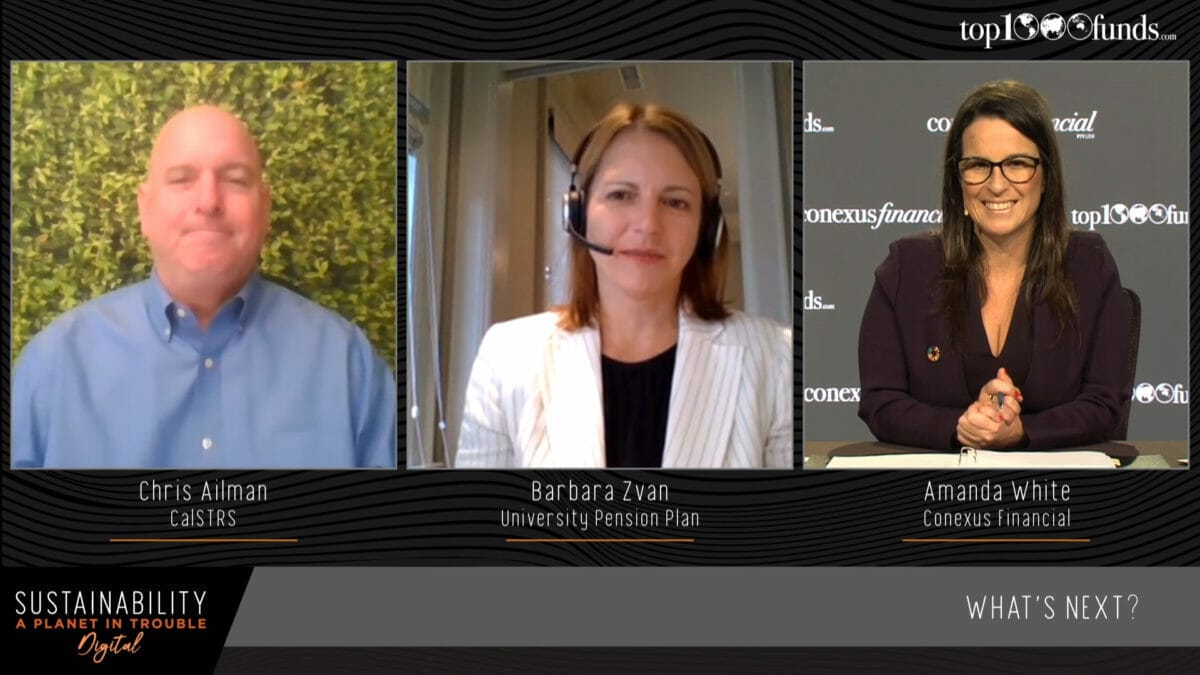
One of the most important, upcoming challenges at CalSTRS is how the fund should evaluate Chinese investments from a human capital and environmental standpoint, says Chris Ailman, chief investment officer at the giant pension fund.
Princeton University Professor of International Affairs, Stephen Kotkin explains why large global investors and multinationals can lead on sustainability but national governments fail.
Integrating the SDGs involves analysing investee companies' core business, the products and services they sell, and mapping that to the SDGs. Two investors, APG and Schroders, outline the indepth process.
In an intimate case study this session at the Sustainability conference profiles the relationship between Robeco and CocaCola and how investor engagement has helped prioritise sustainability issues and drive long-term growth through a focus on the circular economy.
International negotiations like the Paris Agreement no longer work. The world needs a new framework supporting a carbon tax with both carrots and sticks to encourage participation, says William Nordhaus, Sterling Professor of Economics, Yale University and 2018 Nobel Prize winner in Economics.
In a rare insight into the portfolio construction process at Bridgewater, the head of investment research, Karen Karniol-Tambour discusses how to shift from only looking at risk and return to adopting a three-dimensional model that incorporates impact.
The Ford Foundation outlines its ability to achieve impact and returns and announces plans to invest for impact in public markets in the next 18 months. Elsewhere, renown impact investor Pictet Asset Management explains how impact investment is becoming more mainstream.
Leave a Comment
You must be logged in to post a comment.
Login