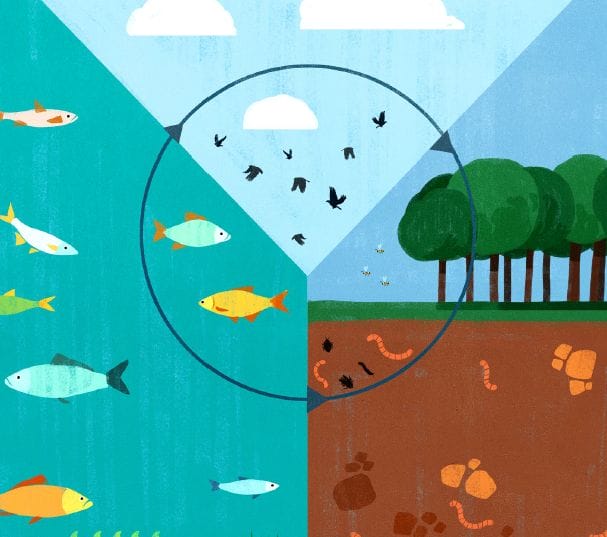
Planetary Boundaries:

[vc_empty_space height=”10px”][vc_media_type_category]Businesses have a huge role to play in containing global environmental risks. And because they have great leverage on companies, so too do investors.  The idea of “ethical” or “green” investing has gained ground in recent years, but it is hampered by a lack of quantitative definitions.

We propose that the Planetary Boundaries framework, devised by Rockstrom et al. in 2009, is a good starting point.

The framework takes nine dimensions of planetary health – measurable criteria such as concentrations of greenhouse gases, or biodiversity loss. It then attempts to establish how far each of these can change without risk of provoking sudden, irreversible damage to the environment. We have also developed a way to apply the Planetary Boundary framework to investment decisions; specifically, we quantify the environmental impact for every USD1 million of annual revenue businesses generate.

If a company’s activities lie within the safe levels for each of the nine dimensions over the whole of the product value chain, then the firm (and potentially its stocks and bonds) can be viewed as being environmentally sustainable; if not, then the business is likely to be speeding up global environmental degradation.

The nine dimensions of the Planetary Boundaries framework are: climate change, biodiversity loss; biochemical flows; chemical pollution; land-system change; freshwater use; ocean acidification; ozone depletion and atmospheric aerosol loading.
We will examine each of them in turn, suggesting changes that we think are necessary to make the metrics more relevant to the investment process.

Investment is often focused on short-term metrics, while planetary health demands a long-term horizon. We have chosen short-term, local metrics that have long-term, globally systemic consequences. But we acknowledge that this also implies an assumption that incremental changes are sufficient to maintain planetary health.

Sponsored Content

Click here to read the full paper.

Leave a Comment

China ESG risk: the next unknown

China ESG risk: the next unknown

One of the most important, upcoming challenges at CalSTRS is how the fund should evaluate Chinese investments from a human capital and environmental standpoint, says Chris Ailman, chief investment officer at the giant pension fund.

Sort content by

The path to a sustainable economy

This episode explores the key pillars of a sustainable recovery including the three important long term trends that need to be addressed climate change, loss of biodiversity and inequality. It explores the key role for the finance industry which includes building new models that are not only about maximising monetary profits but also transition theory, and the value of ecological and social capital.

The need for urgent action on climate

Nigel Topping who was appointed by the UK Government as the High Level Climate Action Champion for United Nations climate talks, COP26 joins Fiona Reynolds, chief executive of the PRI, in conversation with Amanda White, editor of Top1000funds.com This episode focuses on climate change and how, amongst and despite, the short-term focus of this COVID-19 crisis, we can mobilise government, business and investors into action around this important issue of climate change.

Embrace a systems framework

COVID-19 has revealed some fundamental design flaws in our global economy, including the relentless pursuit of economic growth - not only at the expense of the environment but also at the expense of people. The investment industry has a role to play in fixing these design flaws. A systems framework for investing could be the answer.

Building back better

For the economic recovery from the COVID-19 crisis to be durable and resilient, a return to ‘business as usual’ and environmentally destructive investment patterns and activities must be avoided. To avoid this, economic recovery packages should be designed to “build back better”.

Fiscal recovery packages and climate

As we move from the rescue to the recovery phase of the COVID-19 response, policy-makers have an opportunity to invest in productive assets for the long-term.

SDG asset owner platform launches

Investors in Canada and Australia have joined the Dutch funds, APG and PGGM, in making their intention of an AI-driven SDG investment platform a reality - the Sustainable Development Investments Asset Owner Platform.

Previous



