Social conditions and the economy

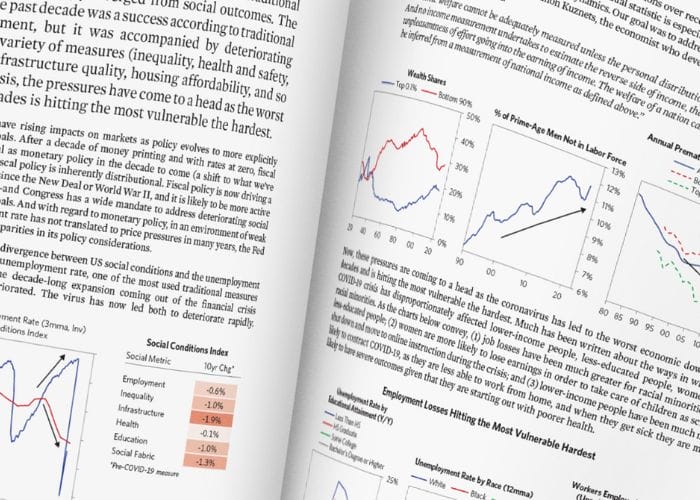
The ultimate goal of economic policy is simple and timeless—to ensure prosperity and maximize living standards. Broad macroeconomic measures such as GDP growth, the unemployment rate, and inflation had for decades been a good proxy of rising prosperity, so they have dominated economic policy making and are enshrined in most central bank mandates. But even before the COVID-19 crisis, it had become clear that traditional economic measures have increasingly diverged from social outcomes. The economic expansion of the past decade was a success according to traditional measures of full employment, but it was accompanied by deteriorating social conditions across a variety of measures (inequality, health and safety, educational attainment, infrastructure quality, housing affordability, and so on). With the COVID-19 crisis, the pressures have come to a head as the worst economic downturn in decades is hitting the most vulnerable the hardest.

Click here to read the full paper.

Sponsored Content

Leave a Comment

Climate the No.1 priority for 2021

Climate the No.1 priority for 2021

Climate is by far the number one sustainability priority for investors in 2021 according to a poll of asset owners from more than 32 countries which came together for the Top1000funds.com online Sustainability event in March.

Sort content by

Bridgewater on the impact revolution

Integrating impact alongside risk and return is a revolution that will see more diversification among investor allocations to asset classes such as commodities. Elsewhere, it requires using multiple data sets to analyse stocks and sovereign bond allocations to see the real-world impact of a company’s product or services, and which governments are heading to net-zero. Bridgewater’s head of investment research Karen Karniol-Tambour explains.

Diversity doesn’t work without inclusion

Achieving diversity requires data, new recruitment practices and nurturing inclusion. And the financial industry must get its own house in order to better put pressure on investee companies.

Diversity uncut

In a fireside chat, Gloria Steinem reminds us why diversity is such an important issue for investors to understand, why it impacts society, business and investments so fundamentally, and why there is still so much work to do.

Sovereign engagement is the new frontier

Robeco chief executive Gilbert van Hassel opened the 'Sustainability Digital: A Planet in Trouble' conference with a reminder of the opportunities in sustainability and the importance of working with others. At Robeco this now includes engaging directly with sovereign governments.

Regulation and economics converge in ESG

Investors from Schroders, Trillium and PensionDanmark discuss how a changing regulatory picture and the economics of sustainable investment are coming together to create a tipping point in ESG, but they warn their peers to look beyond the label to what is on the inside.

Principles of a climate-impact dashboard

The climate-impact dashboard is part of a 3-D investment framework that balances risk, return and impact. This includes total portfolio thinking, long-horizon investing, impact investment strategies, system-level engagement and strategic partnership between asset owners and asset managers. Here Tim Hodgson lays out eight guiding principles to help shape a climate-impact dashboard.

Previous




