
Social conditions and the economy

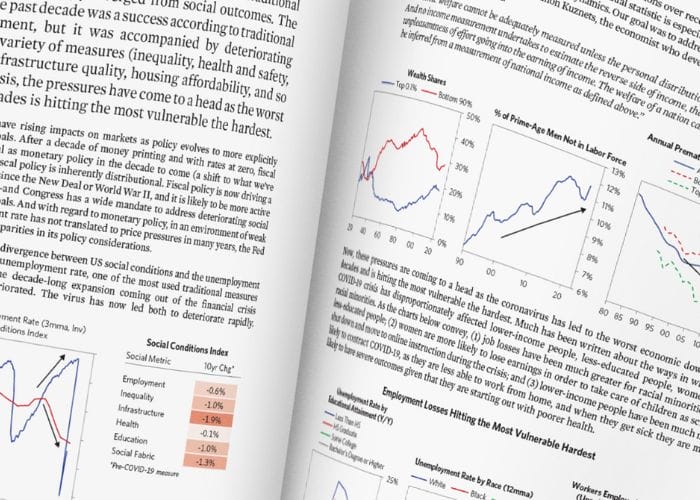
The ultimate goal of economic policy is simple and timeless—to ensure prosperity and maximize living standards. Broad macroeconomic measures such as GDP growth, the unemployment rate, and inflation had for decades been a good proxy of rising prosperity, so they have dominated economic policy making and are enshrined in most central bank mandates. But even before the COVID-19 crisis, it had become clear that traditional economic measures have increasingly diverged from social outcomes. The economic expansion of the past decade was a success according to traditional measures of full employment, but it was accompanied by deteriorating social conditions across a variety of measures (inequality, health and safety, educational attainment, infrastructure quality, housing affordability, and so on). With the COVID-19 crisis, the pressures have come to a head as the worst economic downturn in decades is hitting the most vulnerable the hardest.

Click here to read the full paper.

Sponsored Content

Leave a Comment

Climate the No.1 priority for 2021

Climate the No.1 priority for 2021

Climate is by far the number one sustainability priority for investors in 2021 according to a poll of asset owners from more than 32 countries which came together for the Top1000funds.com online Sustainability event in March.

Sort content by

Nordhaus and ‘No Regrets’

Nobel Prize winner Professor William Nordhaus, Sterling Professor of Economics and Professor of Forestry and Environmental Studies at Yale University, explains his theory of ‘No Regrets’ whereby companies can integrate ESG at a level that brings real benefits for society but has limited impact on the corporate.

APG and NYC talk Amazon push back

Two of the world’s most influential institutional investors are hitting a brick wall in their attempts to engage with Amazon’s board on workplace safety. Every time the Netherland's APG and the office of New York City Comptroller, fiduciary to New York city’s five pension funds, try to engage with the board at the tech giant in which they own a combined $6.5 billion they get push back from management.

The path to net zero

Investors from Brunel, Wespath and Robeco talk about the challenges of shaping their net zero portfolios including data, benchmarks and holding managers to account.

The missing link: EM green bonds

Sustainability bonds issued by sovereign governments in developing and emerging markets offer exciting investor opportunities. The proceeds are used for impact and allow investors to target real change in sectors like health and education. Emerging market specialists describe how it could be the missing link to the ESG jigsaw.

Diversity: How to move the needle

Targets, allocating to diverse managers and acting on calls for change from diverse staffers are just some of the ways asset owners are boosting diversity in their own organisations. Investors at the Kresge Foundation, AP2 and AIMCo talk about their diversity, equity and inclusion action.

Sustainable investing

Bridgeewater's Macro Approach to ESG Integration