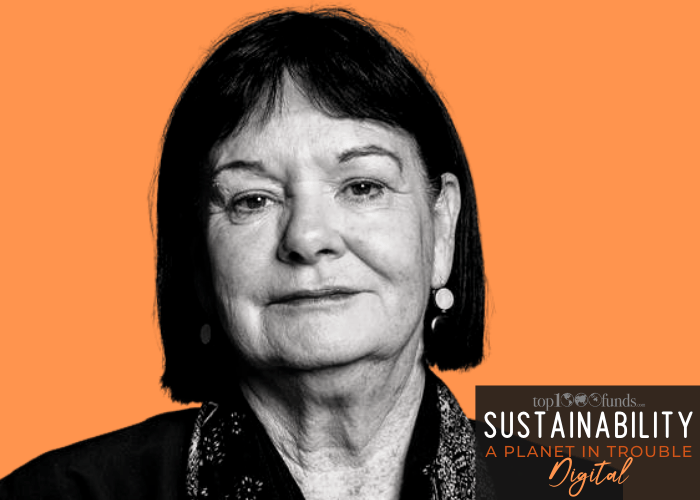

How to fix a broken labour market

Sharan Burrow, general secretary of the International Trade Union Confederation, is calling on investors to do more to fix what she calls a broken labour market.

In an impassioned call to delegates at “Sustainability Digital; A Planet in Trouble,” Sharan Burrow, general secretary of the International Trade Union Confederation which represents 200 million workers in 163 countries called on institutional investors to do more to protect workers rights.

She said investors can choose to have an impact and shouldn’t put “making a profit” before “dehumanizing workers.”

She said investors need to ensure they are supporting democracy and that their capital is going to build strong companies that contribute to jobs and security. Moreover investors have a stake in repairing the broken social contract between workers and business because they invest workers capital.

A labour market that offers no security for workers or adequate retirement provision is good for neither business, investors or sustainability, said Burrow.

In what she called a “moment of truth,” she asked if business leaders and investors are prepared to reform the current model. She warned of conflict, already visible, if this didn’t happen, and noted that investors willingness to make change is often dependent on change not “effecting their environment.”

Sponsored Content

Burrow also highlighted the importance of a Just Transition that creates new jobs for those whose jobs disappear in the new economy. She highlights the auto sector particularly, where the transition to a low carbon economy is already having an impact on jobs and skills.

“Labour’s share of income has slumped and so many workers live day to day,” she said, calling for equality of race and gender to rebuild trust. “All investments must have a rights and sustainability lens; ESG is no longer an option.”

Burrow questioned whether global monopolistic companies were sustainable, suggesting they should be broken up.

She said workers need occupational health and safety, a minimum living way and control over the number of hours they work.

Reflecting how the Biden administration will impact workers rights, she noted the conflict inherent in the US between strong unions on one hand and resistance to human rights and labour laws from business that comes from the top on the other.

However, she said Biden was “a friend” to the union movement and would support freedom of association, but that he also had an eye on the economy and the urgent need to transition.

Burrow said that it is impossible to build a sustainable economy that doesn’t include benefits for labour and people. She also flagged worrying challenges in democracy, concluding that “many young people” no longer believe that democracy is good for them.

Leave a Comment

Climate the No.1 priority for 2021

Climate the No.1 priority for 2021

Climate is by far the number one sustainability priority for investors in 2021 according to a poll of asset owners from more than 32 countries which came together for the Top1000funds.com online Sustainability event in March.

Sort content by

Engaging with Investors on ESG Issues

Bond issuers—including sovereigns, who represent 50 percent of the fixed income asset class—are faced with increasing scrutiny on environmental, social, and governance (ESG) issues from investors. Forums organized by the World Bank Treasury to promote dialogue between institutional investors and sovereign bond issuers have highlighted the challenges sovereign issuers face in engaging with investors on ESG topics and in communicating ESG-related information that investors consider financially material to their portfolios. This document provides examples, best practices, and action plans that can help debt managers enhance their capacity to engage with investors incorporating ESG information in investment decisions.

Portfolio Engineering

For decades, we have engineered scalable portfolios to help institutional investors achieve their goals. In the past, these goals have typically been financial (eg. return and risk targets), but now many investors are also seeking to achieve environmental and social impacts through their portfolios. We believe the best way to achieve both financial investment goals and these impact goals is through portfolio engineering that incorporates these objectives holistically, beginning with crisply defining an investor's goals, systematically looking across a variety of asset classes to find assets that are aligned with these goals, and then combining those assets to create a portfolio that is designed to achieve a high ratio of return to risk.

New Policy Concensus

We are now at a turning point, with Democrats controlling both legislative chambers and the presidency, and an emerging concensus among Democratic policy makers and their advisors that enables fiscal spending that is both significant in size and ambitious in scope. Later this year, we expect to see the first expansionary fiscal package centered around the pursuing long-term social, environmental, and competitiveness policy goals (following the more immediate COVID recovery package). In these Observations, we explore two key shifts in Democrats' thinking underlying these policy proposals, which we expect will be sustained well beyond this fiscal package.

Social Conditions Consideration

The ultimate goal of economic policy is simple and timeless - to ensure prosperity and maximise living standards. Broad macroeconomic measures such as GDP growth, the unemployment rate, and inflation had for decades been a good proxy of rising prosperity, so they have dominated economic policy making and are enshrined in most central bank mandates. But even before the COVID-19 crisis, it had become clear that traditional economic measures have increasingly diverged from social outcomes.

Secular Supply and Demand

Over the past two decades, China's secular rise dominated commodity markets, as its industrialization required a massive amount of raw materials to build up the country. As we consider the future, we see many reasons to be bullish on commodities tactically, but one of the most important secular factors will likely support industrial commodity demand for years to come: the shift in global economies away from fossil fuels and toward greener energy.

Diversity Impact Score

Throughout its history, the U.S. domestic Asset Management Industry, projected by PwC to grow to $71.2 trillion in assets under management by 20251, has exhibited an empirical lack of diversity with respect to gender and ethnicity within its ranks. Numerous studies have shown that Women and People of Color (“POC”) are underrepresented in the Industry, including a 2019 study commissioned by the Knight Foundation finding that Asset Management firms owned substantially or majority-owned by Women or POC managed only 1.3% of the Industry’s total assets under management.

Previous