


The transformational effect of artificial intelligence has already been felt across a number of industries. Its impact is now also being felt in financial markets and particularly in the function of investing within asset management.
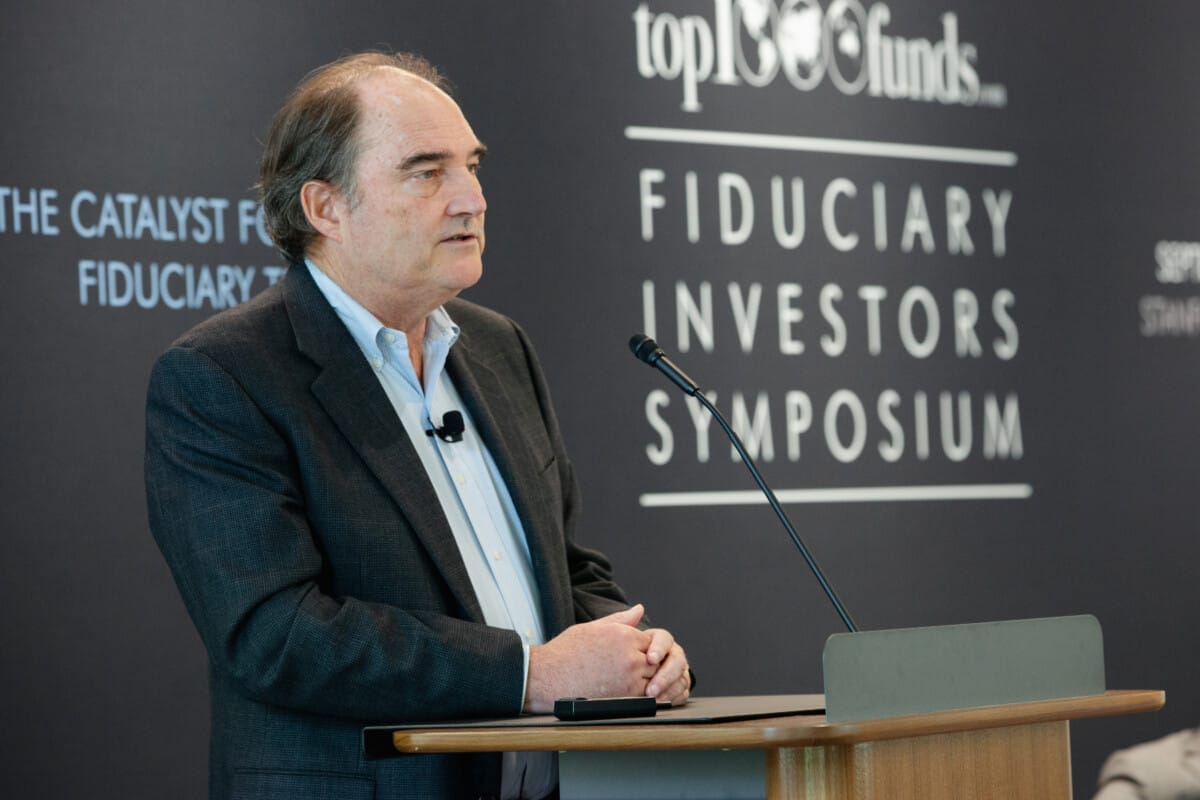
David Wright, co-head of Quest, quantitative business strategy, at the Switzerland-based Pictet Asset Management, told the Fiduciary investors Symposium at Stanford University that current techniques being used included large language models, natural language processing, and machine learning to make predictions.
Wright quoted a recent global survey by Mercer that showed nine out of 10 investment managers were either already using AI or planned to use AI in the future as an indication of the potential uses for both quantitative and fundamental managers.
“On one side, you’ve got tools that can help be more effective, be more efficient, and focus where the investor want to spend their time,” he said.
“At the other end, you’ve got the quant space, where you’re starting to see front-to-back machine learning-based models to forecast returns.
“It comes together a little bit in the middle as well, with kind of quasi-tools. These are often natural language processing, where you want to assess sentiment, or you want to summarise documents.”
He gave the example of a Pictet team developing an in-house, large language model to summarise all the 10-K financial documents – comprehensive financial reports required by the US Securities and Exchange Commission to be filed annually by public companies – that they otherwise would have to go through by hand, bringing it down to a summary that takes only 10 to 15 minutes to read.
Quant Race
Wright says machine learning has been looked at in some capacity for 10 to 15 years on the quantitative side of the industry, with the equivalent of an arms race in the quest for data, technology, and computing speed.
With significant progress being made, there have been a lot of headlines and even academic papers over the past couple of years suggesting stock picking can be done by large language models. Wright says this is not credible yet, but machine learning is starting to really have an impact on stock picking elsewhere in the investment world.
“The reason this is possible is that the opportunity has really accelerated for quantitative investing over the last 10 years,” he said.
“There’s so much more data, there’s much faster computing speed, computer storage is much cheaper. The barriers to doing machine learning today are much lower than they ever were historically.”
Some recent applications of AI lend themselves to the more traditional stock picking fundamental managers as well.
That includes being able to make more accurate return forecasts, particularly over shorter horizons, because it can incorporate a much larger number of features or signals or data sources.
“What machine learning can allow you to do in the quant space is overcome one of the key challenges that we have, and that is the trade-off in modelling between complexity, accuracy and errors,” Wright said.
Fully Transparent
One of the key challenges with machine learning relates to transparency, with asset managers generally wary of not being able to fully understand where the returns are coming from, or where the investment positions come from
Wright says his team used some academic work focused on currency markets undertaken in the US, and wrote a paper that took that work and transported it over to the equity market.
“Where we stand today with our live models is that every single position in our portfolio, we can take it back to which features drove that, what is the interaction effect between those features, and then we can explain to our clients and attribute the performance to the features.” he said.
“It gives them a lot of comfort that we can truly understand what we’re doing. We can move from a black box to a fully transparent crystal box.”
With that growing comfort level, institutions are looking for machine learning models to help them generate pure alpha, stripped of common factor returns. They want active returns that are independent from the market regime, customisable approaches that can be implemented in different types of strategy, and transparency and interpretability.
“The alpha is getting harder and harder to come by in the market,” Wright said.
“Trading off analyst sentiment in the market now is much less effective than it ever was historically. But if you understand how an analyst forecast interacts with how close it is to the company reporting its results, there is alpha to be made from that.”







Leave a Comment
You must be logged in to post a comment.
Login