
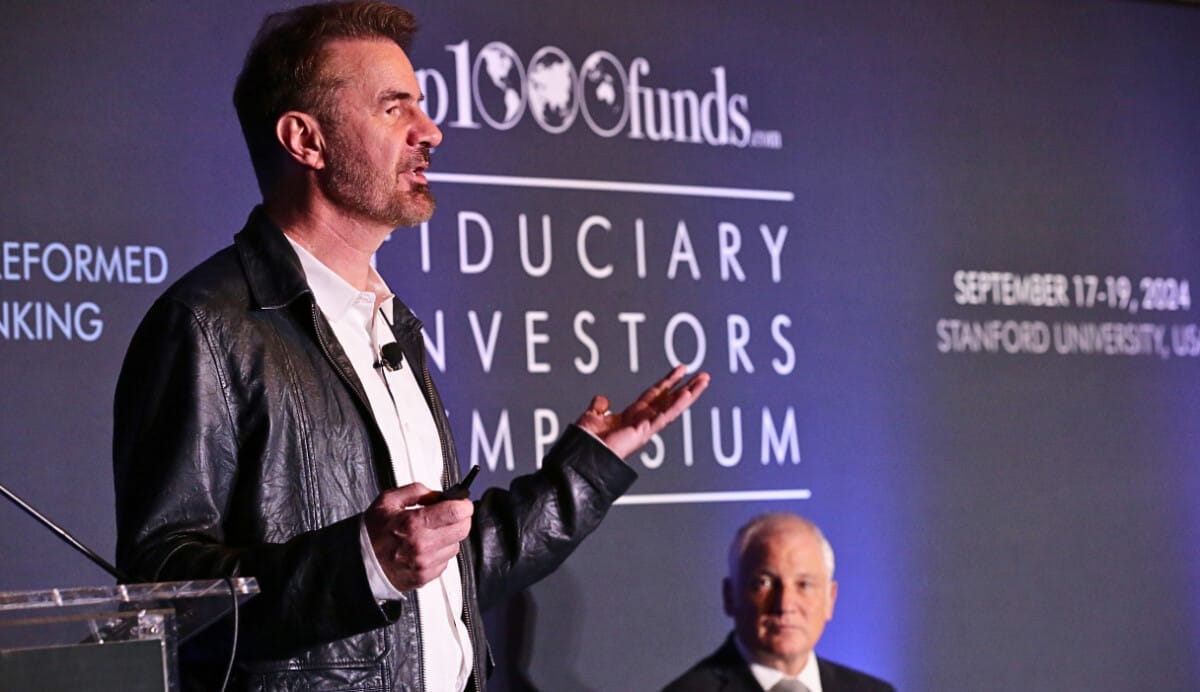

Analyses of the economic impact of artificial intelligence (AI) too often start with a top-down view of economies, industries or businesses, when a more accurate picture of the impact can be gained by examining the individual tasks that are bundled together to form jobs, the Fiduciary Investors Symposium has heard.
The Jerry Yang and Akiko Tamazaki Professor and Senior Fellow at the Stanford Institute for Human-Centred AI, Erik Brynjolfsson, said that “too often [we] think about how AI is affecting the whole economy, or industries or companies or jobs”.
“None of that is the right way to think about it,” Brynjolfsson told the symposium.
“You need to go all the way down to individual tasks. And when you do it at that level, you can get a much better understanding. Every occupation, every job, is a bundle of tasks.”
Brynjolfsson, who is also a director of the Stanford Digital Economy Lab, said that radiologists, for example, “do maybe 27 different tasks”.
“Or you can make it even more fine-grained than that, financial managers, economists, truck drivers, nurses, everybody does a whole bunch of individual tasks,” he said.
“Once you break it down to individual tasks, you can start understanding…the implications of AI for those specific tasks. Some of them it’s going to help with, and others it’s not. Then you can roll them back up, weight them by wages or value added, and you start getting an image, a picture of what’s happening in the company or the whole economy.”
Brynjolfsson said a task-based analysis makes it clearer that there are some tasks that humans can do better and some tasks that machines can do better, but he said his research has not found a single job in the economy where machine learning or AI did every single task better than a human.
“On the other hand, we didn’t find a single job where there was no effect at all of machine learning,” he said.
“So the takeaway is that instead of mass unemployment [or] mass joblessness, from these technologies, [or] complete elimination of occupations, what we’re seeing instead is mass restructuring, mass reorganisation.
“As some of the tasks get done by humans [and] some get done by machines, managers and entrepreneurs have to rethink how they organise the economy. That’s what we’re going through right now – the biggest transformation in the economy that I think we’ve ever seen as more and more opportunities, more and more places for machines to help out and supplement what humans are doing.”
Brynjolfsson said AI is the general-purpose technology (GPT – before ChatGPT appropriated the acronym) of our time, and it follows previous GPTs such as the internal combustion engine, electricity and the steam engine in moving the dial on economic growth and wealth creation.
“Tim Bresnahan and Manuel Trajtenberg, here at Stanford, defined GPTs as having these three characteristics: pervasive, able to be improved over time, and able to spawn complementary innovations,” Brynjolfsson said.
“That last one is probably the most important one: they trigger a whole bunch of complementary innovations.”
Brynjolfsson said there is a threshold that any new technology crosses where it becomes better, faster and cheaper than the process or technology it is designed to replace.
“That threshold is important because, just like when water crosses the boiling point and changes from a liquid to a gas, it’s a threshold,” Brynjolfsson said.
“It is a phase transition that’s happening in the economy. When you have two ways of doing something and one of them becomes significantly better, faster, cheaper than the other way, then managers, entrepreneurs, are going to switch over from one to the other.”
Brynjolfsson said we’re starting to see “this phase transition of machines outperforming humans in a broader and broader array of tasks”.
However, he said, it’s not yet true of all tasks and we’re still some way off developing artificial general intelligence, but “there are a lot of concrete tasks where we now have machines outperforming humans”.
This has profound implications for the occupations and sectors it touches, but not always in obvious or expected ways. Brynjolfsson said one example is medical imaging, where applications built on machine learning outperform humans in identifying pathologies. Around 10 years ago it was firmly believed this would lead to declining demand for radiologists. In fact, the number of radiologists has almost tripled, because while reading medical images is what radiologists do, they do a lot of other things as well.
“You end up having more demand for some of the other tasks, some of the complementary tasks,” Brynjolfsson said.
“And as the price goes down, if you’ve got a downward sloping demand curve, remember, from economics 101, lower price leads to greater quantity. So more medical images are being read than ever before, and they continue to require humans in the loop.”







Leave a Comment
You must be logged in to post a comment.
Login