
Blue bonds: The next wave of sustainable finance?

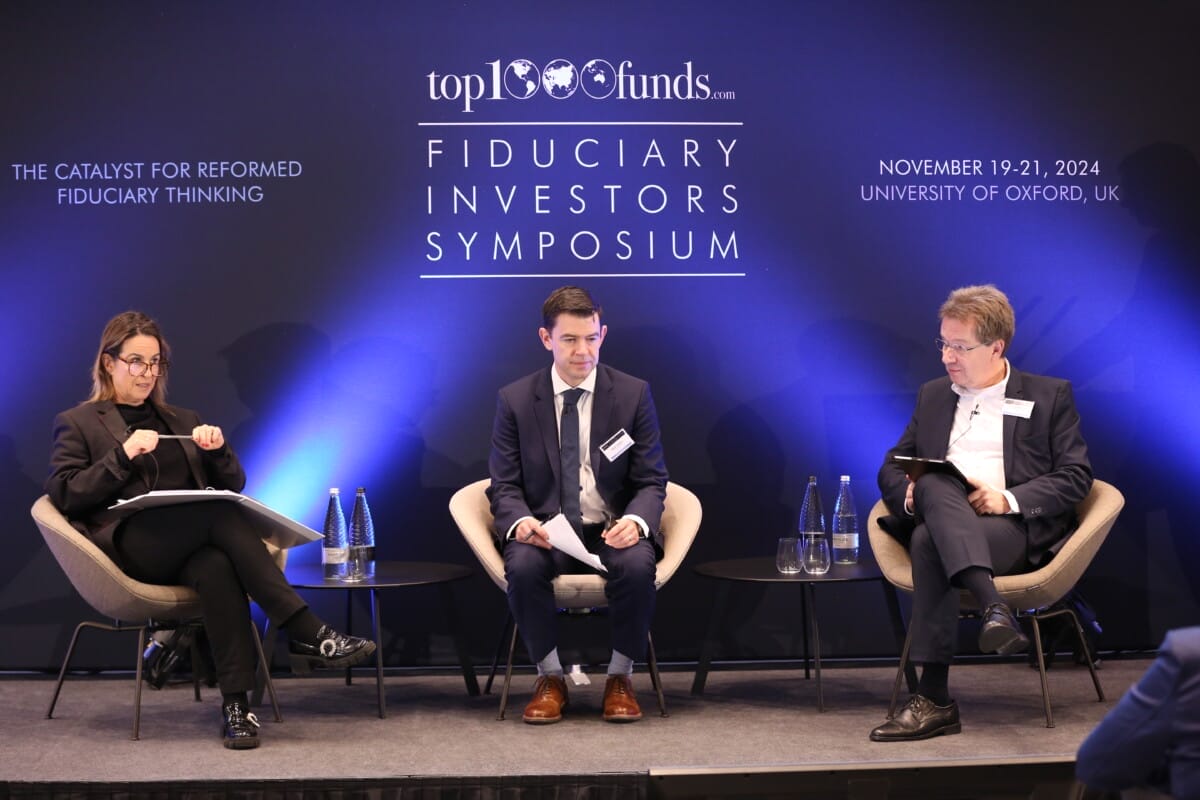
L-R: Amanda White (Conexus Financial), Matt Lawton and Martin Dasek

The blue bond market can provide an innovative means of supporting the critically underfunded ‘blue economy’ and offer a compelling opportunity in fixed income with untapped impact potential.

Speaking at the Fiduciary Investors Symposium at Oxford, Matt Lawton, portfolio manager of fixed income, T. Rowe Price, said he observes a shift in appetite amongst asset owners to integrate ESG via blue bonds. He added that the nascent market offers investors first mover advantage.

Martin Dasek, senior regional climate finance lead and climate advisory expert at IFC Financial Institutions Group, said that blue bond investments are increasingly on investors’ radar. Blue investments are global and touch huge populations working across the marine ecosystem. They don’t just funnel capital into the oceans, but include fresh water and inland water where pollution like sewage and plastics begin their journey to the sea. He noted that blue investments are particularly impactful in Asia given the continent’s proximity to the sea and many sea-dependent economies.

Panellists reflected on the growth of the green bond market to signpost the potential growth in blue bonds. Like blue bonds today, green bonds were not regulated and market awareness was poor in the beginning.

Investors and asset managers like T. Rowe Price at the vanguard of the asset class have a role in providing regulatory support and partnering with key stakeholders. This includes providing guidelines for clients and investors that outline what the underlying asset looks like including metrics and KPIs.

The IFC’s Guidelines for Blue Finance provides a globally accepted template for blue finance, informing the investment industry on what classifies as blue to prevent blue washing. The IFC offers an advisory arm that is able to work with clients ranging from corporates to financial institutions to create sustainable frameworks that kick-start issuance

Sponsored Content

Lawton explained that T. Rowe Price is also seeking to build capacity in the blue bond market. This involves speaking to corporate issuers in emerging markets and encouraging them to originate and bring out new transactions. The asset manager is also working with bankers to try and bring out those transactions.

Risk and returns

Lawton explained that because the focus is on emerging market corporates, issuers typically have a low BBB credit rating. Typically, blue bonds have a 3-4 year duration profile and the investments have an attractive Sharpe ratio.

Another advantage is that in highly volatile markets these bonds outperform and trade more defensively because they are held by long-term investors: investors should think about allocating to blue bonds as a defensive long-term allocation that they hold through bouts of volatility.

Comparisons between a blue bond and a conventional bond issued by the same company show that blue bonds trade with an enhanced yield. They also trade with less liquidity and investors are paid a premium for holding that illiquidity. Panellists said that this illiquidity will likely compress over time as more supply comes into the market.

Investors in blue bonds focus most on the credit risk of the issuer. Returns are not dependent on cash flows coming in from the projects that blue bonds finance, and fundamental underwriting is crucial.

By going out first to emerging market corporates, T. Rowe Price is able to hand-select issuers and projects and find the most compelling impact.

Panellists noted that measuring returns is challenging because of the limited universe of blue bonds. However, this is starting to change. Blue bonds are also appearing in developed markets with issuance visible amongst shipping groups and sovereigns where investors can combine impact and return. Other industries entering the picture include the chemical sector and sustainable tourism, sea transport and port logistics. Investments in these areas will require deep and robust frameworks to ensure impact and development are delivered.

The panel stressed the importance of ensuring alignment between investors and issuers between impact and the financial return. Investors often say they don’t have a “shelf” to place the investment. But investors already have fixed income portfolios that have the same yield and credit rating – and a bit less US exposure.

The blue economy desperately needs funding to support and sustain the existential role it plays in all our lives. But investors are not putting their capital to work in the sector. To date, SDG 6 (clean water and sanitation) and SDG 14 (life below water) have realised just 5 per cent and 1 per cent of total SDG funding, respectively, in an alarming shortfall given water’s uniquely fundamental role.

Meanwhile, oceans produce 50 per cent of the oxygen on earth and absorb emissions.

Leave a Comment

Reckoning on growth: Why tech offers the solution

Reckoning on growth: Why tech offers the solution

Daniel Susskind, author of "Growth: A Reckoning" argues that leaning into new technology will allow global economic growth without gobbling up the earth's finite resources.

Sort content by

‘Opportunity to lose a lot of money’ in net zero investments

Allocating capital to net zero opportunities doesn’t mean investors are prepared to do charity. In a universe of potential transition solutions, Battcock Professor of Environmental Economics Cameron Hepburn at the Smith School of Enterprise and the Environment, University of Oxford said investors should look at them with some filters.

FIS Oxford 2024 Gallery

mrec4inarticleinline Sponsored Content scnative1 scnative2 scnative3

Room for fee innovation as traditional models come under pressure

Asset owners and managers may not always agree on fees, but one thing both parties are thinking a lot more about these days is creating innovative structures which – if done right – could provide rewards for the former and value for the latter.

Drivers of the future: Asia rises but demographics and debt impact the West

Speaking at FIS Oxford Ian Goldin, professor of globalisation and development, senior fellow at the Oxford Martin School, professorial fellow at the Balliol College, University of Oxford sketched an emerging world characterised by a rising Asia and declining west.

Leveraging geographic diversification in a multipolar world 

The past 20 years have seen large pools of capital become larger, more global and diversified across asset classes. The Fiduciary Investors Symposium heard how Bridgewater Associates is allocating capital and resources to meet this shifting paradigm and why investors can’t try to bet on certain geographic regions overperforming.

CFA Institute: Galvanizing the industry for change

In a wide-ranging discussion at the Fiduciary Investors Symposium at Oxford, CFA Institute chief executive Margaret Franklin, and global head of content at WTW Roger Urwin, examined some of the challenges the investment industry faces and the need for evolution.