
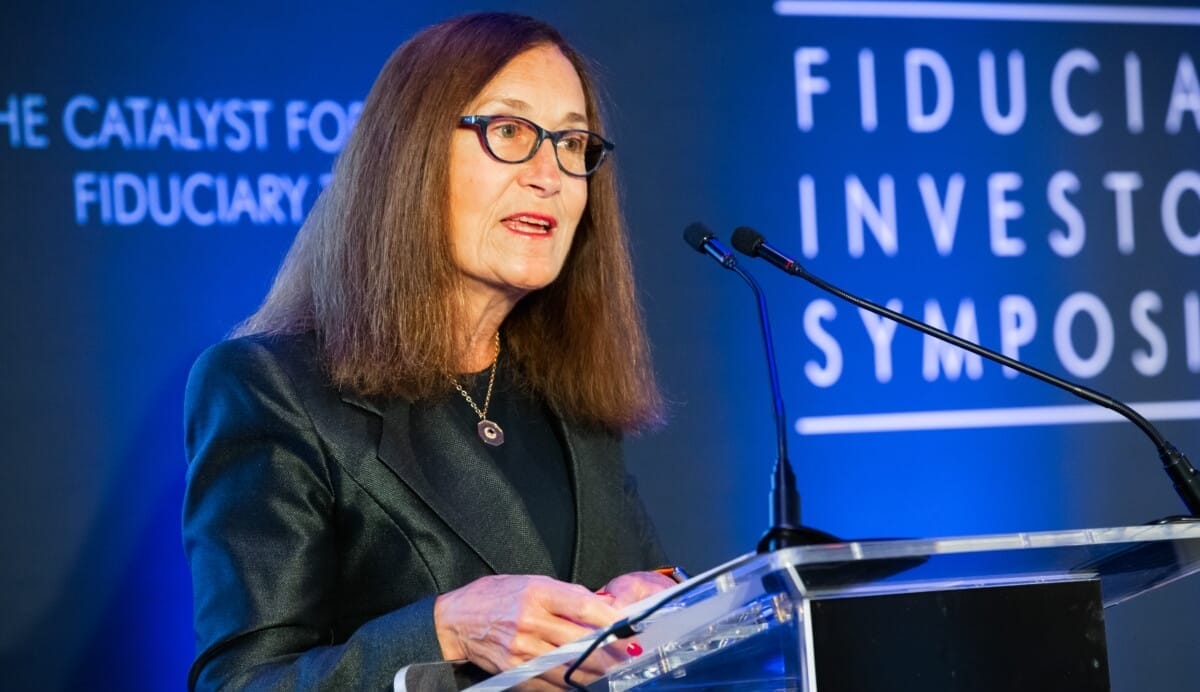

Massachusetts treasurer Deborah Goldberg said the current US political climate is “not business as usual”, adding that the state’s key strengths – including its higher education institutions and progressive social policies – are being targeted by the federal administration.
“All that makes Massachusetts great are direct targets of the federal administration,” Goldberg said during an opening speech at the Top1000funds.com Fiduciary Investors Symposium at Harvard University’s Medical School.
“This is not business as usual, and to be candid, this level of uncertainty and volatility is not good for anyone, both within this country and throughout the world.”
The state was credited as the first the country to have a constitution that abolished slavery, in 1780; and as the first to legalise same-sex marriage, in 2004. Aside from Harvard University, Massachusetts also houses 113 other public and private higher education institutions, including the Massachusetts Institute of Technology (MIT).
Just days after Goldberg’s comments, the Trump administration upped the ante on its war against Harvard, barring the Ivy League school from accepting international students on the grounds that it is permitting antisemitism and “pro-terrorist” behaviours on campus.
Harvard has since secured a court order temporarily blocking the Trump administration’s order, but without a longer standing arrangement, close to 7000 existing international students at the university may face visa cancellation or mandatory transfer to another institution.
Goldberg said Massachusetts’ investment in education is a key to not only maintaining its status as an innovation hub for industries like healthcare and biotechnology, but also as an attractive destination for domestic and international talents.
“Other recent challenges, not surprisingly, are the detention and arrests of visa holders, legal residents and citizens,” Goldberg said.
“These aren’t just assaults on the civil rights of people living here but threaten our workforce capacity. From hospitals, colleges and universities to restaurants and local businesses, our economy depends on the breadth of immigrants who come to work, study and thrive in our state.”
Goldberg is chair of the $110 billion public employees’ pension fund, MassPRIM, and its stewardship and sustainability committee. Despite recent efforts to label sustainable investing “with politically charged buzzwords”, she said MassPRIM’s commitment to stewardship is “simply common-sense investing”.
“[It’s] what every successful, savvy businessperson has always done,” she said.
“We believe in all of the challenges that the committee and our breadth of investments address. We look for well-run companies.
“We know quarter-to-quarter is not what we want to be invested in, and we understand the elements that help a company or our investments grow.”
But as a state treasurer, Goldberg said her primary goal is to maintain Massachusetts’ AA+ credit rating – the same level as the US federal government after its recent downgrading from a triple-A credit score by multiple ratings agencies.
She also signalled that the research innovations and start-ups in the state will need more support from investors as opposed to federal funding, “at least for now”.
“I am actually hopeful that philanthropic dollars will help to support our colleges and universities, which are generators [for the state’s economy],” she said.
“We have a combination of all types of things that are involved in health care delivery and all that are involved in pharma… High tech, bio tech, you name it.
“Invest in it. Invest in it here. It’ll be well-used, and you will be very successful.”







Leave a Comment
You must be logged in to post a comment.
Login