
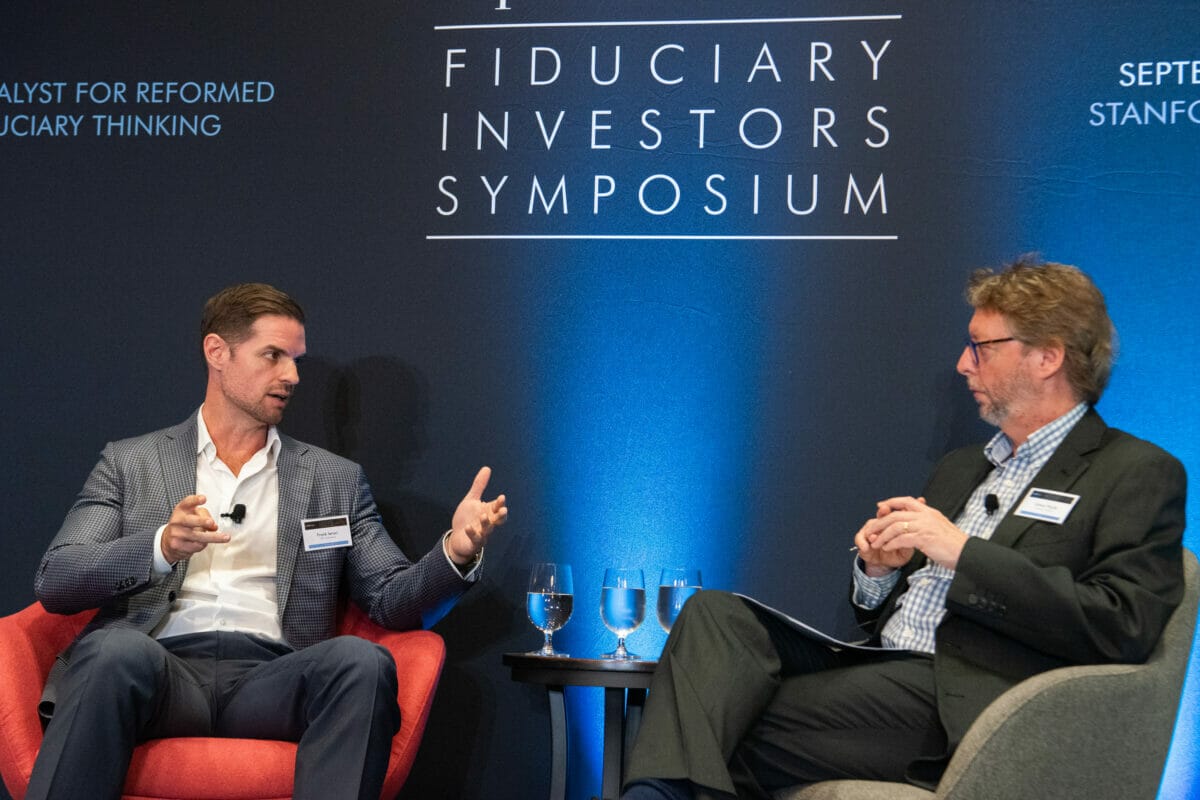

Access and analysis of unique data is key to CPP Investments’ active equities team creating “one of the most sophisticated fundamental shops in the world” head of the team Frank Ieraci told the Fiduciary Investors Symposium at Stanford.
Unique insights and data are the driving force of CPP Investments’ fundamental active equities team as it identifies what will really will drive a company’s stock price.
“The unique insight comes from when you have conducted research and you end up with a conclusion you think is meaningfully different to what you think is priced in,” Frank Ieraci, global head of active equities and investment science at CPP Investments told the Fiduciary Investors Symposium at Stanford last month.
Within the C$75 billion ($54.6 billion) fundamental active equities portfolio, empirical analysis is crucial as CPP continues to push for evidence to back its investment thesis.
“We measure everything we do very explicitly and granularly and frequently and evaluate that over time, and evaluate the original thesis against that,” Ieraci said. “That is increasingly driven by more data and analytical techniques, and that forecast is more real-time and continuous and more probabilistic, and that distribution of outcomes is being compared to what we see in the market and played out in the market to see what is the degree of mispricing.”
Ieraci says the C$575 billion CPP is bringing more data and technology to the process and, like other investors, started to deploy different data, such as credit card data. In addition, it has the advantage of being a large, diversified investor and so can use proprietary data and insights from its private company investments.
“We also take a really focused approach at trying to find data that will answer the specific question we are trying to answer,” he said, pointing to a recent example where the purchase and analysis of some unique data revealed its hypothesis on the company was wrong, and it didn’t invest.
Ieraci said another unique element of the fundamental approach is the team’s willingness to experiment.
“We have an ambition to be the world’s top performing institutional investor, and that means we have to push ourselves. And that means we experiment with novel forms of data or technology as it relates to decision making, and that is a key part of the journey we are on with active equities,” he said.
Technology is essential to the fundamental analysis, with technologies inhouse spanning machine learning, large language models, newer forms of AI, deep learning and transfer learning.
“The technologies might not be unique but how we are trying to apply them tends to be unique,” Ieraci said. “Many investors are using the same technologies we are, the difference is do they do it to the same extent, how committed are they to it, and do they have a platform that allows them to think and act like a long-term investor?”
Back in 2018 Ieraci predicted that fundamental analysts would not use Excel but would need to code and use Python. In line with that prediction, he said the skills needed today are very different to the past.
“The talent we need today is changing,” he said. “Fundamental analysists were always data scientists, like an investigative journalist trying to understand what mattered and then hunting for the information to validate it. We were always looking for data to help us and today the amount of data we have and the ability to analyse it with sophisticated tools has changed, which has changed the skills we need in our folks. Increasingly today I want people who are programming and managing large sets of data.”
Ieraci said the fundamental active equities long-short portfolio has delivered about 150bps at around 4.5 per cent risk on average over the past five years.
“We are on a journey. We are looking to create one of the most sophisticated fundamental shops in the world. What we are doing at CPP is very different from how fundamental investing was done over the last 50 years.”








Leave a Comment
You must be logged in to post a comment.
Login