
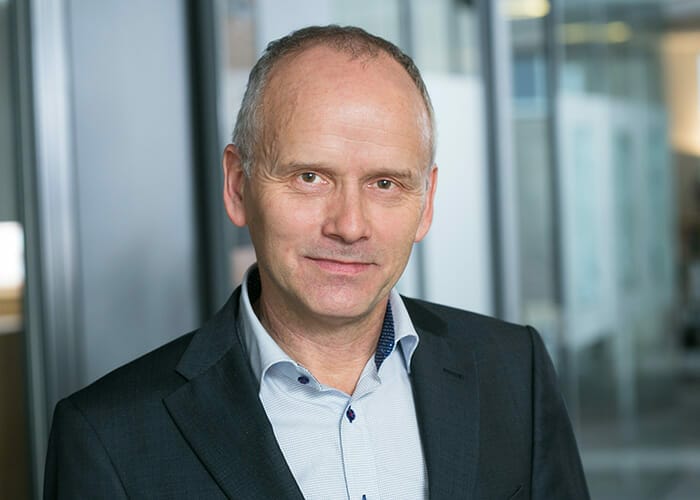

Through the course of this year, Denmark’s Lønmodtagernes Dyrtidsfond (LD) will make new alternative investments to suit its maturing profile. In an interview from the fund’s headquarters in smart Copenhagen suburb Frederiksberg, chief financial officer Lars Wallberg explains that alternative credit is an area where he’s focused.
“We will be looking at different types of direct lending and trade finance in the illiquid, unlisted credit space,” Wallberg says. “Because it has to be an illiquidity that we can live with … we will be looking at five-year maturities.”
LD is a non-contributory pension scheme for Danish people that is based on cost-of-living allowances for workers, granted in 1980. Assets are now about €5.5 billion ($5.8 billion), but will decline by about 25 per cent over the next five years and 50 per cent over the coming 10. The fund is organised like a mutual fund, with one large, balanced unit-link investment option, LD Vælger (LD Discretionary Investments) that accounts for about 90 per cent of assets, along with a number of small, separate funds that members can choose as an alternative to the balanced fund.
LD favours a mix of passive and index investment to keep costs down, but the increased allocation to credit will be active.
“Passive doesn’t work because avoiding defaults in a downturn is key to successful investing in the credit space,” Wallberg says. “Passive investment here is simply too low a standard of risk management.”
Despite the fund’s maturity, it will still allocate 25 per cent to 30 per cent of its assets to equity. However, strategy throughout 2017 will also include continuing to scale down the legacy private-equity allocation.
“We are at the latter stages of our investment cycle and within the next five years the allocation to private equity will be close to zero,” Wallberg says.
Assets break into three groups
Investment falls into three large asset buckets. High-grade bonds, primarily comprising Danish government and mortgage-backed bonds and global inflation-linked bonds, account for about a third of the portfolio, in an allocation that returned 4 per cent in 2016.
“This was quite a good return for a secure investment class and given the low interest rates,” Wallberg says.
Another third of the fund is invested in credit, comprising assets such as senior loans, and high-yield and emerging market credit; this portion returned about 9 per cent last year. Finally, a little less than a third is invested in equity, with the small remainder in alternatives, including a mature private-equity allocation.
Although global equities did well through 2016, Danish shares, which account for a quarter of the public equity allocation, didn’t keep up. The allocation lost 2.8 per cent over the year, a turnaround from stunning gains of 37.5 per cent in 2015.
“The Danish equity market is characterised by around 20 large caps and some of these companies did badly,” Wallberg explains.
One of the worst offenders was the world’s largest insulin producer, Novo Nordisk. Last year, the pharmaceutical giant came under pressure to lower prices in its key US market, and faced greater competition from rivals.
LD outsources all of its asset management to third-party providers and keeps fees low by cultivating deliberate competition among managers.
“Keeping fees down is achieved by conducting public tenders where we ensure a lot of interest,” Wallberg says. “We don’t negotiate directly on fees with managers.”
Exposure to climate opportunities
One of LD’s best performers has been a climate and investment fund that sits in the main balanced fund. The allocation began in 2011, with an initial €100 million investment. It is the fund’s strategy for gaining exposure to climate opportunities that it has struggled to access because of its short-term horizon.
“We can’t invest in long-term climate infrastructure like wind or solar energy because these investments may have a 20- to 30-year horizon,” Wallberg says.
Instead, the fund has built an exposure to quoted companies that are developing climate change products and services.
LD’s equity and property investments have gradually reduced by about €3 billion ($2.3 billion) since 2004, due to the fund’s need for liquidity. Yet Wallberg still endeavours to maintain a long-term view in the portfolio, something particularly important to mute today’s noisy politics.
“I try not to be distracted by short-term events,” he says. “You can’t ignore what is out there, but you can’t be too focused on it either. Otherwise, you’d spend all your time discussing politics, rather than investing.”







Leave a Comment
You must be logged in to post a comment.
Login