
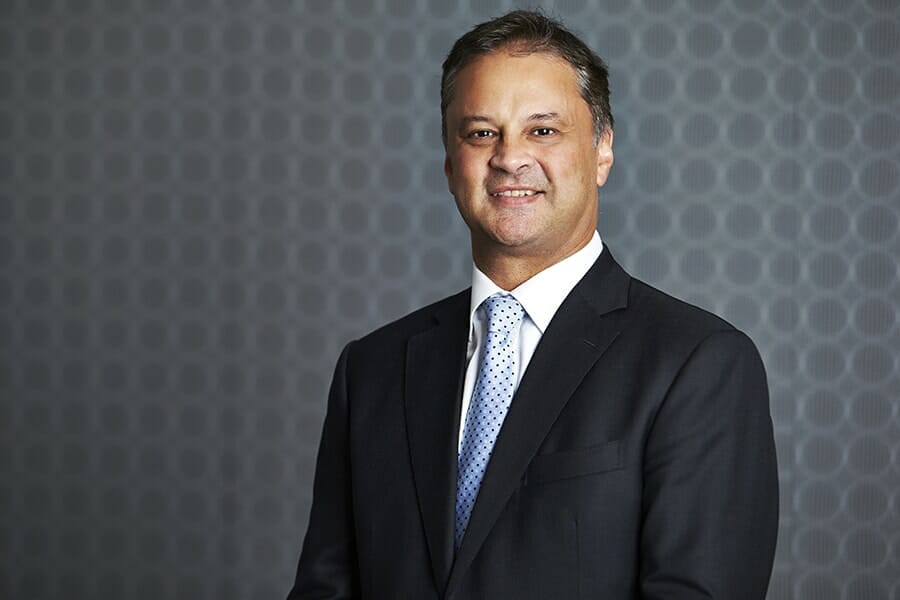

China and the US engaging in a prolonged economic and political cold war is a much larger risk than a trade war between the two countries, says UniSuper’s John Pearce.
“The ramifications for the Australian economy could be potentially disastrous if we are forced to pick a side, as we would inevitably have to side with our political ally,” he warned.
“Canberra must beware of the implications on business of automatically siding with Americans with regard to commercial decisions on those occasions when it’s clear that the Americans are acting in their own self interests.
The investment chief of the A$70 billion Australian superannuation fund for higher education and research workers also cautioned against lecturing the Chinese on how they need to evolve into a liberal democracy.
“It’s not going to happen. Period.”
Pearce, who was head of global asset management for Chinese insurer Ping Ang from 2007 to 2009, is aware of the investor unease over emerging markets and China in particular.
Stock prices have tumbled nearly 10 per cent since the sudden collapse of US/China trade talks late last month. But to Pearce, these fears provide one more good reason for UniSuper to look for opportunities in China.
“If you look at the valuations, once again on any sort of relative value analysis, China and Asia look cheaper than the US. They probably don’t look cheaper than Europe but that’s fine,” he argued.
“We think Europe is cheap because it deserves to be cheap. Europe is Japan redux. The question is whether that’s where the rest of the world will ultimately head.”
The fund’s exposure to China is “hundreds of millions” invested indirectly through external managers as well as $200 million through A shares.
While prolonged trade negotiations are spooking investors – most would generally add corporate debt and insolvency to their list of what’s wrong with the country.
“Investors analyse the wrong number when they look at China’s debt. They look at gross debt rather than net debt.
“It’s crazy. People look at gross numbers when they should be subtracting China’s foreign reserves from that figure. The Chinese government is a net creditor, not a net debtor.”
More importantly, he said, China has very little external debt.
Neither is the CIO worried about the growing unease that China is showing signs similar to those seen during Japan’s bubble period of the 1980.
“The biggest fear everyone has got is Japan. Is this really a precursor to what’s going to happen to the rest of the world?
As he sees it, Japan has been battling deflation for two decades.
“How many decades now has everyone been worried about Japanese debt? But Japan hasn’t had a debt crisis because it is all internally funded.
“China is not going to have a Minsky moment because the debt is all internal”
Pearce concedes that reform is slower than he’d like but says he is reassured by Beijing’s progress thus far.
“If you look at the last 20 years and rate the economic performance of governments around the world, the Chinese government would be right at the top and developed markets would be right down the bottom.”
Listed infrastructure
Aside from investing in China, Pearce is buying listed infrastructure companies outside Australia and is in the process of building a couple of positions of around $500 million each.
While institutional investors are very heavily invested in unlisted markets, Pearce sees more opportunity in the listed space.
“All the dry powder is going at the moment into unlisted infrastructure assets which is why we haven’t played in that game.
“It’s just too competitive. It becomes a real capital shoot out. That, we don’t want to do.”
In his view, the relative pricing is far more favourable in the listed space.
UniSuper, which has more than $70 billion in assets under management, has an infrastructure portfolio that includes stakes in Sydney Airport and toll-roads operator Transurban Group.
The superannuation fund is currently bidding for Macquarie Group’s 51 per cent stake in Hobart International Airport that is now up-for-grabs. In addition, it is looking at Canadian pipelines and Spanish airports.
The super fund has 7 per cent of assets allocated to unlisted assets. This is in stark contrast to other industry funds which have somewhere between 25-30 per cent.
With the benefit of hindsight, should Pearce have bought more unlisted assets?
“Maybe,” he said. “But we bought huge stakes in Transurban and Sydney Airport which are the three best infrastructure companies in the country.”
Transurban and Sydney Airport are the fund’s largest Australian equities holdings, followed by the ASX, APA Group and Woolworths.
The top five international equities positions are Aena SME SA, Enbridge Inc, JP Morgan Chase, Microsoft and Alphabet.
Outside of China and listed infrastructure deals, Pearce doesn’t see many opportunities and is not shifting his portfolio.
“Right now, there are not a lot of inefficiencies to exploit. Things are looking a bit on the rich side.”
UK Opportunities
However, there are particular opportunities in the UK which are potentially interesting to the CIO.
“In terms of developed market utilities, the UK is the only place you can buy assets at a decent price and that’s because everyone is worried about Brexit.
“The question is are we going to have a bad Brexit. If it is a bad Brexit, you will find these prices will drop further.
Pearce has recently built up small stakes in RBS and Lloyds, both of which have strong domestic franchises. As he sees it, the banks’ share prices will be impacted but he is convinced their underlying businesses should be able to survive and turmoil.
Like everyone else, Pearce is keeping a watchful eye on the US Federal Reserve which has more than hinted that it will cut rates, possibly as soon as June 19.
With lower rates for longer, Pearce argued, what people think of as “historical normality” will not occur for at least the next 10 years. If you look at the forward yield curve, he added, what the market is telling us that in five years bond yields will be below 3 per cent.
“If the market is right, then equities are not expensive. Higher price-earnings multiples won’t look too bad if indeed we get to a zero-inflation environment.
The investment specialist expects a ‘sugar shock’ as the market reprices. “So, while assets will be revalued, the problem then becomes that future expectations of returns are then going to have to change.”








Leave a Comment
You must be logged in to post a comment.
Login