

Making sense of an increasingly complex and chaotic world is testing the capabilities of even the most seasoned investors as they try to determine whether the established orthodoxy of causality in markets and economies still holds true.
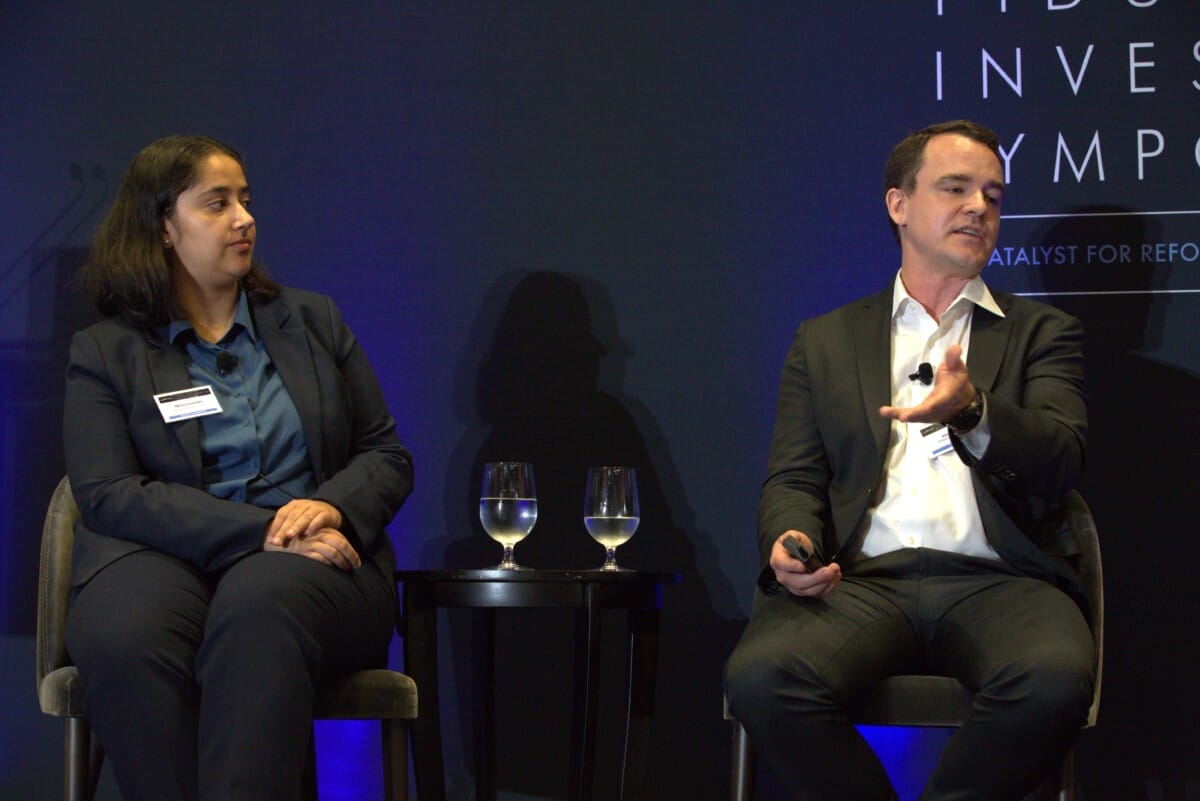
Bridgewater Associates has found success employing a proprietary AI, which it calls AIA (short for Artificial Investment Associate, and pronounced “eye-a”) to help it make sense of this shifting landscape and to manage portfolios. The Fiduciary Investors Symposium at Stanford University heard that while there are strong use cases for AI, it also has limitations.
Alex Smith, partner and senior portfolio strategist at Bridgewater, said the firm’s ambition is to use AI to help it “understand the world, and importantly not in a black box way, [but] in a causal way, a fundamental way”.
“When we think about how to understand the world… predicting the future is really hard, and so our approach has always been to take fundamental understanding, and by that, I just mean we’re obsessed with causality,” he said.
“We want to know why something works. If we’re going to put capital behind it, we think the world works like a machine. If you understand that machine, measure conditions, you can better anticipate outcomes.”
Smith said that once the fundamentals of something are understood, they can be systemised. And that system can be tested “across every historical case you can find, across every country you trade, to test its reliability”.
If it proves to be reliable, it’s turned into an algorithm, which can be applied at scale.
Recent events – geopolitical, macro-economic and market-related – might appear chaotic or random, and have certainly tested investors’ mettle, but Smith says that “all the causal linkages that have always mattered”, including growth, inflation, monetary policy, commodity prices, portfolio allocation, still matter.
But two unique challenges stand out today. One is that understanding causality relies on being able to manage unstructured data “that doesn’t fit neatly into a numerical time series”.
“It’s always important, but it’s really important today, because in this mercantilist world, so much policy is government-driven,” he said.
“And related to that, many of these events [have] very few historical precedents. The challenge is that with unstructured data that’s hard to measure and systemise. You can do it, but it’s hard, and because there’s few historical precedents, there aren’t that many analogues that you can stress-test against, which underscores the need to be causal, the need to be fundamental.
“And up until recently, that had been a unique ability that we humans have.”
Generational technological progress
Nina Lozinski, co-head of artificial intelligence and machine learning investment strategy at Bridgewater, said these unprecedented geopolitical and economic events are “happening against the backdrop of generational technological progress”.
Lozinski said the pace of progress is accelerating: it took 15 to 20 years for technology to progress to the point of being able to understand handwriting – and even then the only organisation really excited about that development was the Post Office – but the advent of speech recognition, then visual reasoning and image recognition, happened much more quickly. Then, “all of a sudden, now we have another kind of intelligence that’s able to process language”, and that opens up vast new possibilities.
“The goal in creating AIA for us was to create something that would be good, that we could have confidence in, that still understood causal linkages, that was stress-tested, that was diversified, but that also would be different, that would lean into the kinds of things that machines are really good at, that humans may not be as good at,” Lozinski said.
“Things like, how do you think in many different dimensions at once? For us, we’ve got two dimensions, we’re pretty good at three dimensions, but past that is more difficult to achieve.”
Using AIA to make decisions on how to invest has resulted in portfolios that look different from portfolios constructed by human investors.
“It’s been good, performance has been solid; but it’s also been different. We’ve had different positions, we’ve had different periods of being up and down, and that’s been the experience so far,” she said.
Something that looks like reasoning
Lozinski said that it appears AI is capable of doing something that looks like reasoning, which leads to questions such as how to use that reasoning ability to help build portfolios.
“Of course, there’s very real weaknesses, and so you may have experienced some of these if you’ve tried to experiment with AI,” she said.
“Some of the ones I’d highlight are AI systems today are not yet very good at complex analytical tasks – they lack number sense. You shouldn’t use them to be a calculator. They can hallucinate. They can make up facts that aren’t in the source materials.”
AI systems also have embedded knowledge, Lozinski said, which raises the issue of working out if a system is genuinely reasoning or just relying on what it has, in essence, remembered.
“In many ways, these are just different ways of saying there’s really two problems. The first is that predicting market returns directly is still too hard, and that’s a very hard problem, and an AI is not ready to do that just as a magic off-the-shelf tool yet,” she said.
“And the second thing is that AI will answer any question you give it, but most of those answers are going to be bad. So how do you know if what you’re going to get back from AI is any good? And those are some of the things I think about a lot.”
Smith and Lozinski said that despite current limitations, there are real opportunities to use AI to address the increasingly complex issues facing investors.
A live, on-stage demonstration of how Bridgewater deploys AIA to process unstructured data and form views about how the world is likely to play out revealed the complexity of the processes it goes through in response to an inquiry.
“It went through a process just now of searching what’s going on in the internet, thinking about what it found, searching again if it needs new information, and coming up with its own independent forecast,” Lozinski said. “We’ll actually have a panel of 10 forecasts here.
“The step that it’s doing now, which is the second phase of this process, is reconciling them. So now, we have another agent that is currently going through each of those 10 trying to understand, well, if they agreed, why did they agree; and if they disagreed, why did they disagree? And what can we do to suss out those questions and try and do a second step which is, on the areas of disagreement, should I be looking up anything? Should I be thinking?”







Leave a Comment
You must be logged in to post a comment.
Login