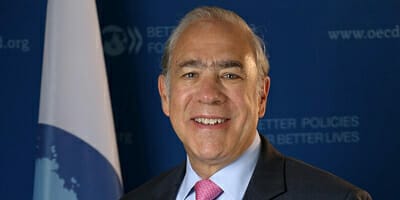

OECD calls for policy solution to long term investing barriers

Governance of institutional investors and the lengthening investment chain causing  bigger distances between assets’ beneficial owners and those involved in executing investment strategies was one of three practical issues raised by the OECD general secretary as a barrier to more investment in long-term investing financing.

Speaking at the OECD Project on Institutional Investors and Long-term Investment roundtable, Gurria gave an update from the recent Brisbane G20 Leaders Summit as well as the future agenda for institutional investors and long-term investment in view of the future Turkish presidency of the G20.

In his speech, he said the G20/OECD High-Level Policy Principles on Long-Term Investment Financing by Institutional Investors provided a solid starting point for tackling the issues but there needed to be policy solutions to remove the obstacles to long term investing.

An extract of his speech is below:

“Following the guidance of G20 Leaders in Brisbane, we now need “to walk the extra-mile” and move “from solutions to actions”.

To this end, let me briefly address a few practical issues:
First, we need to address the issue of the governance of institutional investors. The lengthening ‘investment chain’, with bigger distances between assets’ beneficial owners and those involved in executing investment strategies, necessitates well-aligned incentives for every link in the chain.

Sponsored Content

We must remember that most of the money that circulates in this investment chain ultimately belongs to ordinary working people. Money they save for retirement or perhaps their children’s education. Similarly, those executing the investments also need to have the right skills and expertise to be able to expand their investment universe to alternative asset classes, in particular those that can support infrastructure investment and green projects.

Second, we need to address the question of financial regulation and its impact on the ability of institutional investors to provide financing for growth.

There is a need to balance stability and transparency against the need to ensure that institutional investors can act as proper financing channels for investment. For example, strict solvency rules, and related ‘mark to market’ accounting, may inadvertently put a brake on productive investment. More generally, governments need to ensure that the “conditions for investment” reduce legal and regulatory uncertainty.

Third, there is a clear need for more in-depth discussion on what are the most relevant and efficient financial instruments for long-term investment. We need to look at project financing needs across the entire life-cycle of investments to identify the optimal “division of labour” between different providers of finance.

“Pooling” mechanisms to get large and small institutions to participate in debt and equity financing can also play an important role. To facilitate these discussions, the OECD is developing a taxonomy of techniques, instruments and vehicles that policymakers can use to leverage private sector financing in infrastructure.

Ultimately, these three issues are just a sub-set of the much broader question as to what type of financial system we wish to construct. In advanced, emerging and developing economies alike, there is a need to enhance the role of fair and transparent capital markets. We need to consider concrete steps like the development of local currency bond markets; the issuance of project bonds; and the development of appropriate hedging instruments.

On these and many other issues, we are working together with the incoming Turkish presidency of the G20 on how best to advance the LTI agenda to promote stronger, fairer, greener growth.”


For the full speech click here

Leave a Comment

Sort content by

Governance, Gonski style

Since becoming chair of the $80-billion Future Fund in March, David Gonski has set an agenda to act like a public company chair. An element of that vision is to very clearly delegate to management. “The general manager has been elevated to a managing director and the six-monthly announcements will be his,” he says. Another

Risk parity manages risk regret

The risk parity approach to portfolio construction might not deliver results in a “bull stockmarket,” but remained a “robust and rigorous” methodology which also “managed risk regret over time.” These are the views of Wai Lee, chief investment officer of quantitive investment at New York-based fund manager Neuberger Berman, who was recently named winner of

African countries come to the sovereign wealth fund party

Many of the countries with the largest oil reserves also boast the largest sovereign wealth funds (SWFs). And yet African producers, like newcomer Ghana, Angola, and Nigeria which has been pumping oil since the 1950s, haven’t saved much of their oil revenue. Now, in an effort to replicate the long-term growth of funds like Norway’s

Regulatory risk in Europe a factor for infrastructure investment

The head of infrastructure at Australia’s $80 billion Future Fund has cited regulatory risk in Europe and the United Kingdom as reasons to be wary about infrastructure investment in the region. Raphael Arndt, the Future Fund’s head of infrastructure and timberlands, told a Sydney conference this week that he was particularly concerned with the situation

Europe’s credit rating crunch

It has been a bad month for credit-rating agency executives who thought they were winning the legal and regulatory arguments about how they conduct their business. In Australia, the Federal Court ruled on November 5 in favour of 12 local councils in New South Wales which claimed that Standard and Poor’s had misled them into

Dutch reform to tread lightly on investment mix

When the Netherlands pension reforms were announced in 2011, many experts argued they were likely to substantially increase the risk appetites at the funds guarding the country’s $1-trillion pension assets. Recent developments to the reform proposals make the overall impact far from clear, however, suggesting there will be no bonanza for Dutch investment managers. The

Previous




