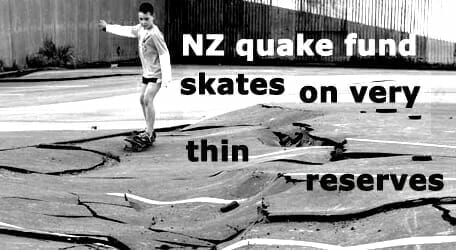

NZ quake fund skates on very thin reserves

New Zealand’s earthquake disaster relief fund could be completely drained following the fatal 6.3 quake that flattened large swathes of central Christchurch on February 22.

The Earthquake Commission (EQC) was already releasing about NZ$1.5 billion ($1.1 billion) of the $4.4 billion disaster fund to pay for claims generated by the 7.1 quake that caused widespread destruction in Christchurch last September.

The latest New Zealand government accounts to the end of January this year show the EQC had budgeted for insurance claims amounting to just over $1.78 billion from the September event.

While the fund itself must meet the first $1.1 billion in claims it had reinsurance in place up to a further $1.85 billion.

The EQC covers residential homeowners up to a value of $74,000 per claim. Owners who had been paid out after the September quake would be able to claim again if their homes sustained fresh damage following the latest catastrophe.

According to latest government estimates, about 10,000 Christchurch homes would have to be demolished while a further 100,000 required some level of repair as a result of the February earthquake.

Sponsored Content

If the latest round of claims exceeded $2.95 billion ($1.1 billion from the fund plus $1.85 billion from reinsurers), the EQC would have to dip into its remaining capital, which would amount to about $2.22 billion of New Zealand fixed-interest investments.

Last year Phil Jacques, EQC chief financial officer, told Top1000Funds’ sister publication, I&T News, the fund would first sell-down its $1.26 billion global equities portfolio to meet claims.

While EQC would not comment, it is understood the global equities sell-down had almost been completed. AXA’s annual accounts to the end of December last year, for example, reveal the EQC redeemed its $237.3 million global equities mandate with AllianceBernstein to cover costs incurred by the September earthquake.

The EQC also had global equity mandates with State Street Global Advisors, Tweedy Browne, T. Rowe Price and Capital International.

The remaining 70 per cent of the EQC portfolio was chiefly invested in a range of New Zealand government securities, including about 20 per cent in inflation-linked bonds.

Russell acts as investment adviser to the EQC fund.

EQC collects about $66.6 million in levies each year but New Zealand Prime Minister, John Key, said that figure could triple next year to replenish the disaster fund.

One response to “NZ quake fund skates on very thin reserves”

  1. Investor need to understand the risk of investing in infrastructure fund.

Leave a Comment

Sort content by

Quality factor explained by profitability: Robert Novy-Marx

Among academic classifications, and the subsequent implementation of factor investing, “quality” is one of the newer areas of investigation. Robert Novy-Marx, the Lori and Alan S. Zekelman Professor of Finance at the University of Rochester, is leading the charge on the academic justification of quality as a factor, although he has a “jaded scepticism” about

How to allocate assets to combat climate risk

  Mercer’s extensive climate change report, launched today, gives investors a practical framework for monitoring and managing climate risk, shifting the discussion from philosophical agreement to practical investment implementation.   In Investing in a time of climate change Mercer outlines extensive dynamic investment modelling that analyses changes in the return expectations of assets between 2015

Behind Norway’s coal divestment

The Norwegian Parliament’s finance committee recommendations to direct the Government Pension Fund Global to divest from companies that generate more than 30 per cent of their output or revenue from coal-related activities, is the evolution of a climate-related investment strategy that dates back to 2010. Amanda White explores the raft of tools the fund uses

CalPERS gives its managers ESG ultimatum

In what promises to be a transformational moment for ESG integration and investment manager accountability, CalPERS will require all of its managers to identify and articulate ESG in their investment processes. CalPERS staff led by Anne Simpson, senior portfolio manager and director of global governance, presented the ESG manager expectations, and draft sustainable investment guidelines,

Sourcing liquidity in fragmented markets

As equity trading becomes more fragmented, and more trading is done outside exchanges, it is prudent to assess whether alternative liquidity pools contribute to well-functioning markets. Norges Bank Investment Management has done the work for you, analysing the contributions, structures and functions of trading venues with limited pre-trade transparency. One of the benefits of liquidity

Factors the same in credit and equities

Robeco will launch the world’s first multi-factor credit fund, after academic research by its quantitative research team reveals that size, low-risk, value and momentum factors have economically meaningful and statistically significant risk-adjusted returns in the corporate bond market. David Blitz, co-head of quantitative strategies at Robeco in Rotterdam, tells Amanda White why an active approach makes

Previous




