
How the Future Fund found agility

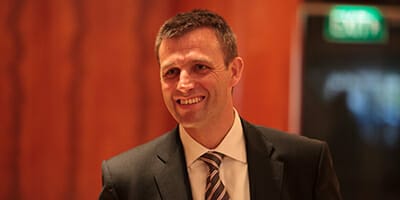
Using a fund of funds enabled the Future Fund to build a large exposure to hedge funds quickly during the global financial crisis, chief investment officer of the Future Fund, David Neal says.

The Future Fund, which uses a combination of fund of funds and direct hedge fund investments, decided it did not have the breadth of skill and research to entirely invest directly.

“Could we realistically, or want to, try to build a team with enough talent and size to cover the industry? It’s not consistent with our notion to keep the investment team small enough to sit around a table and talk about all of the opportunities and strategies to build our portfolio,” Neal says.

“We thought with fund of funds, and the extra edge of someone who’s actually doing it, was worth exploring. As we started, we found other benefits of fund of funds, for example, in the crisis we were able to move quickly. We had one investment-management agreement with one organisation, which has relationships, and we can throw money at them quickly and could build a large exposure quickly. There was an execution service that came from it that would have taken a long time.”

Environment-specific risk

Neal says the Future Fund, which has almost 20 per cent exposure to hedge funds, is looking to expand its exposure and invest in commodities, catastrophe bonds and macro managers.

Sponsored Content

The fund has generated 4.9 per cent since inception, well below its mandate of consumer-price index plus 4.5 to 5.5 per cent

“We are clearly behind, but we don’t think there is much more we could have done. It is very dangerous to play catch-up. If you load up more risk, you’ll blow it,” Neal says. “You have to take the right amount of risk given the environment.”

Investors must manage the risk profile to the prevailing landscape, Neal says, but he believes there will be opportunity to take more risk in the next decade.

Meritocracy for assets

The Future Fund has a “dynamic” allocation process, but it is not relative to a benchmark. Rather, all investment opportunities are assessed on their merit.

“Long-term characteristics can change quickly, the GFC showed that,” he says. “It is not about active tilting but managing risk/return and adjusting accordingly.”

Because of this dynamic nature, the funds are shifted from one opportunity to another.

“There are managers we are happy with who we take money from because the opportunity changes,” Neal says.

The Future Fund considers every investment opportunity on a hedged basis, so each investment can be compared on a like-for-like basis. The fund then decides how much currency to hold.

At the moment it has 12.5 per cent in emerging-market currencies and 18 per cent in developed-market currencies

“Currency is the risk I worry about the most – or it is the cause and solution of the risk I worry about the most – liquidity.”

Neal sits on the Hedge Fund Standards Board and encourages investors to sign the standards’ investor chapter.

“The more investors that sign, the more that managers are interested.”

Asset Owner:Future Fund

Leave a Comment

Sort content by

World Economic forum identifies global risks

The World Economic Forum’s 2014 Global Risk report, has implications for investors.   The report, released ahead of next week’s meeting in Davos, highlights how global risks are not only interconnected by also have systemic impacts. The risks were broken down into economic, environmental, geo-political and social. The seven economic risks were: fiscal crises in

Focusing on the long term: asset owners need to step up

Asset owners must step up and “join the fight” to end the focus on short-term results by companies and investment firms. Four practical steps to make this happen are outlined by president and chief executive of the Canada Pension Plan Investment Board, Mark Wiseman, and global managing director of McKinsey, Dominic Barton, in the most recent

Free advice: Mercer’s 10 tips for DC plans in 2014

As the growth of defined contribution plans continues to outpace the defined benefit sector, the focus for those running defined contribution plan sponsors should be on meeting objectives, good governance and investment risk management. Consulting firm, Mercer, has some advice for the DC sector. According to Mercer establishing best practices across all areas of defined

Cardano and Monty Python collaborate on the crisis

Chief executive of Cardano UK, Kerrin Rosenberg, is a Monty Python fan. In the same eccentric vein as the famous satirists he has a healthy disrespect for the status quo and a quirky view of how pension assets should be managed, which for most funds includes a radical change in asset allocation. In 2010 Cardano,

New era for Barra risk modelling

MSCI’s risk management tool, BarraOne incorporated 31 private real estate models and a macro-factor asset allocation model in 2013 and this year will add global private equity analysis giving it coverage across all asset classes. BarraOne, which is widely used among investors for risk analysis and management, started as an equities analysis tool, but now

A new model of liquidity

The risk-adjusted benefit of being able to rebalance a portfolio is worth tens of basis points, according to new research that assigns risk and return measures to liquidity so it can be analysed alongside other portfolio decisions. The award-winning research is now being used by large sovereign wealth funds, to determine the value they should

Previous




