
How the Future Fund found agility

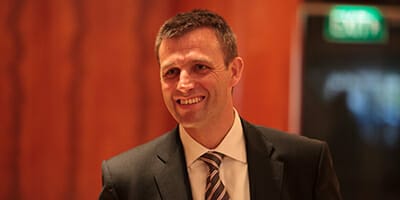
Using a fund of funds enabled the Future Fund to build a large exposure to hedge funds quickly during the global financial crisis, chief investment officer of the Future Fund, David Neal says.

The Future Fund, which uses a combination of fund of funds and direct hedge fund investments, decided it did not have the breadth of skill and research to entirely invest directly.

“Could we realistically, or want to, try to build a team with enough talent and size to cover the industry? It’s not consistent with our notion to keep the investment team small enough to sit around a table and talk about all of the opportunities and strategies to build our portfolio,” Neal says.

“We thought with fund of funds, and the extra edge of someone who’s actually doing it, was worth exploring. As we started, we found other benefits of fund of funds, for example, in the crisis we were able to move quickly. We had one investment-management agreement with one organisation, which has relationships, and we can throw money at them quickly and could build a large exposure quickly. There was an execution service that came from it that would have taken a long time.”

Environment-specific risk

Neal says the Future Fund, which has almost 20 per cent exposure to hedge funds, is looking to expand its exposure and invest in commodities, catastrophe bonds and macro managers.

Sponsored Content

The fund has generated 4.9 per cent since inception, well below its mandate of consumer-price index plus 4.5 to 5.5 per cent

“We are clearly behind, but we don’t think there is much more we could have done. It is very dangerous to play catch-up. If you load up more risk, you’ll blow it,” Neal says. “You have to take the right amount of risk given the environment.”

Investors must manage the risk profile to the prevailing landscape, Neal says, but he believes there will be opportunity to take more risk in the next decade.

Meritocracy for assets

The Future Fund has a “dynamic” allocation process, but it is not relative to a benchmark. Rather, all investment opportunities are assessed on their merit.

“Long-term characteristics can change quickly, the GFC showed that,” he says. “It is not about active tilting but managing risk/return and adjusting accordingly.”

Because of this dynamic nature, the funds are shifted from one opportunity to another.

“There are managers we are happy with who we take money from because the opportunity changes,” Neal says.

The Future Fund considers every investment opportunity on a hedged basis, so each investment can be compared on a like-for-like basis. The fund then decides how much currency to hold.

At the moment it has 12.5 per cent in emerging-market currencies and 18 per cent in developed-market currencies

“Currency is the risk I worry about the most – or it is the cause and solution of the risk I worry about the most – liquidity.”

Neal sits on the Hedge Fund Standards Board and encourages investors to sign the standards’ investor chapter.

“The more investors that sign, the more that managers are interested.”

Asset Owner:Future Fund

Leave a Comment

Sort content by

Quality factor explained by profitability: Robert Novy-Marx

Among academic classifications, and the subsequent implementation of factor investing, “quality” is one of the newer areas of investigation. Robert Novy-Marx, the Lori and Alan S. Zekelman Professor of Finance at the University of Rochester, is leading the charge on the academic justification of quality as a factor, although he has a “jaded scepticism” about

How to allocate assets to combat climate risk

  Mercer’s extensive climate change report, launched today, gives investors a practical framework for monitoring and managing climate risk, shifting the discussion from philosophical agreement to practical investment implementation.   In Investing in a time of climate change Mercer outlines extensive dynamic investment modelling that analyses changes in the return expectations of assets between 2015

Behind Norway’s coal divestment

The Norwegian Parliament’s finance committee recommendations to direct the Government Pension Fund Global to divest from companies that generate more than 30 per cent of their output or revenue from coal-related activities, is the evolution of a climate-related investment strategy that dates back to 2010. Amanda White explores the raft of tools the fund uses

CalPERS gives its managers ESG ultimatum

In what promises to be a transformational moment for ESG integration and investment manager accountability, CalPERS will require all of its managers to identify and articulate ESG in their investment processes. CalPERS staff led by Anne Simpson, senior portfolio manager and director of global governance, presented the ESG manager expectations, and draft sustainable investment guidelines,

Sourcing liquidity in fragmented markets

As equity trading becomes more fragmented, and more trading is done outside exchanges, it is prudent to assess whether alternative liquidity pools contribute to well-functioning markets. Norges Bank Investment Management has done the work for you, analysing the contributions, structures and functions of trading venues with limited pre-trade transparency. One of the benefits of liquidity

Factors the same in credit and equities

Robeco will launch the world’s first multi-factor credit fund, after academic research by its quantitative research team reveals that size, low-risk, value and momentum factors have economically meaningful and statistically significant risk-adjusted returns in the corporate bond market. David Blitz, co-head of quantitative strategies at Robeco in Rotterdam, tells Amanda White why an active approach makes

Previous




