
Finnish pension reform a lesson for all

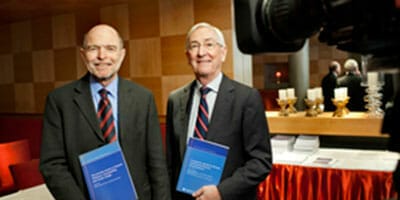
The findings from the first review of the Finnish pension system, commissioned by the Finnish Centre for Pensions, were handed down by Nicholas Barr from the London School of Economics and Keith Ambachtsheer from the Rotman International Centre for Pension Management last month.

Although Helsinki in January is far from a party Ambachtsheer and Barr reached celebrity status in presenting the findings, with their photos on the front page of the newspaper and more than 250 people showing up for a workshop.

The purpose of the evaluation was to get a forward-looking external view of the Finnish pension system from an international perspective, and to specifically get recommendations on improvement.

According to Ambachtsheer and Barr the Finnish pension system is comprehensive and robust. However, the population structure and an increasingly global economy call for further development of the system. Retirement needs to be postponed, and pension asset investments need to seek higher returns.

The first recommendation relates directly to efficiency and cost, and Ambachtsheer is of the opinion that larger pension providers, or stronger co-operation between providers, would facilitate a drop in administrative and investment costs.


Sponsored Content

Value creation

The system costs about €1.1 billion a year to operate, (with total benefit administration of about €440 million) which is roughly €107 per member and is significantly higher than the average €60 per member of an international peer group assessed by CEM Benchmarking.

However it is worth pointing out that the pension administration costs cover both pension pillar one, the universal old age pension, and pillar two, employment based pensions. This is unusual compared to other countries.

Nevertheless, Ambachtsheer says that a value creation/cost reduction target of €400 million a year is not out of the question.

Further he says if €150 billion in Finnish pension assets were moved into long-horizon return-seeking investment strategies there is a potential €1.5 billion a year incremental return potential.

These two actions combined are equivalent to a potential 1 per cent gain in Finland’s GDP, the report says.

About a third of the system’s assets are invested in Finland, and Ambachtsheer says the system, and its beneficiaries, would benefit from being more global.

One way to do this is to be more cooperative with other funds around the world and syndicate investments.

“They need to think about Finland’s funds as part of a cooperative of international funds that invest all over the world,” he says.

Interestingly the Finnish pension organisations outsource a significantly smaller proportion of asset management than their international peers – around 35 per cent, compared with an average 88 per cent in the CEM database.

The report also found that the Finnish pension organisations currently spend less money on the internal investment oversight function than their international peers, and also have lower levels of compensation of senior pension executives.


What makes a sustainable system?

More broadly Ambachtsheer believes there are three tenets to a sustainable pension system.

The first is that you need as many instruments as there are goals. So for example affordability and payment certainty are two goals and so need two instruments.

Secondly, is what he calls the John Nash principle. (Nash is the Nobel Prize winning mathematician who was the subject of the movie “A Beautiful Mind”. He specialises in game theory). Ambachtsheer says that a situation has to be win/win all of the time, even in the bad times, which means if situation changes the solutions need to be dynamic.

And the third aspect is borrowed from Einstein, keep things as simple as possible but no simpler.

With regards to the pension industry, Ambachtsheer says there is a tendency to add a layer of complexity to solve the problems.

Leave a Comment

Sort content by

Investors x embrace ethics

More than half of the world’s largest sovereign wealth funds, and around a third of the largest US state pension funds, have a disclosed code of ethics for their staff. According to the Public Fund Investment Policies 2015 annual review produced by the Ohio State University Moritz College of Law, a code of ethics helps

Shared fund objectives key to investor success

The practice of benchmarking the salaries of senior executives of institutional funds with reference to external financial services firms, instead of the shared objectives of the fund, is a major barrier to their success, according to Professor Gordon Clark of Oxford University and director of Smith School of Enterprise and the Environment. Clark sees the

PGGM halves CO2 footprint in investments

Ahead of the COP21 in Paris, the second largest Dutch fund with €161 billion ($160 billion), Pensioenfonds Zorg en Welzijn (PFZW), has announced it will halve the CO2 footprint of its investments by 2020. After an in-depth study with its fund manager, PGGM, the fund has decided its capital should be focused on companies that

Mercer’s seven tools for risk management reflect evolving landscape

Mercer Investments is using its deep insurance and environmental, social and governance (ESG) skills, contacts and processes to evolve its tools for advising clients on investment risk assessment, analysis and reporting – a move that reflects the evolving landscape for risk faced by investors. Partner and global head of responsible investment at Mercer, Jane Ambachtsheer,

OTPP advises on climate risk mitigation

Ontario Teachers’ Pension Plan (OTPP), an investor known for its advanced risk-management tools and processes, considers that the common tools available to investors to mitigate carbon risk for investors – portfolio carbon footprints and thematic divestment – provide incomplete risk management. The fund has suggested macro- and microanalysis is necessary to understand a company’s complete

PRI to consider new principle focusing on systemic risks

The UN-backed Principles for Responsible Investment (PRI) is considering a seventh principle that will focus on broad financial system systemic risks. The six principles were written before the global financial crisis and are focused on environmental, social and governance (ESG) integration. Now, a decade after their creation, consideration of systemic risks is on the agenda and

Previous




