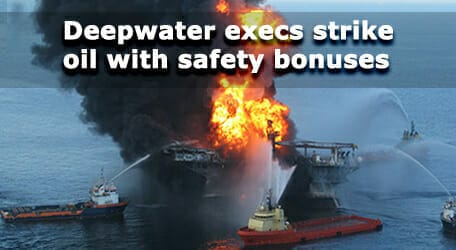
Deepwater execs strike oil with safety bonuses

As incongruous as it sounds, executives at Transocean Ltd – the company that owns the Deepwater Horizon oil rig which exploded in the Gulf of Mexico last year killing 11 people – have been paid bonuses for their improved safety performance.

According to a company SEC filing last week, last year was its best-ever for safety, “notwithstanding the tragic loss of life in the Gulf of Mexico”.

Executives receive 25 per cent of their bonuses based on the company’s safety performance in a given year.

Last year, they were given two-thirds of this. In 2009, the company withheld all bonuses after four deaths.

The calculation for overall safety performance is not based on deaths alone, but rather the number of “incidents” and their “potential severity”.

The number of incidents fell 4 per cent in 2010 and their potential severity fell 15 per cent.

Sponsored Content

The Deepwater Horizon rig was leased by BP, which operated the rig. Transocean blames BP for the damage.

The US Government is continuing its investigation into the cause of the explosion.

Leave a Comment

Sort content by

Does your portfolio have bad breadth? Choosing essential betas

In this article, Ed Peters, co-director of global macro at First Quadrant, Ed Peters, examines what markets, or betas, are essential to fully diversitfy a global portfolio, while still achieving long-term goals; and how breadth is often confused with diversification. mrec4inarticleinline Sponsored Content scnative1 scnative2 scnative3

Control shift in GP/LP dynamic: Cambridge Associates

In the headiness of the bull market, institutional investors generally took on more risk and enjoyed fewer rewards than alternatives managers. But the crisis has provided an opportunity for both counterparties to redefine the balance in the LP/GP relationship, in which institutions are entitled to demand a true alignment of interests on returns, lock-ups and

CalSTRS makes allocation changes at expense of equities

In the nine months to March 2009, the $111.6 billion US fund, CalSTRS has vastly altered its asset allocation, decreasing its equities allocation, with global equities now 6.8 per cent underweight the target allocation. mrec4inarticleinline Sponsored Content scnative1 scnative2 scnative3

$100b mismatch in private equity secondaries demand and supply

Recessions are traditionally considered a good time to invest in private equity, but liquidity constraints and the growth of unlisted assets within portfolios is causing pension funds to sit on the sideline. Sally Collier, London-based partner at global private equity fund of funds Pantheon Ventures, said there was a US$100 billion “mismatch” between the funds

Managing opportunities and risks: insights from the world’s largest institutional manager

Richard Lacaille, chief investment officer of the world’s largest institutional investment manager, State Street Global Advisors, spoke with Amanda White about the economy, when markets will turn and the asset allocation and strategies that will best take advantage of that. mrec4inarticleinline Sponsored Content scnative1 scnative2 scnative3

Dynamic AA helps underfunded plans curb risk

Last week Russell Investments released new research arguing some pension plans should consider liability-responsive asset allocation – asset allocation that changes depending on the plan’s funded status. In this in-depth interview Amanda White explores the concept with one of the report’s authors, director of investment strategy, Bob Collie, including why until now such dynamic asset

Previous




