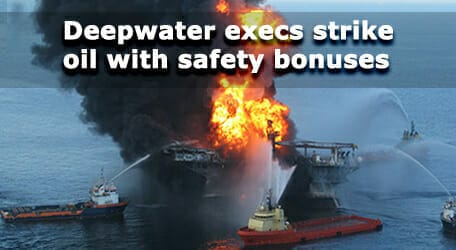
Deepwater execs strike oil with safety bonuses

As incongruous as it sounds, executives at Transocean Ltd – the company that owns the Deepwater Horizon oil rig which exploded in the Gulf of Mexico last year killing 11 people – have been paid bonuses for their improved safety performance.

According to a company SEC filing last week, last year was its best-ever for safety, “notwithstanding the tragic loss of life in the Gulf of Mexico”.

Executives receive 25 per cent of their bonuses based on the company’s safety performance in a given year.

Last year, they were given two-thirds of this. In 2009, the company withheld all bonuses after four deaths.

The calculation for overall safety performance is not based on deaths alone, but rather the number of “incidents” and their “potential severity”.

The number of incidents fell 4 per cent in 2010 and their potential severity fell 15 per cent.

Sponsored Content

The Deepwater Horizon rig was leased by BP, which operated the rig. Transocean blames BP for the damage.

The US Government is continuing its investigation into the cause of the explosion.

Leave a Comment

Sort content by

CalPERS’ absolute return mess

Wilshire’s annual review of CalPERS’ internal risk managed absolute return strategies (RMARS) has revealed a number of anomalies compared with its other global equity investments, including an over-reliance on quantitative tools and inadequate staff compensation incentives. mrec4inarticleinline Sponsored Content scnative1 scnative2 scnative3

Swedish pension fund collaboration to influence local market

Four of Sweden’s national pension funds (AP1-4) have collaborated with another nine investors to form the Swedish arm of The Sustainable Value Creation, and have already begun surveying the top 100 companies on the NASDAQ OMX Stockholm regarding their governance policies and sustainable value creation. mrec4inarticleinline Sponsored Content scnative1 scnative2 scnative3

Crisis will force private real estate to go public

Tight credit conditions in the US will diminish the private sector’s monopoly on residential and commercial property, driving assets into public markets and real estate investment trusts (REITs) loaded with cash from a spate of capital raisings. mrec4inarticleinline Sponsored Content scnative1 scnative2 scnative3

Commodity investing: papering over the problems

As funds globally review their investment policies, investment consultants are now strongly endorsing commodity investment, with funds generally planning a staged 3 to 6 per cent strategic allocation into commodities. Writing exclusively for conexust1f.flywheelstaging.com, chairman of Mountain Pacific Group, Ronald Liesching, traces the history of commodity investing, highlighting the risks and benefits for pension fund

Russell changes tune on TAA

After a long history of opposition to tactical asset allocation, Russell Investments has not become a convert but is allowing for a “slower twitch” version of the discipline, says global chief investment officer of the consultant and multimanager, Peter Gunning. mrec4inarticleinline Sponsored Content scnative1 scnative2 scnative3

ATP staff reduce own CO2 emissions

Each employee of the $110 billion Danish fund, ATP has saved the environment 300 kilograms of CO2 in one year, according to its first climate change report, which coincides with the fund’s strategic move to focus on climate and environmental considerations within its investment policy. mrec4inarticleinline Sponsored Content scnative1 scnative2 scnative3

Previous




