Deepwater execs strike oil with safety bonuses

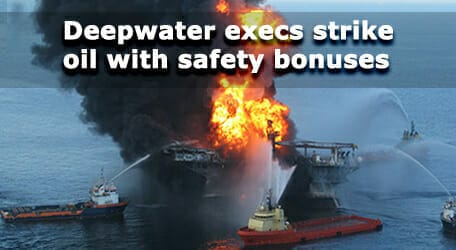
As incongruous as it sounds, executives at Transocean Ltd – the company that owns the Deepwater Horizon oil rig which exploded in the Gulf of Mexico last year killing 11 people – have been paid bonuses for their improved safety performance.

According to a company SEC filing last week, last year was its best-ever for safety, “notwithstanding the tragic loss of life in the Gulf of Mexico”.

Executives receive 25 per cent of their bonuses based on the company’s safety performance in a given year.

Last year, they were given two-thirds of this. In 2009, the company withheld all bonuses after four deaths.

The calculation for overall safety performance is not based on deaths alone, but rather the number of “incidents” and their “potential severity”.

The number of incidents fell 4 per cent in 2010 and their potential severity fell 15 per cent.

Sponsored Content

The Deepwater Horizon rig was leased by BP, which operated the rig. Transocean blames BP for the damage.

The US Government is continuing its investigation into the cause of the explosion.

Leave a Comment

Sort content by

The benefits of US regulatory reform

US regulatory reform, such as the SEC’s plan to restore the uptick rule and the Volcker rule to restrict proprietary trading, are a step in the right direction for those advocating transparency. Amanda White explores the story with the chief executive of Principal Global Investors, Jim McCaughan, and head of research, analysis and strategy at

CalPERS considers new asset class classification

CalPERS is considering doing away with traditional asset class classifications in favour of classifying assets according to fundamental characteristics in a bid to provide a better understanding of portfolio risks and performance drivers and so move to a more effective portfolio construction and risk management framework. Amanda White reports. mrec4inarticleinline Sponsored Content scnative1 scnative2 scnative3

Risk parity becomes bittersweet flavour of the month (2)

  “Understanding a program’s results involves attributing relative performance to active management, identifying any tactical asset allocation decisions and assessing mechanical factors such as leverage costs. “For most investors implementation of a leveraged strategy would likely require the retention of a beta overlay manager to execute and maintain the desired leveraged systematic exposures or an

Selective opportunities in private markets: Wurts

Private market investors should focus on distressed debt and to a lesser extent secondaries, according to the annual private equity outlook by consultant Wurts Associates, which contrary to other industry observers believes value can be added through top down analysis of the sector. mrec4inarticleinline Sponsored Content scnative1 scnative2 scnative3

Strategic implications drive climate change study

The 14 institutional investors participating in the climate change strategic asset allocation study, a collaborative between Mercer, Carbon Trust and the IFC, will all receive individual portfolio scenario analysis of how physical and policy climate change-related events could affect their portfolio at an asset allocation level. mrec4inarticleinline Sponsored Content scnative1 scnative2 scnative3

CalPERS sharpens risk, liability tools

After watching the simultaneous declines of its market value and funded status during the financial crisis, the $204.8 billion CalPERS will conduct a full review of the methodologies underpinning its asset liability management (ALM) process. mrec4inarticleinline Sponsored Content scnative1 scnative2 scnative3

Previous




