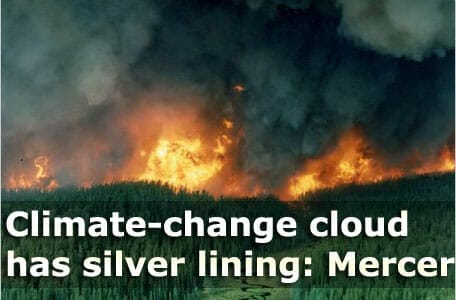
Climate-change cloud has silver lining: Mercer

Climate change could slash as much as 10 per cent off portfolios in the next 20 years, according to Mercer’s much-anticipated climate change report, the result of an 18-month collaboration with 14 institutional investors from around the globe.

With support from the International Finance Corporation and the Carbon Trust, the report, ‘Climate Change Scenarios – implications for strategic asset allocation’, had three broad objectives:

1.      To investigate and analyse the potential investment risk from climate change

2.      Look at the key performance drivers for markets

3.      Identify scenarios around climate change that help in understanding and framing climate change as a strategic investment priority.

Sponsored Content

“It is about setting the framework so institutional investors can transform to a low carbon economy,” Danyelle Guyatt, head of global research in Mercer’s responsible investment team, said.

The report looks at the impact of climate change on investments, concluding it could contribute as much as 10 per cent to portfolio risks.

Guyatt said Mercer would research managers with the best ideas across ideas and regions, and urged investors to introduce climate risk into reviews and strategic asset allocation.

Mercer’s chief investment officer, Andrew Kirton, said investors should look to allocate more to infrastructure, real estate, private equity, agriculture land, timberland, and sustainable assets.

The 14 global institutional investors, representing more than $2 trillion in AUM, are: AP1, APG, AustralianSuper, British Columbia Investment Management Corporation, British Telecom Pension Scheme, CalPERS, CalSTRS, Environment Agency Pension Scheme, Government of Singapore Investment Corporation, Maryland State Retirement and Pension System, Norwegian Government Pension Fund, Ontario Municipal Employees Retirement System, PGGM and VicSuper.


Leave a Comment

Sort content by

The Intersection of Energy, the Environment and the Economy

Cary Krosinsky, vice president of Trucost and co-editor and author of Sustainable Investing: The Art of Long Term Performance, recently presented at an Audubon-hosted event alongside Libby Cheney of Shell. Here he writes for conexust1f.flywheelstaging.com drawing on his presentation about the intersection of energy, the environment and the economy, and the implications for asset owners.

Investors seek liquidity in hedge fund managers: Preqin

Transparency, liquidity and risk management have replaced the performance record of a fund as the key consideration of hedge fund investors, according to a recent survey of 50 global institutional investors by Preqin, which also found half of those surveyed intend to maintain their current exposure to hedge funds in the next year. mrec4inarticleinline Sponsored

LACERS prioritises local companies

The Los Angeles City Employees’ Retirement System (LACERS) will give preference to Los Angeles-based companies in its alternative investment allocations, providing all else is considered equal in terms of performance, strategy, personnel, and philosophy. mrec4inarticleinline Sponsored Content scnative1 scnative2 scnative3

Alaska continues self assessment with special meeting

The Alaska Permanent Fund Corporation Board of Trustees has called a special meeting for October 15, to discuss among other things the performance of the executive director and the fund’s securities lending agenda. mrec4inarticleinline Sponsored Content scnative1 scnative2 scnative3

Russell Investment Manager Outlook

The market is no longer undervalued, according to the views of more than 200 funds managers in the September Russell Investment Manager Survey, which among other things found that 54 per cent of managers believe the US equity market is now fairly valued. mrec4inarticleinline Sponsored Content scnative1 scnative2 scnative3

Cost vs value: US funds suffer fee creep

The 2009 cost of doing business survey by the Callan Investments Institute found that fees paid by US funds have been increasing on the back of higher allocations to more expensive asset classes and lower allocations to passive investment. Amanda White spoke with Callan’s executive vice president and director of capital market and alternatives research,

Previous



