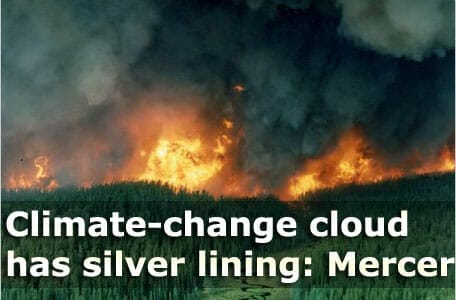
Climate-change cloud has silver lining: Mercer

Climate change could slash as much as 10 per cent off portfolios in the next 20 years, according to Mercer’s much-anticipated climate change report, the result of an 18-month collaboration with 14 institutional investors from around the globe.

With support from the International Finance Corporation and the Carbon Trust, the report, ‘Climate Change Scenarios – implications for strategic asset allocation’, had three broad objectives:

1.      To investigate and analyse the potential investment risk from climate change

2.      Look at the key performance drivers for markets

3.      Identify scenarios around climate change that help in understanding and framing climate change as a strategic investment priority.

Sponsored Content

“It is about setting the framework so institutional investors can transform to a low carbon economy,” Danyelle Guyatt, head of global research in Mercer’s responsible investment team, said.

The report looks at the impact of climate change on investments, concluding it could contribute as much as 10 per cent to portfolio risks.

Guyatt said Mercer would research managers with the best ideas across ideas and regions, and urged investors to introduce climate risk into reviews and strategic asset allocation.

Mercer’s chief investment officer, Andrew Kirton, said investors should look to allocate more to infrastructure, real estate, private equity, agriculture land, timberland, and sustainable assets.

The 14 global institutional investors, representing more than $2 trillion in AUM, are: AP1, APG, AustralianSuper, British Columbia Investment Management Corporation, British Telecom Pension Scheme, CalPERS, CalSTRS, Environment Agency Pension Scheme, Government of Singapore Investment Corporation, Maryland State Retirement and Pension System, Norwegian Government Pension Fund, Ontario Municipal Employees Retirement System, PGGM and VicSuper.


Leave a Comment

Sort content by

Conservative overweighting hinders world’s largest investor

An overweight allocation to domestic bonds has not helped the world’s largest investor in the June quarter, with a massive $42 billion shaved off the assets of the ¥116,802 billion ($1.37 trillion), Government Pension Investment Fund of Japan (GPIF).mrec4inarticleinline Sponsored Content scnative1 scnative2 scnative3

Deflation: the taboo which needs to be examined

The funds management industry is famous for its navel-gazing. After a crisis, you can just imagine how much of it goes on. But, perhaps, that self-examination may provide more rewards if it starts to actually look at industry taboos rather than accepted practices.mrec4inarticleinline Sponsored Content scnative1 scnative2 scnative3

European pension funds have blinkered view of risk

The liability-hedging portfolio of European pension funds is imprecisely modelled at nearly half of the pension funds as measured in a EDHEC-Risk Institute survey.mrec4inarticleinline Sponsored Content scnative1 scnative2 scnative3

Financial health reports essential says Mercer

After the damage of the global financial crisis, funds should be submitting themselves for voluntary financial health checks to diagnose vulnerabilities and pinpoint risks, asset consulting firm Mercer says.  mrec4inarticleinline Sponsored Content scnative1 scnative2 scnative3

Liquidity as an investment style

This paper by Yale School of Management Professors, Roger Ibbotson and Zhiwu Chen, shows that liquidity, as measured by stock turnover or trading volume, is an economically significant and distinct investment style, and introduces and examines the performance of several portfolio strategies.mrec4inarticleinline Sponsored Content scnative1 scnative2 scnative3

Dodd-Frank Act will stand or fall on right people

At a Yale-hosted roundtable on the Dodd-Frank Wall Street Reform Act, professor of economics, Robert Shiller, said the success of the Act, and the agencies created to study aspects of the market, will depend on appointing the right people, who should be willing to take advice from his fellow economists. Click here to read more.mrec4inarticleinline

Previous



