
Europe in quest for sustainability

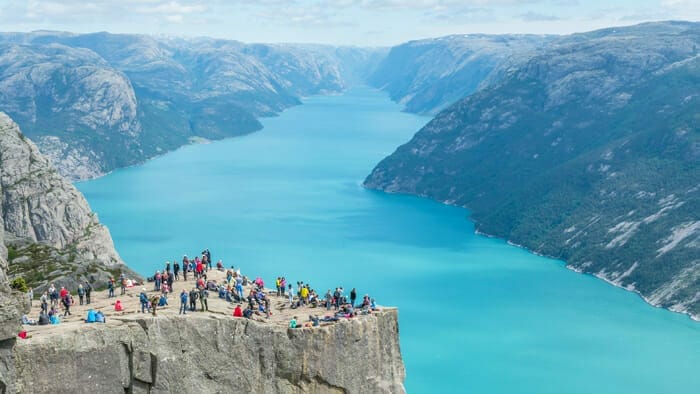
One of the most famous attractions in Norway, Pulpit Rock.

Traditional benchmarks and indices are under the spotlight as Europe considers how to make a sustainable financial system a reality.

Christian Thimann, who is chair of the UNEP Finance Initiative and chair of the European Union’s high-level expert group on sustainable finance, told delegates at the PRI in Person conference in Berlin that the use of “classic benchmarks” was under review.

“Users of indices always look at the classic benchmarks,” Thimann said. “We are looking at the use of benchmarks and indices as part of our review, and asking whether moving away from those is a way to move to a more sustainable system.

“This is a complex point because it’s not driven by regulation but by industry standards. But investment flows are heavily influenced by benchmarks. Are they sustainably aligned or not? Maybe there are some that are better than others.”

Thimann said there was momentum towards a sustainable system with political, corporate and regulatory players all making headway.

“If sustainability means to be broader in scope and have a longer horizon, then we are making more progress on breadth than length,” he said. “There have been advances in taxonomy, green bonds, disclosure, sustainability, integration and supervision. But overall, how can we get the financial system to have more patience so investment horizons are more like the real economic horizon [is the question].”

Sponsored Content

Meanwhile, former North Carolina state treasurer Janet Cowell said she believed markets, rather than governments and policy, would drive change.

“I was elected treasurer in the midst of the financial crisis, and my first press conference was to announce a $20 billion loss to the portfolio,” Cowell said. “But we have seen a number of changes in that time – a decrease in leverage, more disclosures, a lot of progress on alignment of interest with managers, how carry would be calculated and distributed, or if it would even be paid, and more managers’ disclosure.”

But she said in the US there has not been progress in inequality, inclusion, retirement, healthcare, or immigration, and there had been a shift back to fossil fuels. Overall, she said, the financial system was still a very short-term system.

Thimann agreed and said there needed to be a move in the market towards long-term research, earnings and management.

“The big question in Europe is how we go from short-term stabilisation to impact – does this system finance the real economy that we want?” he asked. “Bank lending has heavy charges, insurance companies are compressed on a short-term horizon and invest little in equity. We need to move to the long term.”

He said a huge amount of spending was needed in infrastructure to make the move to a sustainable system, estimating about $100 billion in infrastructure investments each year.

“The money is there, but there is a lack of projects, we need more development capacity and the early stage of infrastructure development,” he said. “We need to build the infrastructure that a sustainable economy needs.”

Leave a Comment

Slavery victims look to financial world

Slavery victims look to financial world

Speaking at the PRI in Person in Paris in a panel to highlight the role of finance in addressing social issues, Ghanaian James Kofi Annan, sold into slavery at the age of six, told his story.

Sort content by

How to convince the ESG sceptics

Trying to find ways to get colleagues to embrace responsible investment strategies can be frustrating but it becomes easier when the business case includes the bottom line.

ESG is strategy at PE firm TPG

A social impact fund and innovative engagement with investee companies make ESG an integrated part of the culture at private equity firm TPG, co-chief executive Jon Winkelried said in an interview.

ESG moves into passive portfolios

Integration of ESG strategies into passive investment is becoming easier with greater sophistication and is set to grow, a panel of experts said.

Water risk is real, experts warn

The seven-year drought plaguing the state with the world’s fifth-largest economy highlights supply-chain issues and other concerns that investors need to take seriously.

Ready for the rough switch to low-carbon

Investors said the move away from the carbon economy in response to climate change was definitely coming and would be difficult. They shared some of the ways they’re getting ready.

Investors find low-carbon opportunities

Leading investors are moving forward on climate change by pouring funds into sustainable investments and applying energy-saving strategies to assets already in their portfolios.

Previous