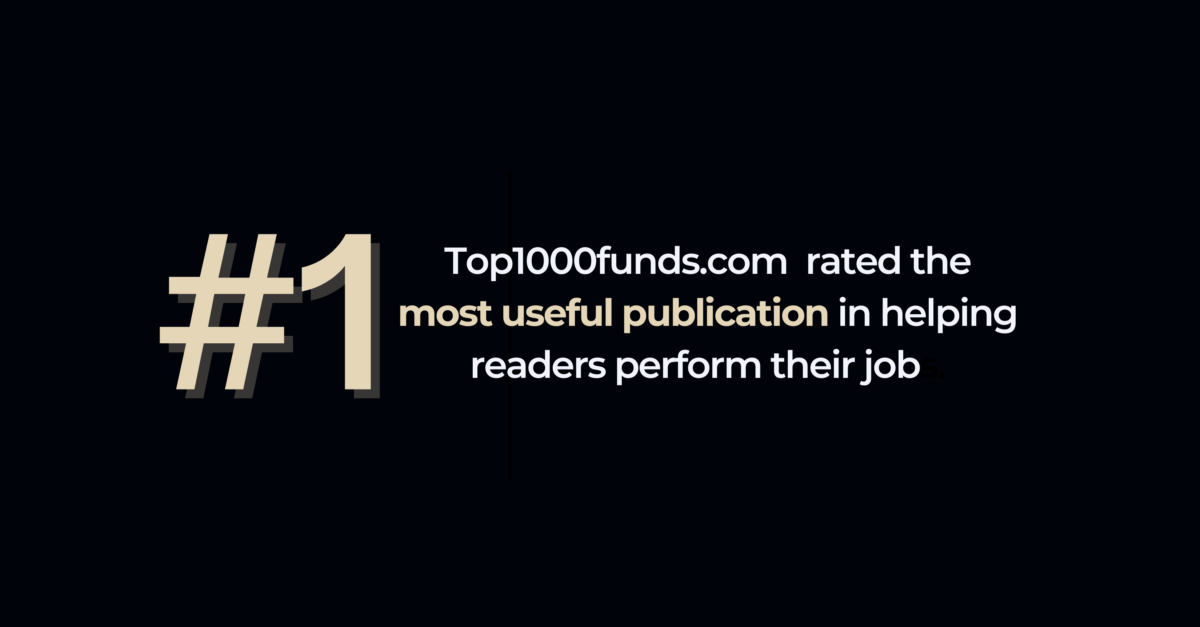

Top1000funds.com rated ‘most useful’ by readers 

Research into Top1000funds.com readers’ preferences and habits reveals that the publication is rated as the most useful to them in the performance of their jobs, and is read by some of the most senior investment professionals inside asset-owner organisations around the world.  

New independent research reveals that Top1000funds.com readers consider the publication the most useful of its type for delivering news, insights and analysis that help them in their jobs.  

The publication, launched in 2008 with the aim of promoting best practice in asset ownership and management in the global community of international pension funds, sovereign wealth funds and other institutional investors, is rated by almost three-quarters (73 per cent) of its readers as the most useful publication to them. 

It ranks well ahead of Bloomberg (68 per cent) and FT.com (65 per cent), while less than half consider Institutionalinvestor.com (48 per cent) and Pionline.com (28 per cent) to be most useful to them. 

Overall, 96 per cent of Top1000funds.com’s readers find the publication useful, including 62 per cent who say they get information from it that they simply cannot get anywhere else.  

Top1000funds.com’s focus on investment strategy and implementation issues and commitment to original news stories, case studies and research means that almost a third (31 per cent) of its readers say it is an essential business resource for them, and around four in 10 (39 per cent) regularly share articles published in Top1000finds.com with colleagues and friends. 

Sponsored Content

The publication’s differentiating factors – including being for and about asset owners, and the mission to lead the global investment industry to continuous improvement – have positioned it well among readers. The publication continues to push the industry to question whether status quo processes and behaviours to tackle risks and opportunities will be sufficient in the future, and actively campaigns for diversity, sustainability, transparency, innovation and better alignment of fees in the investment industry. 

The research, conducted independently by US-based market research firm Signet Research, shows that more than half (52 per cent) of Top1000funds.com’s readers are employed by asset owners, including public and corporate pension funds, sovereign wealth funds, foundations, and non-profit institutions. 

96 per cent of Top1000funds.com’s readers find the publication useful for their jobs

It shows that Top1000funds.com reaches the key decisionmakers inside asset-owner organisations. More than half of its readers hold senior roles within their respective organisations, including 18 per cent who are chairs, chief executives, presidents or partners; and more than a quarter (26 per cent) who are chief investment officers, portfolio managers or heads of asset classes. 

In addition, almost half (47 per cent) of readers are involved in investment policy committees, pension boards, boards of directors or executive committees, or other committees and boards.  

Around 45 per cent of readers are personally involved in selecting external asset management firms – and for around half of the 55 per cent that are not, it’s only because their organisations do not employ external firms. 

Overall, about 85 per cent of readers are directly or indirectly involved in or influence asset manager selection. 

Almost a quarter of Top1000funds.com’s readers work for organisations that manage $100 billion or more. The average asset size of a Top1000funds.com reader is $148 billion. 

Top1000funds.com enjoys a truly international reach and a geographically diverse readership, with 44 per cent located in North America, 28 per cent in Europe and 19 per cent in Oceania.  

And its readers are loyal, with one in seven (14 per cent) having read the publication for 10 years or more, and another four in 10 (38 per cent) having read it for between five and 10 years. But it also continues to attract new readers, with around one in 12 (8 per cent) having read the publication for a year or less. 

Three of Top1000funds.com’s regular featured editorial and research projects and Fiduciary Investor Symposium (FIS) events are well understood and supported by its readers, with 66 per cent, 63 per cent and 57 per cent of readers aware of the Asset Owner Directory, CIO Sentiment Survey and Global Pension Transparency Benchmark, respectively. 

More than a third (35 per cent) of readers have already attended a FIS event and will attend again in future, with another 24 per cent saying they plan to attend their first FIS event in future. 

Around eight in 10 (79 per cent) of Top1000funds.com readers are male and two in 10 (20 per cent) are female, with an average age across the board of 54 years. Almost six in 10 (58 per cent) hold a master’s degree or higher, including 12 per cent who are PhD qualified. 

Leave a Comment

GIC, Temasek eye trillions of growth in climate adaptation market

GIC, Temasek eye trillions of growth in climate adaptation market

Singapore’s two largest asset owners, GIC and Temasek, see attractive opportunities in climate adaptation solutions – a relatively underfunded area compared to decarbonisation. The former has already made selective adaptation investments and said the opportunity set across public and private debt and equity could increase to $9 trillion by 2050.

Sort content by

Inflation/deflation continuum can plot holes

This paper by RogersCasey’s Ryan Dembinsky and Srivatsa Kilambi demonstrate the “inflation/deflation continuum” is a way of assessing an investment program’s vulnerability to the dual threats, and competing forces, of inflation and deflation. The paper presents a framework whereby investors can plot their existing asset classes and assess where there may be holes. mrec4inarticleinline Sponsored

The beta-alpha ratio will yield more success

Using a “Beta-Alpha Ratio” will yield more success in choosing managers ex-ante, compared to other methodology prevalent in the consulting industry, according to a new paper by Wurts Associates’ director of research, Eric Petroff, and research associate, Curtis Yasutake. mrec4inarticleinline Sponsored Content scnative1 scnative2 scnative3

Spillover effects of counter-cyclical market regulation

Professor of finance at the EDHEC Business School and member of the EDHEC Risk Institute, Abraham Lioui, looks at the spillover effect that counter-cyclical regulation affecting one part of the market, banning short-selling, has on the broad market. By examining the effect of the ban on short-selling in 2008 on market indices in the US

Study links executives’ pay and behaviour

This research, commissioned by APG (the investment division of ABP, the €208 billion Dutch pension fund), examines the published literature on the link between remuneration and executive behaivour. It was conducted by the London Business School. mrec4inarticleinline Sponsored Content scnative1 scnative2 scnative3

A quality approach to investing in European equities

This research by T Rowe Price looks at the performance of European stocks over a seven-year period to December 2009 and finds, among other things, that companies with the highest return on equity outperform in times of risk aversion, giving investors some downside protection, but fall out of favour in momentum-driven markets.mrec4inarticleinline Sponsored Content scnative1

The ABCs of Hedge Funds: Alpha, Beta and Costs

This hot-off-the-press revised version (March 30) of The ABCs of Hedge Funds, which decomposes returns into three components – systematic market exposure (beta), value-added by hedge funds (alpha), and hedge fund fees (costs) –  includes data up to the end of December 2009. Among other things it finds the universe of hedge funds produced a

Previous



