
How Danone leads corporate world on ESG

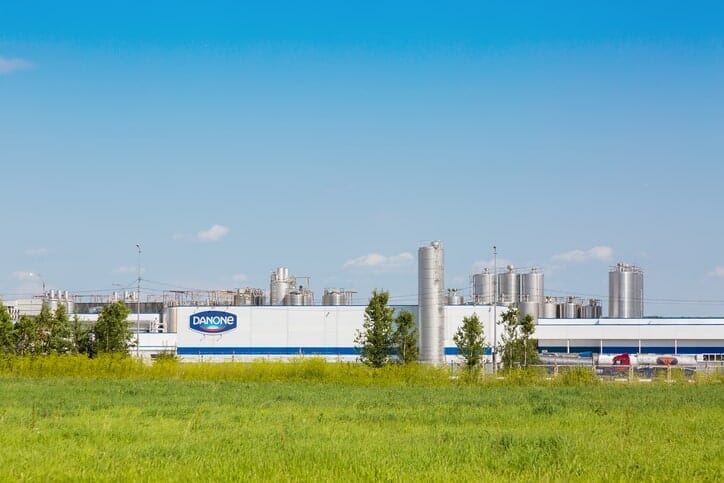
MOSCOW REGION, RUSSIA - AUGUST, 2017: Danone factory in Russia with green grass and blue sky.

Business has a key role to play in leading on sustainability in a complex world, said Cécile Cabanis, CFO of French multi-national food group Danone. In conversation with Eva Halvarsson, CEO of SEK 334 billion ($34 billion) Swedish buffer fund AP2 at PRI in Person in Paris, Cabanis told delegates in an opening session that the goal of the company is to contribute positively to all 17 Sustainable Development Goals.

Danone, which is celebrating its 100th birthday and operates in more than 100 countries with 100,000 employees worldwide, started its ESG journey nearly 50 years ago. Back then in a pioneering strategy, the company committed to its business extending beyond the factory gate. Today, a core belief is that a healthy business depends on a healthy society; that the health of the planet and its people, is intertwined.

The company has prioritised three SDGs particularly: SDGs 2, 3, and 6 around Zero Hunger, Good Health and Wellbeing and Clean Water and Sanitation, respectively. But other SDGs are just as important, said Cabanis. For example, the company is focused on better management of waste and natural resources (SDG 12) in line with its commitments towards the development of a circular economy. And it promotes inclusive growth as well as a safe and secure work environment for all. And since agriculture is responsible for about 31 per cent of global greenhouse gas emissions, Danone has also committed to contribute to the fight against climate change by becoming carbon neutral by 2050. “If you are not serious about putting this at the heart of how you do business, ultimately you will not have a business,” she warned, urging companies and investors alike to “shift the conversation” and not focus on the “short-term.”

In a particularly landmark innovation, Cabanis told delegates about how the company has tied its financing to ESG criteria. Two years ago Danone partnered with 12 global banks to lower its cost of borrowing if it increased its verified positive impact in the world. The deal on Danone’s $2 billion syndicated credit facility means its ESG performance (verified by a third party) will directly impact – upwards or downwards – the margin payable to the banks over the entire duration of the facility. “We are making progress, but it is still a drop in the ocean,” said Cabanis. “There is a tension between the short-term and what we need to do for the long-term. It is a tension that we need to manage.”

Cabanis also called for more homogenous reporting. She said the number of indices was “a mess” that required “teams and teams” at Danone to manage, with everyone measuring different things. “Everyone reporting in their own way is a waste of resources,” she said. She also urged delegates that reporting needs to be followed up with actions. “We can do it if we are all together,” she concluded.

Sponsored Content

Leave a Comment

Slavery victims look to financial world

Slavery victims look to financial world

Speaking at the PRI in Person in Paris in a panel to highlight the role of finance in addressing social issues, Ghanaian James Kofi Annan, sold into slavery at the age of six, told his story.

Sort content by

Culture is key in the ESG journey

Renosi Mokate, board member at Africa’s largest pension fund South Africa’s Government Employee Pension Fund, GEPF, believes that one reason the R1 trillion ($107 billion) fund so comfortably embraces ESG principles stems from South Africa’s own turbulent history. “Our investment policy has been influenced by our history,” she says, speaking at PRI in Person 2015, the annual

Debate around fiduciary duty moves on

Fiduciary duty shouldn’t be a barrier to investing according to ESG principles, said Marcel Barros, executive director of Latin America’s largest pension fund, the Banco do Brasil SA, or PREVI, talking at PRI in Person 2015, the annual conference for the UN-supported international network of investors working to put Principles for Responsible Investment into practice.

The importance of investment beliefs

It’s often said that investment beliefs provide the solid frame on which investment strategy can hang. Some of these Magna Carta’s are beguilingly simple, like ‘Costs Matter’. Others may enshrine beliefs like ‘A Long Term Investors Has Opportunities and Responsibilities.’ So, it was with keen interest that delegates at PRI in Person 2015, the annual

Director nominations: findings from the PRI-led collaborative engagement

“At West Midlands we believe robust governance makes companies much more resilient to shocks,” says Leanne Clements, responsible investment officer at the Wolverhampton-based £11.4 billion West Midlands Pension Fund. It’s the reason why the UK local authority fund has been working with an ongoing PRI-led collaborative engagement process exploring different corporate practices around director nominations

Asset owners step up battle against climate change

Spurred on by its vocal student body and a rich ESG precedent it’s no surprise that the $91 billion University of California is leading on climate change investment. “We thought about our beliefs and realised that climate change matters because it will impact our investments over the long term. We can’t afford to sit idly

How to sell the ESG message: follow human behaviour

“How can we entice savers to look at how much is in their pension pot? How can we make pensions more dynamic and interesting to our beneficiaries?” asks Jennifer Anderson, responsible investment officer, The Pensions Trust, the £7 billion scheme which manages pensions for the UK’s charitable sector. The problem under discussion at the UN-backed PRI

Previous