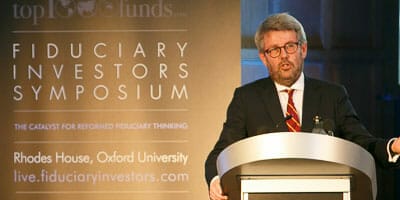
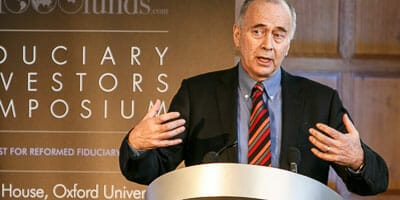
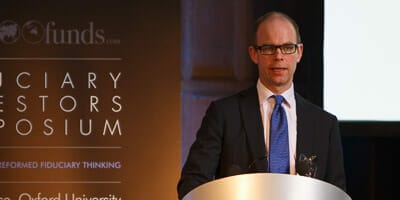
Governance of institutional investors and the lengthening investment chain causing  bigger distances between assets’ beneficial owners and those involved in executing investment strategies was one of three practical issues raised by the OECD general secretary as a barrier to more investment in long-term investing financing.

Speaking at the OECD Project on Institutional Investors and Long-term Investment roundtable, Gurria gave an update from the recent Brisbane G20 Leaders Summit as well as the future agenda for institutional investors and long-term investment in view of the future Turkish presidency of the G20.

In his speech, he said the G20/OECD High-Level Policy Principles on Long-Term Investment Financing by Institutional Investors provided a solid starting point for tackling the issues but there needed to be policy solutions to remove the obstacles to long term investing.

An extract of his speech is below:

“Following the guidance of G20 Leaders in Brisbane, we now need “to walk the extra-mile” and move “from solutions to actions”.

To this end, let me briefly address a few practical issues:
First, we need to address the issue of the governance of institutional investors. The lengthening ‘investment chain’, with bigger distances between assets’ beneficial owners and those involved in executing investment strategies, necessitates well-aligned incentives for every link in the chain.

We must remember that most of the money that circulates in this investment chain ultimately belongs to ordinary working people. Money they save for retirement or perhaps their children’s education. Similarly, those executing the investments also need to have the right skills and expertise to be able to expand their investment universe to alternative asset classes, in particular those that can support infrastructure investment and green projects.

Second, we need to address the question of financial regulation and its impact on the ability of institutional investors to provide financing for growth.

There is a need to balance stability and transparency against the need to ensure that institutional investors can act as proper financing channels for investment. For example, strict solvency rules, and related ‘mark to market’ accounting, may inadvertently put a brake on productive investment. More generally, governments need to ensure that the “conditions for investment” reduce legal and regulatory uncertainty.

Third, there is a clear need for more in-depth discussion on what are the most relevant and efficient financial instruments for long-term investment. We need to look at project financing needs across the entire life-cycle of investments to identify the optimal “division of labour” between different providers of finance.

“Pooling” mechanisms to get large and small institutions to participate in debt and equity financing can also play an important role. To facilitate these discussions, the OECD is developing a taxonomy of techniques, instruments and vehicles that policymakers can use to leverage private sector financing in infrastructure.

Ultimately, these three issues are just a sub-set of the much broader question as to what type of financial system we wish to construct. In advanced, emerging and developing economies alike, there is a need to enhance the role of fair and transparent capital markets. We need to consider concrete steps like the development of local currency bond markets; the issuance of project bonds; and the development of appropriate hedging instruments.

On these and many other issues, we are working together with the incoming Turkish presidency of the G20 on how best to advance the LTI agenda to promote stronger, fairer, greener growth.”


For the full speech click here

2015 is poised to be the turning point as a number of key issues relating to environmental, social and governance (ESG) issues take centre stage says Fiona Reynolds, managing director of the Principles for Responsible Investment.


First and foremost is climate change. With the Paris talks scheduled for December 2015, it’s an issue that is top of mind for governments, investors and companies alike. Climate change is one of the biggest challenges facing the world today because of its potential to seriously impact water, food, land and biodiversity—all of which can have enormous consequences for the health and well-being of humankind, and the sustainability of the global economy.

With overwhelming scientific evidence supporting the increased rate and level of climate change, it is essential that governments act now and make climate change a top priority.

Towards the end of 2014, we saw the US and China signing an agreement to reduce carbon emissions, which was a huge step forward for global climate action.

We also saw thousands of individuals taking part in climate marches, as well as institutional investors wielding their financial muscle to try and get policymakers to move swiftly on this issue.  At PRI, we initiated the Montreal Carbon Pledge in September 2014, which asks our signatories to understand their exposure to carbon risks by taking the first step to measure the carbon footprint of their portfolios.

Finally, in December, we had the Lima climate talks, which tested the political will of agreeing a global climate deal.

The Lima talks put a strong foundation in place for the Paris climate talks, due to take place at the end of 2015, as the world tries to set the first ever guidelines around greenhouse gas emissions.

The World Wildlife Fund (WWF) expected that governments coming to Lima would act with urgency to close the emissions gap, including by scaling up renewable energy consumption to 25 per cent and doubling energy efficiency by 2020.

Post-Lima and into next year, there will be many obstacles to overcome,  including the new Republican-led Senate in the US, and how to address the continued division between rich and poor nations when it comes to issues such as de-forestation, the latter issue being highlighted during the Lima talks.

There is also the issue of the growing divisions between the EU and the US, with the former favouring legally binding elements on carbon emissions and the latter preferring the “buffet option,” that would contain some legally binding elements but allow countries to determine the scale and pace of their emissions reductions, even if this calls into question the aim of keeping temperature rises below 2 degrees centigrade.

One encouraging sign is the fact that contributions made to the Green Climate Fund in 2014 now total more than $9 billion, short of the target of $10 billion to $15 billion, but contributions ramped up significantly in the last months of the year. The funding, which would help developing nations cut emissions and adapt to climate shifts already happening, is seen as another way to open the door to a global climate agreement.

Multinational tax reform

Headlines abounded in 2014 about multinational companies—Yahoo, Google, Apple, Starbucks, Amazon—which were seen not be paying their fair share of taxes.

In the autumn of 2014, the G20, during its final meeting of the year, received from the OECD its first recommendations for a coordinated international approach to combat tax avoidance by multinational enterprises. The recommendations come under the G20 and OECD Base Erosion and Profit Shifting Project designed to create a single set of international tax rules to end the erosion of tax bases and the artificial shifting of profits to jurisdictions to avoid paying tax.

The G20 is expected to enact the measures in 2015.  If they are passed, companies will no longer be able to employ many commonly-used practices to shift profits into tax havens. Under the measures, companies operating in more than one country will have to tell the tax authorities where their money is generated.

There is also a persuasive business case for closing tax loopholes.  Oxfam, the international aid agency, estimates that developing nations lose $114 billion in tax revenue each year. While most countries feel the impact of tax avoidance, this deficit takes a particular toll on low-income countries.

At the end of 2014 in the Autumn Statement, UK Chancellor George Osborne   launched a crackdown on tax avoidance by multinational technology firms such as Google and Amazon, by imposing a 25 per cent levy on profits which are generated in Britain but “artificially shifted” abroad.

In 2015, all eyes will be on the Forum of Tax Administrators, where we will be able gauge whether tax reform on a global scale is likely to happen.

Shareholder activism on social issues

A final issue that will undoubtedly continue to gain ground in 2015 is shareholder activism, which saw a number of high profile cases during 2014 around a variety of social issues.

The trend for shareholder engagement has been fuelled in part by growing concerns about the environmental impact of business, as well as by the widespread questioning of modern capitalism since the credit crunch of 2008.

According to recent data from Citigroup, globally, the pace of public activist campaigns in 2015 is on track to exceed that of prior years. In the US, almost one-sixth of companies in the S&P 1500 since 2006 have faced a public shareholder activism campaign, with some of these experiencing multiple campaigns.

Outside the US, shareholder activism has a foothold in the UK and is also gaining some traction in other regions. Moreover, there are a significant number of activist investors in every market who primarily engage with target companies behind closed doors. This is particularly the case in Europe, where research on activism suggests that nearly 45 per cent of all campaign activity is private.

Shareholders area increasingly turning to activism as a way to try and effect change on a number of social issues. For example, during an AGM held in 2014 by AMEC, a global engineering and project management firm, shareholder activists raised the issue of the company’s position on the UK Living Wage.  Activists were able to confirm that all employees at the company earned above the minimum wage but the company did not know if they earned a UK Living Wage. This is something that AMEC has promised to address.

We will have to wait and see if real progress on ESG issues can be achieved in 2015.

But one thing is clear, investors should continue using their financial clout to engage policymakers on effecting change, rather than simply waiting for governments to act.

The PRI has produced a new guide “The Case for Investor Engagement in Public Policy”, which includes practical steps investors can take to effectively engage policymakers. It’s through investors coming together, working collaboratively and ensuring that their voices are heard, that we will see change and move from awareness to impact.


The holiday season is a good time to catch up on the reading you may have put off throughout the year. To make it easy for you here is a choice of articles that speak to some of the key themes for investors – long-termism, economic growth, climate risk and capitalism.

Long-termism is one of the mostly hotly debated topics in the industry and there is an un-ending amount of literature on what long-termism means and how asset owners should react to it, promote it, and position investments to take advantage of it.

Theresa Whitmarsh’s candid admission in her International Journal of Pension Management guest editorial follows her journey from skeptic to cautious optimist, and outlines a practical view of the issues for asset owners. She says there are a number of catalysts for the increasing dialogue on the benefits of long-termism, and one of those is the increasing recognition of the negative effect of rising income inequality.

Income inequality was at the core of Thomas Piketty’s lauded Capital in the 21st Century, which showed that inequality has increased sharply since the late 1970s. He says that 60 per cent of the increase in US national income in the 30 years after 1977 went to just the top 1 per cent of earners.

I fumbled my way through the book this year, but for those that haven’t I recommend the Guardian’s Stephanie Flanders’ review which argues the debate about the book is more important than the book itself.

Flanders points out that many people are worried about the slow rate of growth in the developed economies since the financial crisis in 2008, which is also highlighted by Joseph Stiglit’z Vanity Fair article to appear next year, The Chinese Century.

In the article, Stiglitz compares the US and China on income inequality, savings and exports. On one level, he argues, it doesn’t matter whether China’s economy is larger than the US. But on another level, it matters a great deal. The US likes to be number one, and the “soft powers” it brings with it. These include the influence of its ideas in economic and political life and Stiglitz argues China’s emergence at the top ranking should be a wake-up call for the US to get its own house in order

Despite slipping in its economy rankings, however the US still holds an important position as the world’s default currency. But as James Rickards explains in The Death of Money the dollar is on a one-way journey, which also has the potential to collapse the international monetary system. If confidence in the dollar is lost, no other currency stands ready to take its place as the world’s reserve currency, he says.

Right now geopolitics is dominated by the interactivity of currency and oil prices, and earlier in the year the manipulation of foreign exchange markets was yet another blow to the trust in the financial services industry. Now Barclays, which was at the centre of the Libor scandal, has decided not to participate in the settlement with US and UK regulators.

The legitimacy of financial market participants and the interactivity of financial services players is at the core of capitalism’s waning brand. And an article in Spiegel Online International’s, How capitalism has gone off the rails, demonstrates that the road to recovery is long and slow.

For too long the savings of every day workers has been dominated by the interactivity and profit-motives of the layers of financial services firms that dominate the industry. The good news is that asset owners are finally starting to flex their muscle and distribute capital in prudent financial allocations that are also for the good of society.

The paper by AP4’s Mats Andersson, Columbia University’s Patrick Bolton and Aumundi’s Frederic Samama, Hedging climate risk, is an example of that. They outline a simple dynamic investment strategy that allows long‐term passive investors to hedge climate risk without sacrificing financial returns by composing a low-carbon portfolio.


In 2014 we have delivered to our readers more than 200 in-depth investor profiles, analytical and research-driven stories on the global institutional investment universe.  The most popular investment stories have been about private equity, ESG integration and how to find the ever-elusive alpha. But asset owners have also liked stories on how to improve their internal structures, decision making and team cultures. Below is a recap of the 10 most popular stories for 2014.

Data doesn’t lie: illiquidity premium doesn’t exist

There is no 3 per cent illiquidity premium in private equity, according to research by CEM Benchmarking.

A cost drag on private assets cancels out the returns of investing in private equity and real estate for those investors that outsource to external providers, the research finds.  read more


Good for Harvard, good for the world: Why HMC embraced ESG with a passion

Harvard Management Corporation (HMC) signed up to the UN-supported Principles for Responsible Investment (PRI) less than a year ago, but the company that manages the $36 billion Harvard University endowment is already moving rapidly to build environmental, social and governance (ESG) factors into every investment decision it makes.

Jane Mendillo, president and chief executive of HMC, told the Fiduciary Investors Symposium at Harvard University that its embrace of ESG factors and the PRI was driven by the changing definition of what it means to be a fiduciary investor, and by a conviction that investing sustainably will improve its portfolio returns. read more


Howard Marks on alpha and making money

“It used to be easier to make money,” Oaktree Capital Management founder and chairman, Howard Marks muses as he discusses meeting the demands and goals of his clients in 2014.

Marks is an avid communicator, and has been writing memos to clients for 24 years. The result is his book “The Most Important Thing”, which Warren Buffett’s review on the front cover summarises as “…that rarity, a useful book”.

His January memo is a 4,000-word musing on the role of luck. In it he discusses many things including “alpha” which he defines as superior personal skill.

“It used to be easier to make money. If you look at the history of inefficiency, there were markets that people didn’t have access to, there was infrastructure that was lacking and investments that were unknown. Now everyone knows everything about everything,” he says. read more


Mercer’s plan for integrating ESG

How to implement ESG into portfolio construction and implementation is an ongoing challenge for asset owners. Mercer has come up with a number of strategies including the best way to use ESG ratings, active ownership, and tailored strategies that play to sustainability themes, including its own unlisted investment solution. Amanda White spoke to Jane Ambachtsheer, global leader of responsible investment and Nick White, global director of portfolio construction research. read more


Is in-house management the future for large asset owners?

The allure of potentially higher net returns from portfolios precisely tailored to values, beliefs and risk appetite is hard for any asset owner to ignore, yet needs to be balanced against the many challenges associated with managing assets in-house.

To this end, it is worth outlining the key benefits that in-house asset management can offer. Several academic studies (see note 1) have shown that funds with more internal management (as a proportion of total assets) have achieved improved net returns, largely due to a significantly reduced cost-base.  According to the research, this does not just apply to the more esoteric realms of private equity; these cost savings can be seen across more traditional asset classes too. In an industry where most outcomes are uncertain, any reduction in costs is compelling. read more


Challenges facing the world’s biggest funds

In the coming weeks, Towers Watson will be writing a series of articles, exclusive to conexust1f.flywheelstaging.com, that look at key challenges facing large asset owners. These will focus on specific practicalities that many global funds are encountering such as the role of internal teams.

To put these challenges in context, this first article by global head of content, Roger Urwin, explores six overarching issues that Towers Watson believe will shape the investment landscape for the world’s large asset owners in the coming years. read more


UPS pension fund’s opportunistic future

The United Parcel Service corporate pension fund is finalising an asset liability study this year which will result in a new strategic asset allocation.

The $28 billion US fund, typically has a lower allocation to fixed income than its peers and has a reasonably aggressive portfolio for a corporate defined benefit fund.

It is a young, open plan with a low payout ratio at around 3.3 per cent. It means the investment allocations can be more innovative than a de-risking mature defined benefit fund, and chief investment officer, Brian Pellegrino, and his team have been exploring new ideas to make the most of these structural opportunities. read more


Where does the next generation of fund managers come from?

According to Malcolm Gladwell’s Outliers, at least 10,000 hours of practice is needed to be a success at your chosen profession. This means that a fund manager will hit their strides around age 40. But the London Business School is giving its students a leg up in that quest to find success. They have real-life stockpicking responsibilities as part of the student-run investment fund.

Ever wondered where the next generation of funds managers will come from? Well the London Business School is helping to nurture this next breed of money managers.

The first European school to have a student-run investment fund, it cultivates an environment of learning by doing. Students are taught to think like funds managers and three times a year there is a competition giving students the chance to pick the fund’s next stock.

The winner doesn’t just get the glory of beating their fellow students, but the honour of having real money allocated from the Student Investment Fund. read more


PGGM finds out what it really means to be a long-term investor

Customised benchmarks, absolute return strategies and long-term mandates are all being considered by the PGGM executive team as it implements the new PFZW investment framework. Amanda White spoke to Ruulke Bagijn chief investment officer of private markets and Marcel Jeucken, managing director responsible investment at PGGM about what it really means to be a long-term investor.  read more


Merton’s message: give up on alpha

Nobel Prize winner, Robert Merton, has thrown down the gauntlet. He claims that by focusing on a retirement income goal he can beat any competitor that is managing a 70:30 portfolio that has wealth accumulation as the goal. Do you dare take him on? read more


And for luck, one more….

Breaking bad habits: why investors aren’t good at asset allocation

Institutional investors act like momentum investors, chasing returns, even over longer time horizons according to Asset Allocation and Bad Habits, a new research paper that looks at the impact of past returns on asset allocation.

The paper commissioned by Rotman-ICPM and authored by Amit Goyal professor at Univeriste de Lausanne, Andrew Ang professor at Columbia Business School and Antti Ilmanen from AQR Capital Management, empirically documents that longer-horizon investors act like momentum investors.

While many large pension funds rebalance there are also many that let their asset allocation drift with relative asset class performance. This might reflect passive buy and hold policies or a desire to maintain asset allocation near to market cap weights but it can also represent more pro-active return chasing. The paper gives evidence to the latter, using data from CEM Benchmarking on evolving US pension funds’ asset allocations from 1990-2011. It shows return- chasing behaviour at asset class level over multi-year horizons.  read more


Investors relying on nomenclature of smart beta indexes as an accurate reflection of their factor exposures should take a closer look. New research, using a “factor efficiency ratio”, finds that most smart beta indexes are unable to provide desired factor exposures without taking on substantial unintended exposures. Importantly the paper finds that some smart beta indexes advertise certain factor exposures, such as value, but have risk profiles that were dominated by unintended exposures, such as size and volatility.

The paper, Evaluating the efficiency of ‘smart beta’ indexes by Michael Hunstad, head of quantitative research and Jordan Dekhayser, quantitative research analyst at Northern Trust Asset Management, constructs a factor efficiency ratio to measure how efficiently smart beta producers gain exposure to desired or intended factors and avoid the unintended factors.

The factor efficiency ratio measures the percent of active risk coming from desired versus undesired factor exposure. For example for a value index how much active risk is coming from the value factor opposed to the other factors in the risk model

The paper finds that most smart beta indexes were generally unable to provide desired factor exposures without taking on substantial unintended exposures.

This is attributed to the relative simplicity of index construction.

Importantly the paper finds that some smart beta indexes advertise certain factor exposures, such as value, but have risk profiles that were dominated by unintended exposures, such as size and volatility. This has important implications for investors, who must be aware of the true risk profile of indexes they use to invest


The paper can be downloaded here

Evaluating the efficiency of ‘smart beta’ indexes


The traditional method of using aggregated monthly data to measure long run risk is flawed and inaccurate, according to important new research by State Street. Co-authors David Turkington, Will Kinlaw and Mark Kritzman have found that there is a huge divergence in risk and return over long periods, which is not visible when using measures such as volatility and correlation derived from monthly data.

Typical measures of risk over three year periods use estimates based on monthly data, however there is a time series effect which means that data is not an accurate reflection of reality.

Their research, which is the subject of a forthcoming paper in the Journal of Portfolio Management, looks at the performance measurement effect of this and measures three data sets: mutual fund performance, hedge fund performance, and risk parity strategies.

David Turkington, managing director and head of investment and risk research at State Street Global Exchange, says the research has important implications for performance measurement.

“We found that measuring across manager or asset allocation strategies, that what is superior depends on the time horizon,” he says.

Further the difference can be quite dramatic, as measured by the hedge fund universe where the quartile ranking of hedge fund performance changes dramatically when the denominator is changed.

“The numerator or return doesn’t change but the risk you think you’re exposed to is very different when you look at performance with monthly data versus yearly data,” he says.

“Risk parity is also found to have superior risk adjusted performance but that can be the opposite when you use three to 10 year data.”

The motivation for this performance divergence concept was the observation that certain asset classes, for example US and emerging market equities, are very correlated using monthly data.

“You wouldn’t expect that there is divergence over three years, but there is and it is meaningful. There are time series effects,” he says.

This is important as typical measures of risk, and the available technology to investors, uses three year data estimated on a monthly horizon.

“It isn’t recognised how bad an approximation of reality it is,” he says. “Clients have long run risk and return targets but they are not measuring the long term risk appropriately.”

The fact that risk measurement is not accurate has implications for portfolio construction.

“It may be that one portfolio cannot run or manage the short term and long term risk at the same time, investors might have to choose between the two,” Turkington says. “Most investors care about both long horizon and within horizon risk. There are a bunch of portfolios better suited to long term objectives that aren’t being evaluated.”

An example, he says, from the asset owner perspective is that on a month to month data set fixed income looks like a better hedge for liabilities, but over the long horizon that doesn’t have the growth aspect for hedging liabilities.

“Equities may be a better hedge for the growth of liabilities.”

The research has important implications for investors, and provides them with additional metrics to look at when assessing managers, strategies or asset allocation decisions.

“There are a striking number of examples where there is large divergence and it is not always in the same direction, divergence could be less or more than expected, so the effect for asset owners is dependent on their portfolios.”

State Street Global Exchange is developing a suite of web-based tools, called Investment Labs, which apply its research concepts and allow investors to analyse and monitor different regimes and risk signals.

The first of these is Risk Lab which pulls together a dozen or so years of research around market turbulence and absorption ratio as a measure of fragility and can compute the risk indices of price returns off any assets.

“This enables any data set to be loaded and evaluated over history, so asset owners can use their own real data. It is a more personalised way to monitor risk.”