
Financial services risks redundancy if leaders don’t step up on AI

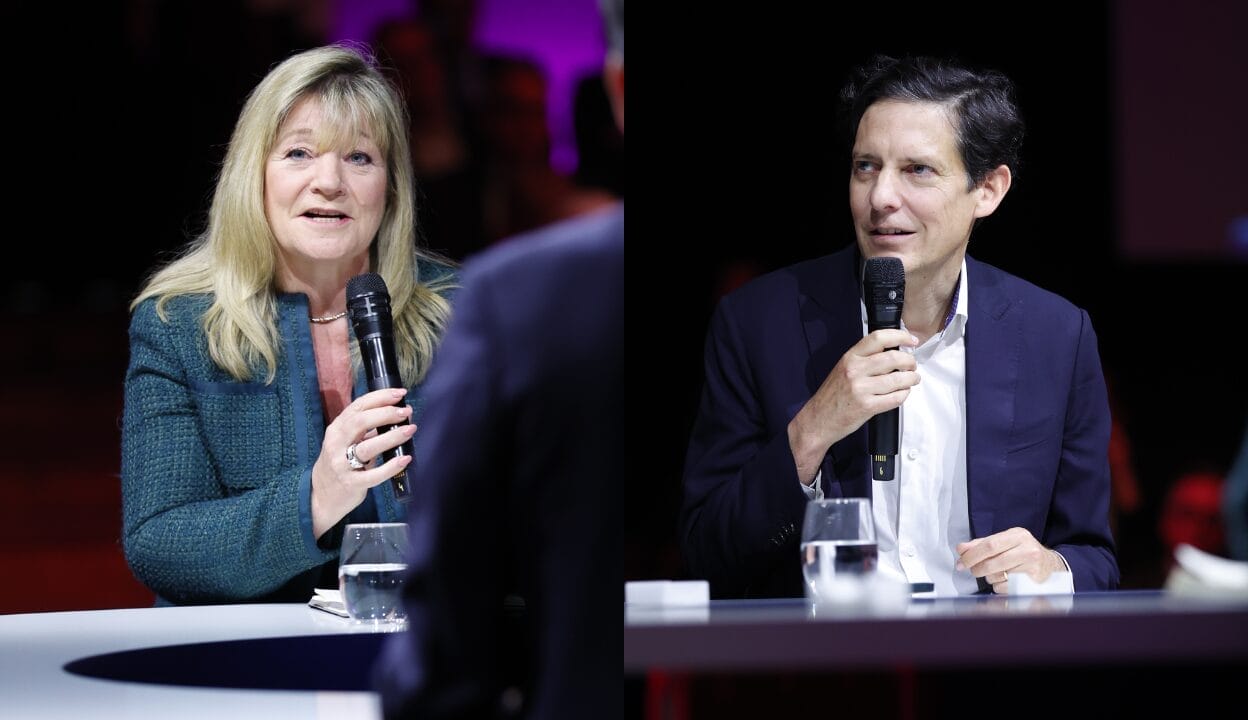
L-R: Kay Swinburne and Fred Tardy. Photo: Amundi on X

Financial services leaders need to step up in their understanding and application of AI, according to chief executive of Amundi Technology Ben Lucas, or risk being left behind.

Speaking at the Amundi World Investment Forum in Paris, Lucas said that the “opportunity is incredible, significant and immediate” but not enough financial services leaders were embracing AI.

“Your job will not be replaced by AI but it will be replaced by someone using AI,” he said. “At a company level your company won’t be replaced by AI but it will be replaced by companies that are using AI in an effective way. This needs to be embraced at a senior level, this is not someone else’s problem.”

Lucas said the financial services industry had done the hard work, including moving to the cloud, but needed to be “more bold and be doing more”.

“When you look beyond efficiency and look at effectiveness we think the upside could be exponential,” he told the 600+ crowd.

“We are not being bold enough and it is going to happen quicker than we think. We all need to embrace this, leadership all the way through the firm. Ultimately the biggest risk is doing nothing,” he said.

Sponsored Content

Also speaking at the event was Frederic Tardy, the head of financial services at Microsoft France, who said he had observed a lag in financial services use of AI.

“The challenge is how quickly you can learn gen AI, how you scale it, and that everyone in the company is learning it and grabbing it,” he said. “Senior execs need to be good at tech and be good at financial services.”

He urged executives to focus on getting the right team which means not just a lead engineer but also training the rest of the team.

“There needs to be practice. Senior leaders are speaking about AI but how many are using it every day? Ask yourself are you learning gen AI? Are you using it?”

Member of the House of Lords, Kay Swinburne, said financial services was uniquely positioned because it was already a highly regulated industry that was used to introducing new technology systems.

“We are in a good position where we can press the acceleration button in financial services,” she said, adding regulators also need to upskill.

“You need to view this as an area where you need to collaborate, not just choosing your partner in the sector carefully but you need to partner with your regulator and treat them as an advisor or partner too.”

Amundi’s chief operating officer, Guillaume Lesage, who is also founder of Amundi Technology said he was excited for the opportunities technology presented for the industry.

“AI enables people to concentrate on their core activities and use new data.”

And while there are risks, including ethics, transparency and cyber security, Lesage said good governance and security infrastructure are the antidote.

“This is going extremely fast and every month there is a new breakthrough. We are in a paradigm where it is risky to be too cautious,” he told the delegates.

Amundi has created an innovative hub with AI scientists embedded in the company to “create real business cases”, he said.

The firm’s own solution, the ALTO platform, now has more than 50 asset managers and €2.5 trillion on its platform.

Amundi is clearly positioning itself as a technology partner alongside its investment capabilities with Amundi Technology launched as a standalone business line in 2021 on the back of the internal front-to-back capabilities and skills, and the firm implementing software and transforming operational models as a result of its many mergers including Pioneer and Sabadell in Spain.

“We have been a partner on investment management for a long time now, we will be a partner for clients on technology,” Lesage said.

Lesage advised there were three key elements to success in technology: invest the right way; invest in people and bet on the right partners.

“Investment needs to be the right way, and not just everything and big investments everywhere. Invest in people. Success in innovation is not about budget it’s about having good people, entrepreneurs that take risks and are innovative. And bet on the right partners that will be there for a long time and will be in a dance.”

Amanda White was a guest of Amundi at the World Investment Forum.

Leave a Comment

Pension funds confront the question of who owns AI

Pension funds confront the question of who owns AI

As the use of AI within asset owners evolves, organisations are grappling with the governance question of where the strategy and accountability sit. Darcy Song looks at the treatment of AI organisationally within a number of high-profile funds, including OTPP, AustralianSuper, CPP and Norges Bank.

Sort content by

IMCO plots private, inhouse future

The C$60 billion ($48 billion) Investment Management Corporation of Ontario, the latest kid on the block in Canada’s pension scene, is planning its asset allocation 2.0, which will involve more private and direct investments, more internalisation and lower costs. Amanda White spoke to chief executive Bert Clark and chief investment officer Jean Michel.

PennPSERS reports carried interest

PennPSERS has announced it pays its private equity GPs about 20 per cent of investment profits. The reveal from the $56.7 billion public pension fund, which came after a laborious process involving 500 staff hours, expands on its commitment to transparency.

Alaska keeps C-suite interviews public

The $64.9 billion Alaska Permanent Fund’s new CIO interviewed for the role while the public watched and listened. A history of transparency at APF defies sovereign funds’ reputation for secrecy.

Quality before quantity for AP1

In a world where it’s difficult to find asset managers that regularly beat the market, Swedish pension fund AP1 looks for managers by evaluating people, process and culture first. The head of external asset management, Majdi Chammas explains.

Cbus benchmarks managers on climate risk

The $32.5 billion Australian superannuation fund has set emissions targets for portfolios and incorporated TCFD disclosure rules as it makes climate risk management a factor in awarding mandates.

AI to transform GPIF manager selection

The $1.4 trillion Japanese fund will use deep-learning technology to monitor and evaluate the styles and processes of managers more effectively and pressure them to adopt high-tech tools.

Previous



