
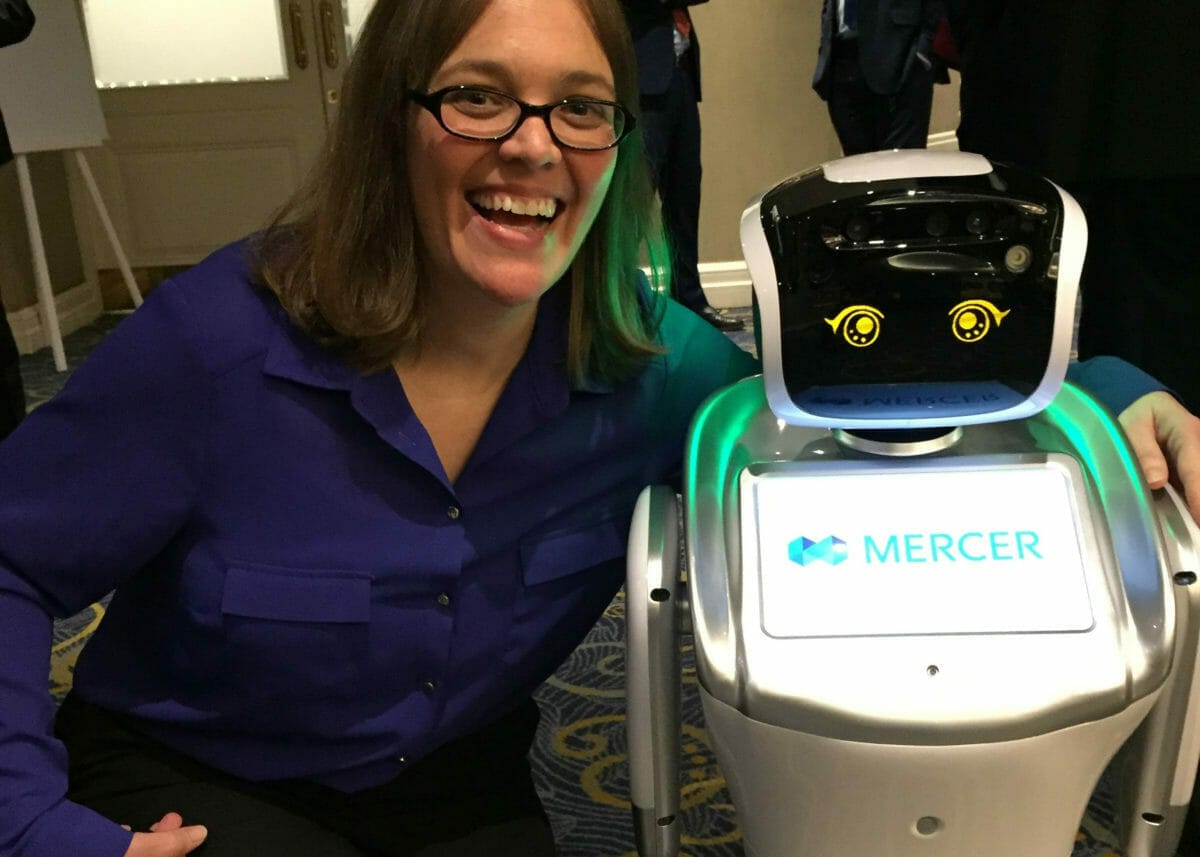

Our lives are touched and influenced by technology daily. And no matter where you get your news from, there is discussion around the jobs that robots and automation will displace. While we might like to think the investment industry is different, reports tell us that 40 per cent of all hedge funds launched in 2015 use artificial intelligence for investment decision-making. Is the role of the human investment decision-maker safe?
First, we are not yet in a world where characters from films such as Terminatoror I, Robotroam the streets or occupy offices. Instead, sophisticated as it is, AI has reached only the first two of four levels as defined by Arend Hintze, assistant professor of integrative biology and computer science and engineering at Michigan State University.
Developments in the field have yet to come up with machines that are “other-aware” or “self-aware” (although there might be some portfolio managers that have yet to reach these levels, too!).
Instead, all AI to date simply uses varying degrees of classification of data – from fairly simple to deeply complex with multiple layers.
This does still create significant advantages for technology relative to humans. The volumes of data that exist today challenge our human abilities; in contrast, the speed with which machines can sort through it all and recognise patterns with accuracy and objectivity is their strength.
However, AI also identify meaningless patterns – it fails to distinguish between correlation and causation and cannot (yet) draw insights from classification. In addition, the perfect objectivity of AI ignores human emotions and motives that may be creating the patterns in the first place.
Today, humans and AI maintain relative advantages over each other. Some might choose to respond to our changing environment by ignoring one or the other. We suggest a better way would be to harness the strengths of each, augmenting or empowering human investors so they perform better or more than they could without technology. In discussing this with portfolio managers across the investment industry, by far the most common response was to do just that.
What might this mean for the investment industry? Building on the comments from portfolio managers, we suggest this might result in:
Smaller investment teams, as machines continue to do more of the ‘heavy lifting’ analysis
A shorter investment decision-making period, as investors are provided with detailed analysis faster
Lower market volatility, as information from new data sources flows through to stock prices more quickly and efficiently
A shift in the shape of investment teams, with data scientists becoming more prevalent and age diversity becoming an issue to consider, as older generations bring experience to complement the younger generations’ ready adoption of technology
Fee reductions for clients, as remuneration-heavy teams shrink in size
A bifurcation in the industry between systematic, AI-related strategies and judgmental strategies, specifically in terms of differences in time horizon. AI struggles to construct a reasonable representation of the distant future, and human portfolio managers of judgmental strategies might gain an easy win over machines by taking an increasingly longer-term perspective.
An increased focus on non-quantifiable factors, such as governance, employee wellbeing and relationships with third parties.
What might be an appropriate response for asset owners? We’d suggest not rushing out to replace your portfolio manager with a machine, but there are some questions to be asked to gauge asset manager readiness for the evolution, such as:
What actions they are taking – how is leadership empowering the analysts through technology?
What insights they are developing – to what extent does their approach come into direct competition with AI?
To what extent are they engaging with the human management of companies to bring about positive change?
We believe the future investment industry will be strongest where machines and humans work side by side, each playing to their own strengths for better outcomes for clients.
Suzanne Lubbe is senior researcher within Mercer’s equity boutique, and co-lead researcher for global and EAFE (global ex-US) equity.








Leave a Comment
You must be logged in to post a comment.
Login