
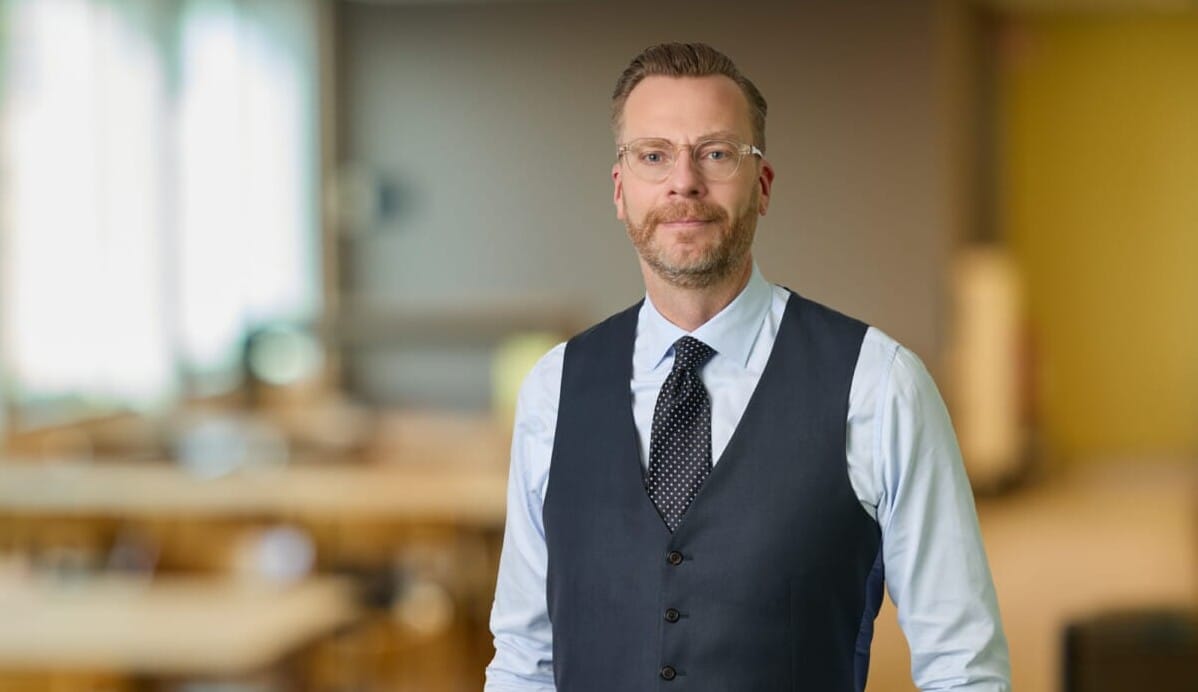

AP3, the SEK534.3 billion ($47.8 billion) Third Swedish National Pension Fund has steadily reduced its exposure to Europe over the last two decades. Only around 11 per cent of the listed equity portfolio – where just over half the fund’s assets sit – is invested in Europe (excluding Sweden) down from over a quarter back in 2006.
The dwindling allocation takes on even more resonance given CIO Jonas Thulin’s overwhelmingly bullish outlook for global equity markets where a strong macro environment that shows no signs of cooling fans AP3’s long-only approach. Yet he says Europe has become less and less important as a source of alpha at AP3, joining a growing number of investors turning away from the continent.
Thulin quotes former Italian prime minister and ECB president Mario Draghi’s recent “bullseye” report to articulate the scale of the problem. Like the fact in 2008 the EU had the same size economy as the US, but this has now shrunk to half. Or that today there is no EU company with a market capitalisation over €100 billion built in the last 50 years unlike the US where all six US companies with a valuation above €1 trillion originated in this period.
Much of the EU’s problem is that it has fallen behind the US in the digital revolution. But it wasn’t always the case. As chief economist at Sweden’s telecoms giant Ericsson in the late 1990s, Thulin had a front row seat at one of many of the European companies in cutting edge R&D and technology at the time. Today only four of the world’s top 50 tech companies are European and the continent doesn’t have any companies competing with US dominance on AI.
“Europe is great at discussion and regulation, but rather poor at actually doing business,” he says. “The equity market is harsh, and when it votes it walks out the door. This has been happening for a long time in Europe.”
Rather than offer seeds of future growth, the green transition embodies Europe’s propensity for talk and regulation over action, he continues. “Europe is the biggest backer of the green economy, but the US invests more than us. We need a green growth agenda in Europe.”
To prove his point, he says AP3 does create alpha in sustainable investment, but only because its active strategy allows it to invest outside Europe’s regulated, dark green Article 9 funds where the bulk of ESG investment flows. “We can do things a bit differently,” he says.
Leaving solutions to European malaise to the likes of Draghi and other policy makers, AP3 is following the money and walking out of the door. It’s even more poignant given Thulin predicts equity market gains of 8 per cent in 2025 and discounts the idea that stretched valuations suggest the market is due a correction.
Valuations, he says, don’t lead equity market performance. Nor does equity risk premia predict returns. Instead, his focus is on the strong macro environment and global momentum. The broad growth metrics AP3 uses to predict equity markets (that have nothing to do with GDP) have rarely been as strong as they are today.
“We hear people discussing soft landings and hard landings. For us it is a question of ‘What landing?’”
active management
Thulin believes active management is the best way to tap today’s abundance of opportunities and runs active strategies across equity, fixed income, FX and derivatives: in corporate credit where the benchmark comprises 9,000 names AP3 owns just 125; elsewhere picking FX serves as both a hedge and as an instrument to create alpha.
One of AP3’s best 2025 investments has come from upping exposure to US banks in “a great trade” that is already “2 per cent up this year.”
He acknowledges that less than a third of active equity asset managers beat the benchmark and passive funds have created a headwind for active managers. But counters that many of these active funds are limited to only investing in one direction, say European small cap, value or growth. AP3’s unconstrained approach to buy whatever it believes in, free from the confines of a particular fund or product type, opens the door to sustained alpha.
“Being unlimited means we have the freedom to invest where we like, and this is a much easier way of doing alpha.”
AP3’s active investment involves short-term tactical adjustments that increase the efficient frontier, he continues. He likens the process to a golfer carefully adjusting their stance before hitting the ball, introducing (short term) adjustments of a centimetre here or there that will have a profound impact (long term) down the fairway.
“If we are successful in the tactical work that we do we can afford to be super long term,” he says.
“People say you can’t predict equity markets, but it is possible. Many investors are shying away from taking big active positions for alpha and focused instead on monitoring risk. I would argue these investors have confused sell side augmentation with the buy side reality.”
The wheels keep spinning
It’s not his only swipe at the asset management community. The sell side – like Europe – risks being left behind the buy side when it come to AI.
In recent weeks AP3 used AI to successfully forecast market movements in the Swedish Krona and US fixed income thanks to a forecasting methodology that accurately predicted the latest CPI figures. It’s just one example of the kind of evolution that throws into question the need for the asset management communities’ cohort of economists and strategists.
Asset managers need to evolve and push their own efficient frontier, he argues. He believes in five years AP3’s investment team will look the same, but their processes and methodology will be vastly different because it will draw on new data points and applications. The team regularly meets new service providers to discuss the latest solutions on how to predict markets.
“Large institutions on the buy side are moving in one direction, but the sell side is struggling to keep up and adjust,” he says. “We have integrated AI, but some of our sell side counterparties have not kept up with us. Investors always want to go to the next level to fine tune and build their conceptual thinking on the economy. Some of our counterparties are doing a great job of being on top of this, but a few are dropping the ball.”
In another example of AP3 forging ahead, the investment team collaborates with local universities. Sometimes as many as 20 students have come into the office to work across the fund. One recent analysis focused on developing how to better predict correlations between rates and equity, opening the door to trading correlations.
“This was impossible five to 10 years ago but it’s not impossible today,” he concludes.







Leave a Comment
You must be logged in to post a comment.
Login