
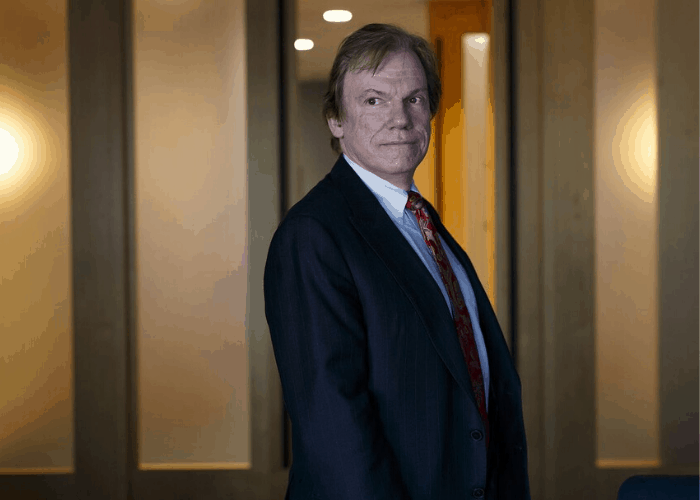

[vc_empty_space height=”10px”][vc_media_type_category el_class=”Article”]Already OPTrust’s portfolio can best be described as resilient, due to its member-driven investment strategy and investment construction that sees the portfolio managed in four separate components. But CIO James Davis, who started his career in October 1987, expects global macro economic changes from this crisis that we have never seen before and he wants to position the portfolio for whatever is around the corner.
James Davis, CIO of the C$22 billion OPTrust started his career in October 1987 and within the first month experienced the “real world of investing” with the crash of 1987. But that experience is nothing compared to the conditions of today, he says.
“In more than 30 years in the industry there is nothing even comparable to the current environment we are operating in now.”
The difference, he says, is that in addition to the market volatility there is the extra challenge of limited visibility into the virus itself, the impact on the economy as well as the individual companies, and the associated policy changes.
“Then add on to that the challenge of everyone working from home. This is an incredible environment and something unlike we have ever experienced. That being said we are holding up really well.”
But more than anything, OPTrust’s portfolio can be described as resilient due to its member-driven investment strategy which is designed to withstand all environments and meet the sole purpose of staying fully funded.
“From an investment perspective we are meeting this challenge head on,” Davis says. “The team is working very well together and we have a very long-term focus so we don’t get too stressed out when we have big drawdown days. We are in a pretty good place as an organisation. When we translate the MDI into investment decision making, our goal is not to earn outsized returns or outperform peers. The sole focus is to keep fully funded,” he says. “Our investment objective is to be able to pay pensions, and we do it by taking as little risk as possible.”
He says this has meant that the portfolio is very risk-centric.
“We stress tested the portfolio under thousands of different macro scenarios and chose the investment mix that reduced the probability that members would have to experience a contribution increase,” he says. “We see periods in those scenarios that show up very sharp drawdowns in equity markets and where correlations go to one. We try to take those things into account in the overall portfolio construction and it has allowed us to weather this environment very well.”
OPTrust has been fully funded for the past 11 years and continues to be fully funded, with “an abundance of liquidity.”
Resilience
From a macro perspective Davis believes there is a paradigm shift underway and the response from governments and central banks dealing with the challenges of the crisis is a game changer.
“We have embarked on a new policy paradigm where innovation is being explored from an economic perspective. The challenges we might face going forward will be different than those from the past,” he adds. “The risk of a policy mistake is greater. The risk of inflation and stagflation is bigger now than two months ago. To assume the type of investment strategy we have had in the past will work is a mistake.”
With regard to resilience, Davis wants to position the fund for whatever is around the corner.
“We don’t know what could cause inflation but it could happen so we need to be prepared,” he says. “In this case we are seeing things unfolding faster than I would have expected. Policy makers are throwing everything at this challenge, we wonder how they will feel about it once it has passed, will they retract some of the measures – that’s a big risk.”
In terms of the shifting global economic environment, Davis is also sharply focussed on the emerging social pressures associated with the crisis.
“Since the 1980s there has been rising income and wealth disparity causing big social risks and the environment is ripe for some big political changes as a result of that. How will policy makers respond? We are coming into the US election, imagine if we have equity markets at new highs and unemployment at 15 per cent, how will people feel about that and vote. We are trying to make sense of the risks associated with the policy perspective and make sure we are positioned accordingly,” he says. “We feel confident our portfolio is resilient. For everyone managing a pension plan, stagflation will be a hard position to manage. We are well funded but for others it could be devastating.”
Portfolio construction in four components
The OPTrust portfolio is divided into four separate components: return seeking; risk mitigating; liability hedging; and a funding portfolio.
Return seeking and liability hedging are the two largest components, with the latter aimed at mitigating interest rate sensitivity.
A lot of the emphasis of the portfolio construction is in the risk mitigation portfolio which Davis describes as “performing spectacularly” with a return of above 30 per cent year to date.
“This is a very diversified portfolio of assets we believe will help in deflationary times and somewhat in inflationary and stagflationary environments,” he says. It’s made up of real return bonds, TIPS, US Treasuries, and longer duration assets as well as trend following strategies, such as CTAs, that do well in a tail risk environment. It’s also got allocations to foreign currency including Yen, Swiss Francs as well as gold. But Davis is quick to point out this portfolio is not trying to time the market.
“We don’t try to manage it in a market timing sense. We see it as a critical part of the overall portfolio that allows for cost effective risk mitigation – we can cut off the left-hand tail without impacting longer-term expected returns,” he says. “In that sense we want to have some core exposure to each of those strategies.”
The team is working on some further systematic strategies that will add to the dynamic nature of this portion of the portfolio.
“Strategies like trend following are systematic so will naturally move you when equity markets are under duress. We are building more systematic strategies,” he says. “We will adjust allocations to these when we think it is appropriate, there is an element of discretion around that. We are not trying to add returns, just cut off the left tail.”
Return seeking portfolio
The fund’s approach to return seeking is different to many other investors. In building the MDI program, diversification according to risk factor exposures was a priority, which meant reducing the exposure to listed equities.
“When I came on board about 80 per cent of the portfolio risk was from equity risk factor,” Davis, who was appointed CIO in 2016. says. “This is not uncommon but we made a deliberate decision to try to reduce that and it is around 40-50 per cent now.”
Equities, including both private and public exposures, now only make up about 20-25 per cent.
“This was a deliberate decision, not made on valuations, but to right side our factor risk exposures,” he says.
In place of equities the fund invested in alternative risk premia, added to its overall hedge fund exposure and increased its allocation to direct investing in real estate and infrastructure. The fund has an internal direct team and has also built up the trend following capability inhouse, and it runs all the bonds, some credit and passive equities inhouse.
“Our asset class teams are thinking a lot about the changing global economy. In real estate we are always thinking about how the world is evolving and how people’s preferences are changing in the retail and office space. We had a relatively low allocation to retail, because we saw the trend that it wouldn’t be positive for shopping malls as an example. That’s not new for us. We have also been thinking about what this current environment means for challenges in real estate in years to come. Davis argues that it is not clear cut there will be less demand for commercial real estate and just because everyone is working from home now doesn’t mean they will continue to. “We have experienced it ourselves, people like to be social. After this people might need more space not less, it’s not clear cut there will be less demand for commercial real estate.”
Rebalancing
While Davis says the fund is disciplined around rebalancing he is also mindful there are opportunities in dislocated markets.
“The current environment necessitates a degree of discretion in rebalancing. Opportunities present themselves in this type of environment. We don’t want to be forced sellers or buyers, and want to take advantage of the ample liquidity we have. We tend to stand back and say we have rebalancing guidelines telling us what to do, and then we have a conversation about the opportunities.”
The CIO has taken advantage of the market turmoil to add to credit and equity exposures, but is really earmarking the ample liquidity it has for private market activity.
“Great opportunities are going to emerge there. We don’t have the visibility we’d like to have, there are not a lot of transactions going on in that space now. But we know when you come out of these types of environments that’s where the opportunities will show themselves. We can prepare ourselves to take advantage of those once they present themselves, we don’t fill buckets, it has to be where the best opportunities are.”
Climate change
Davis says a few months ago climate change was front and centre in all investment conversations. While he says that won’t change over the long run, right now the focus is dealing with the immediate challenge.
“This type of environment shows you how vulnerable the world is and the necessity of trying to take those types of risks into account. We are very long-term investors so we are interested in looking at the future and what types of risks we might be exposed to. Climate change continues to be important to us and a centre point of our overall investment strategy.”
Davis acknowledges there are a lot of risks and opportunities in the current environment and wants to take advantage of that.
“Humanity can use ingenuity to solve problems. We think there will be great opportunities investing in those areas that are trying to solve big major problems.”
OPTrust has created a small team focused on investments at the intersection of innovation and sustainability and has hired Alison Loat, formerly of FCLTGlobal, to look at that.
“We are already big investors in renewables and that will always be part of the investment strategy. Here we are looking at things beyond that, that have the potential through technology to significantly change the landscape. Our members want to retire into a safe world, that is how we view our overall mandate.”







Leave a Comment
You must be logged in to post a comment.
Login