
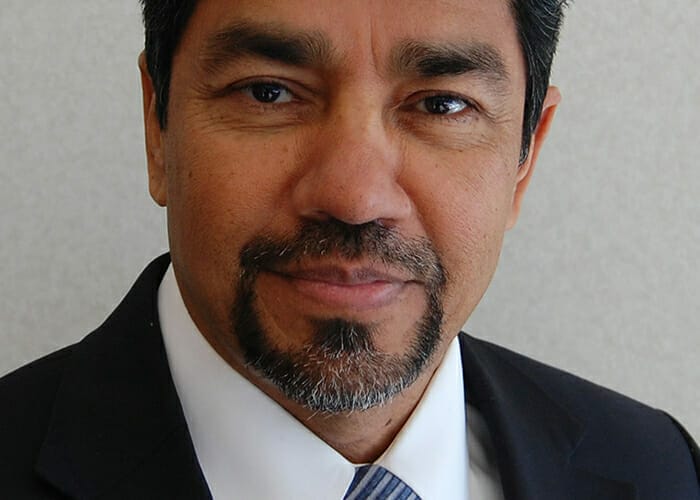

An overweight position in real assets and private equity, and an underweight to equities and bonds, positioned the Ohio School Employees Retirement System for success in the past year where it outperformed its benchmark by more than 3 per cent. But CIO Farouki Majeed is now even more convinced a stagflationary environment is likely and is positioning the fund accordingly.
In a year where equities market returns challenged public pension funds, the Ohio School Employees Retirement System whose investments are led by chief investment officer, Farouki Majeed, returned -0.49 per cent.
Surviving the year so well was due to the fund’s underweight allocation, by a combined 10 per cent, to equities and bonds. The fund has been underweight bonds for about 18 months, according to Majeed, and sits at the bottom of its allocation range in that asset class, about 7 per cent underweight.
A combined allocation of 32 per cent to real estate, infrastructure and private equity were the main drivers of performance and Farouki says he’ll look to add even more investments in infrastructure in particular, as the environment continues to baffle.
“We were protected quite a bit on the downside due to our significant allocations to real assets and private equity,” he says. “One of the things I was instrumental in doing here was getting rid of hedge funds and moving those allocations into real assets, as we needed income-oriented, stable returns. That has really helped us out in the past year.”
For some time Majeed has been concerned about the investment environment, back in May 2021 the growing debt to GDP ratio was driving his concerns and the decision to pull back from fixed income. At that time his concerns about growth and valuations meant expectations for double or even single digit returns were being questioned.
“We are in unfamiliar territory. I was more convinced of our fixed income position, that was an easier, more robust sort of a call to be underweight fixed income,” he says. “At the same time rising rates always causes equities to be re-rated because of a higher discount rate and that has happened.”
He says the fund was particularly underweight in developed equities, especially in Europe, where he thought the chance of a recession was higher than the US.
Stagflation more likely
Now he thinks that the likelihood of a stagflationary environment is increasing and is worried about how to position assets for that scenario.
“Stagflation is more likely now and it’s a concern,” he says “Inflation can come down from 9.1 per cent, but even if it stays around 5-7 per cent that is still pretty high compared to the Fed’s target of 2 per cent. We think growth will be quite slow. Even if we don’t enter a deep recession, with GPD growth at 0.5 per cent in 2023 and inflation at say 6 per cent that is a stagflationary environment, and then there’s nowhere to hide.”
Majeed says real assets will continue to be a focus for investments in that environment, and government bonds “might be a place to be” if the Fed backs off the interest rate hiking cycle.
The fund currently has 21 per cent in real assets and Majeed sees that nudging up to 23 per cent, with infrastructure in particular likely to increase. Real assets contributed a 24.5 per cent return in the past year with a 10-year return of 11 per cent. The private equity one-year return was 34.35 per cent.
Real estate currently dominates the real asset allocation, with a bias to US industrials and multi family, with infrastructure only making up about 5 per cent of the fund.
The team has also looked at other real assets including timberland and farmland but decided the prices were not as attractive as real estate.
Ohio’s bond target, which includes all types of credit, is 19 per cent and it currently sits at 12.5 per cent. Majeed says he may look to close that gap if the 10-year treasury rate gets above 3.5 per cent.
Separately the fund has 5 per cent allocated to private credit and Majeed says that asset class “might be another place to be in this environment”.
The equities will continue to be underweight for some time, and the correlation issues between equities and bonds is an ongoing concern.
“That is the biggest thing that has caused our portfolios everywhere to experience these negative returns,” he says pointing to credit and high yield being very correlated to equities. “If we were at target we would be 65 per cent in our bonds and equities but together we were about 10 per cent below so that helped us. Our portfolio is more diversified than most of our peers because of high allocation to private equity, private credit and real assets.”
All of the fund’s private assets are externally managed with about 25 GPs in private equity mostly focused on middle market and small market buyouts. In real assets the fund works with about 20 partners.








Leave a Comment
You must be logged in to post a comment.
Login