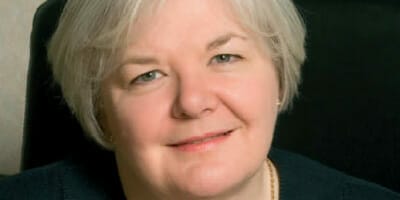

Penny Green: London’s lady of the long term

When Penny Green joined the Superannuation Arrangements of the University of London (SAUL) as chief executive in 1998, the multi-employer defined benefit scheme had £790 million ($1.27 billion) assets under management and two asset managers. Sixteen years later the pooled fund now manages assets for 49 employers in higher education institutions including the University of London, but also others such as Imperial College and the University of Kent. It has $3.2 billion under management and mandates with 23 managers. Proud of the link between SAUL’s steady growth and her longevity at the helm, it’s no surprise that Green’s investment strategy is also focused on the long term. In an approach which challenges recent criticism that many UK funds are too focused on quarterly capitalism, Green is diversifying the fund and reducing its equity allocation despite SAUL’s buoyant 16.7 per cent return for the year ending March 2013 being attributable to roaring equity markets. “In the last financial year equities have done best, but we never make decisions on an annual basis and quarterly numbers don’t mean anything to us – they are just noise. We are only interested in the long term.”

Improving status

In the last year, strategy at SAUL has concentrated on whittling down the deficit and improving the fund’s 95-per-cent funded status. As of June 2012, all new members have benefits calculated over a career-average basis rather than on a final-salary basis. SAUL has also introduced a hedging strategy whereby 20 per cent of the value of the liabilities are now in a liability-driven investment (LDI) portfolio. Run by Legal and General, the portfolio aims to reduce the downside risk attached to falls in long-term bond yields and any increases in inflation, explains Green. “Talking to employers and unions, we became aware that they were very sensitive to downside volatility.” The LDI portfolio is biased in favour of inflation, which Green “sees rising because there is so much money in the system”, a particular worry since the scheme’s liabilities are fully index-linked. Legal and General increase the hedging on a quarterly basis, which is also supplemented by funding triggers. When hit, the triggers prompt additional inflation and interest rate hedging. They have already been hit twice, says Green. “We would like to get to having 100 per cent of our liabilities hedged and be 100 per cent funded.” SAUL’s assets are split between a 19 per cent allocation to the LDI portfolio, 77.4 per cent in a non-LDI portfolio and 3.6 per cent in cash.

Synthetic equity

In another development, SAUL has sold off its holdings in index-tracking funds covering the UK and US markets, as well as one actively managed equity allocation, investing instead in a synthetic equity portfolio. By investing in equity market futures rather than the underlying companies, Green says she has freed up money to invest elsewhere and built a more flexible portfolio. “If you buy the futures, you get the same performance as an index fund but it takes away the emotion from decision-making. If we want to cut our equity exposure, we can do so quickly.” The downside, she says, is that it introduces more leverage into the portfolio and SAUL has had to invest in a certain amount of expertise to monitor and manage its derivative positions in house.

Some of the cash freed from the equity allocation has gone towards a new risk parity portfolio, accounting for 5 per cent of assets under management – some $128 million of the non-LDI portfolio. First Quadrant was appointed in December last year to invest across equities, bonds and commodities in the strategy, which ensures
risk comes equally from each asset class. It means assets with lower risk, such as bonds, form a larger part of the risk parity portfolio than high risk ones such as equities. In its mandate, SAUL targets equity-like returns but consistent, bond-like stability. “We will grow this allocation if we have the free cash, but right now we are not cash-flow positive.

Protecting capital value

SAUL’s bond portfolio comprises a tiny allocation to fixed interest and index-linked gilts, but a larger allocation to corporate debt accounting for 18 per cent of the non-LDI portfolio. Selling out of passive equities has now allowed the scheme to build its bond exposure developing a new mandate run by Payden and Rygel to include sub-investment-grade credit for the first time. “We looked at our total assets under management and realised there was no exposure to emerging market debt or high yield. We wanted this exposure, but at the same time it makes us nervous because of the equity-like volatility.” The solution was an absolute return mandate in an unconstrained strategy that allows the manager to switch out of high yield to emerging markets or sovereign debt as they see fit. “This absolute return mandate protects against downside volatility. We wanted to put something in place to protect our capital value,” she says.

SAUL was an early investor in private equity but withdrew from the asset class in the late 80s. In 2007 the Trustees decided to build up the portfolio again with allocations to funds of funds run by Morgan Stanley in a broader mixed asset mandate and, more recently, Partners Group. The allocation to Partners includes a direct investment, although Green prefers the funds-of-funds route. “We have no capacity internally; direct investment requires more expertise than we have.”

Sponsored Content

The recent changes in allocation mean the non-LDI portfolio is now split between a 0.3 per cent allocation to fixed interest and index-linked gilts, a 1.3 per cent tactical allocation, 5.1 per cent to long-lease property, 18 per cent to corporate debt, 24.5 per cent to conventional equity including the synthetic allocation and emerging markets, 27.9 per cent to an equity-based absolute return portfolio and 17.4 per cent to a non-equity based absolute return portfolio. Green hopes the fund will grow with more employers, although she is cautious here too: “We do want more employers, but we are not open to anybody. Our existing members are our priority.”

SAUL doesn’t run any assets internally, although Green’s internal team does manage the cash positions and monitor the fund’s managers – another aspect of the job she views only in the long term. “The average tenure of our managers is about five years. Our longest serving manager has been with us for over 13.”

Leave a Comment

Finland’s Elo: Larger equity allocations promise new media scrutiny

Finland’s Elo: Larger equity allocations promise new media scrutiny

As Finland's pension funds prepare to increase their equity allocations to unprecedented levels compared to global peers, they must also navigate a new and unfamiliar risk. Elo's chief investment officer Jonna Ryhänen explains the fund's investment approach going forward and how it will manage stakeholder and media scrutiny as they react to swinging volatility and returns.

Sort content by

NBIM prepares to up voting transparency

The world’s largest sovereign wealth fund says that voting is one of the most important tools to safeguard the fund's assets. Ahead of the AGM season getting underway, NBIM - which is the largest single owner of global stock markets - plans to publish its voting decisions five days ahead of corporate meetings in a bid to increase transparency.

Old Mutual SuperFund on COVID and ESG

Hugh Hacking from South Africa's Old Mutual SuperFund refects on the impact of the pandemic on the fund and the importance of ESG integration in its externally managed portfolio.

BpfBOUW: The importance of hedge funds

Hedge funds are getting a bad press again, but for Dutch fund BpfBOUW the latest skirmish simply underscores their importance in a portfolio as Erik Hulshof, trustee and chair of the investment committee explains.

CalSTRS takes on ExxonMobil

The $255 billion Californian pension fund, CalSTRS, has embarked on a new era of “activist stewardship” which will see it take on large companies such as Exxon Mobil which have not responded to shareholder engagement.

Behind OTPP’s net zero 2050 plan

Ontario Teachers' has launched its plan to reach net-zero portfolio emissions by 2050, the culmination of a decade of work by the fund in addressing climate change. Amanda White looks at the fund’s climate journey, which has significant lessons for other funds looking to move to net zero.

CalPERS: Lessons from CIO departure

The CalPERS board is considering whether to require a new CIO to transfer all of their personal stock holdings into a blind trust while they are a CalPERS' employee. The move follows the resignation of Ben Meng as CIO last year after an ethics investigation related to some of his personal investments.

Previous



