
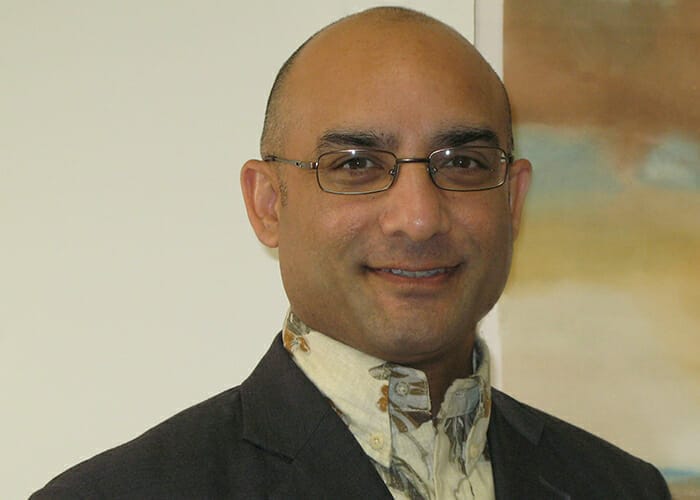

“It looks like a beautiful day!” greets Vijoy Chattergy, chief investment officer of the $14.1 billion Employees’ Retirement System of the State of Hawaii, HIERS, speaking from his office in Honolulu. Chattergy is in the final stages of constructing a new risk-based asset allocation at the fund.
It’s the culmination of a process of reform and regeneration to build a more robust portfolio that began after the GFC, and hastened by the alarming increase in the fund’s unfunded liabilities.
“If you go back 15 years, HIERS had a strong funding status but it has deteriorated to where we are today at 62 per cent. We realised that what we were doing was not going to take us forward. It was a bit of a wake-up call,” he recalls.
Chattergy has led the overhaul at the fund since he was appointed chief investment officer in 2012, having initially joined as an investment specialist. Previous roles included working for the Federal Reserve Bank of New York, and recommending investments in a fund of hedge funds for Japanese asset manager SPARX Group in Tokyo and Hong Kong.
Returning to live and work in Hawaii after two decades away was always his dream, but the challenge of getting the state’s largest pension fund back in the black is the day-to-day reality.
“Lots of my family and friends are members of the plan,” he says. “Mum and Dad are retired professors. My brother is a public sector teacher. If the fund has a bad quarter we have a difficult Sunday dinner!” he says, only half joking.
The new risk-based asset allocation divides the portfolio into a 76 per cent allocation to broad growth, 12 per cent to principle protection, 5 per cent to real return and a 7 per cent allocation to real estate.
Broad growth includes US and global equity, private equity – targeting 10 per cent of the broad growth bucket – and covered calls, first introduced as an asset class in 2011; a less volatile equity exposure comes through credit strategies.
Although broad growth currently accounts for three quarters of the portfolio, this will fall to 63 per cent by 2020.
“We are actually re-making the equity portfolio under new policy guidelines. We’ve completed the passive manager, options-based equity manager, and low volatility global equity selections; and are now finalizing a global equity large/mid-cap and small-cap searches.” The real return portfolio comprises inflation-hedging allocations to timber, agriculture, infrastructure and TIPS.
Crisis Risk Offset allocation
As the outright allocation to long-only equity managers falls, the slack will in part be taken up by a new Crisis Risk Offset (CRO) allocation expected to rise from 10 per cent at the end of 2016, to 20 per cent of the portfolio by 2020.
Here the allocation will be split between tilts to systemic trend-following strategies, alternative risk premia and long duration treasury bonds.
It’s a strategy especially designed to counter equity risk, resulting in a more stable return pattern for the overall portfolio over time. Its crisis-period focus means returns from the allocation may be challenged during non-crisis periods, but Chattergy is convinced of the benefits.
“The CRO is designed to be a line of defence in a major market crisis and should absorb prolonged shocks,” he says. “Success may hinge on our ability to maintain a disciplined approach. When equity markets go up in a bull market we do not want to abandon these principles, as we lag our peers and market indexes. If you believe that periodically there will be crisis events, this approach can work through a full cycle. This is the way we now see the world.” Chattergy plans to go to the market in early summer with a Crisis Risk Offset search. “We need managers that are experienced and knowledgeable for the allocation.”
The readjustments and turnover in the portfolio has resulted in a bidding process that is allowing HIERS to renegotiate better fees with its managers.
“We are substantially bringing down our costs,” he says. HIERS, which has grown under Chattergy’s leadership to have five investment professionals, has “no desire” to build the infrastructure for “an investment shop” at this time.
However, the fund may build an in house capability to better participate in private market investments.
“We will seek opportunities in the private market where we can outperform public markets,” he says.
A bigger in-house team would potentially allow the fund to be more responsive to co-investment opportunities and one off projects.
Chattergy hopes to have increased assets under management to around $20 billion by 2020. Long-term his aim is that the fund is fully funded by the mid-2040s, estimating that by then HEIRS will have $45 billion assets under management.









Leave a Comment
You must be logged in to post a comment.
Login