
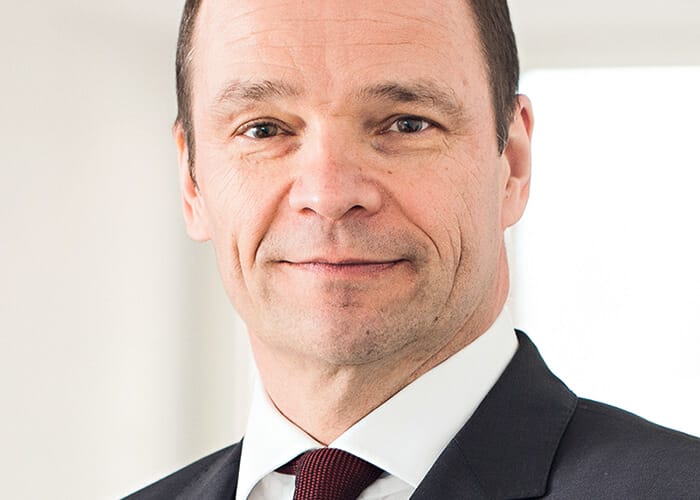

Investment strategy at the German pension fund Ärzte-versorgung Westfalen-Lippe, ÄVWL, the €12.3 billion ($13.7 billion) fund for doctors and their dependants, is shaped around long-term, anti-cyclical investments concentrated in real estate, infrastructure and asset-backed lending to corporates.
Based in Germany’s northern city of Münster, only 10 per cent of the fund is in listed equity. It is not only the stable cash flows associated with these assets that the fund favours; they also provide shelter from market events – none more so than its own struggling Eurozone.
More than 20 per cent of the fund’s assets are invested in real estate in an allocation that has led returns over the years.
“Real estate has always represented a cornerstone of the ÄVWL’s total investment strategy,” explains Markus Altenhoff, director of capital investments.
“Our approach within real estate is to diversify across the whole risk-return-spectrum and to cover the entire value chain. A fundamental principle of the strategy is to also identify real estate opportunities in new regions, trends, and niche segments in which we can – sometimes anti-cyclically – play a pioneering role.”
Important recent investments include the fund’s stake in a three-building office complex in Washington, D.C. of which 89 per cent of the space is leased to AA-rated federal agencies, Altenhoff explains.
“This is about an A-class asset that offers credit cash flows with incremental yield opportunities; ideal characteristics of a long-term wealth preservation tool. The rent roll will also offer a significant yield premium over the U.S. Government credit.” ÄVWL’s in-house real estate team stuck by their anti-cyclical ethos when they divested from some of the fund’s trophy London real estate holdings in response to overheating in that market; a strategy that has also fortified the portfolio from any Brexit tail-wind.
Now, growing competition for real estate assets and tougher market conditions has made value added a key theme.
“Here we identify under-valued and fairly valued markets with a substantial appreciation potential over the investment period. A stable basis of at least 70 per cent in core and core plus investments guarantees steady and sustainable cash flows,” Altenhoff says.
ÄVWL is also busy building its allocation to infrastructure with the unlisted allocation now “a significant part of the portfolio” accounting for around 15 per cent of total assets and including asset-based investment and project financing, often as part of a consortium, and a growing commitment to renewable energy.
However, it is noteworthy that the fund does not see infrastructure as an asset class in its own right. Rather its sees infrastructure investment across the portfolio in loans and mortgages, fixed income and alternatives; projects with system relevance, or those involving a certain type of regulation, explains Lutz Horstick, head of securities and loans.
“When we speak about ‘long-term’ investments, we mean ones that have a time horizon of at least 10 to 20 years. If we believe in the long-term profitability of an asset, we intentionally accept a certain degree of volatility and price fluctuations. We are ready to enter investments with more complex structures in order to profit from extra yields in terms of illiquidity premiums. This often includes arranging consortia,” he says.
Seizing opportunity
One consequence of the fund’s increased exposure to infrastructure has been a jump in US dollar exposure.
“We have sought access in particular to the US dollar credit markets, important because infrastructure and asset-based investments are to a large extent US dollar denominated. We have moved away from full currency hedging and used the US dollar as an asset class in its own right. In addition, we also keep a high share of hard currency emerging market debt. As a consequence, the US dollar exposure at the end of August 2016 was about 12 per cent of assets under management.”
It has given rise to the other reason the fund is immune to structural weakness in the Eurozone post Brexit: “ÄVWL is a net gainer of the Brexit decision so far and has profited from the US dollar appreciation which has, to a large extent, overcompensated the depreciation of a relatively moderate sterling exposure,” Horstick says.
Along with financing infrastructure, asset based lending with an anti-cyclical bent includes the fund financing ships and aircraft, seizing opportunity in two niche segments where traditional bank backers have fled the market.
“In the asset-based space we saw a widening of the spreads as a consequence of banks leaving the sector, especially in the aviation and shipping sector. ÄVWL invested a three-digit-million-Euro-amount in this sector during the last three years.”
ÄVWL manages about 60 per cent of its assets internally.
“We aim to have internal know-how for all relevant asset classes. External managers help us in asset classes where it is not worth building in depth in-house expertise and we also use external managers in areas where we have no direct access to the market or where we are regionally not present, like the US and emerging markets. We use consultants only in special niches or if we are entering a new area or asset class and do not have the necessary experience.”
The fund uses dedicated managers in private equity because it doesn’t have the resources for direct investments.
“At this point in time we are focusing on manager selection in private equity as this is the main driver for the performance within this asset class.”
Active management also lies at the heart of strategy.
“We strongly believe that active management adds value. To us it is very important to select the best strategy which fits our requirements. We see this as an essential driver for the performance of our fund,” Horstick says.








Leave a Comment
You must be logged in to post a comment.
Login