
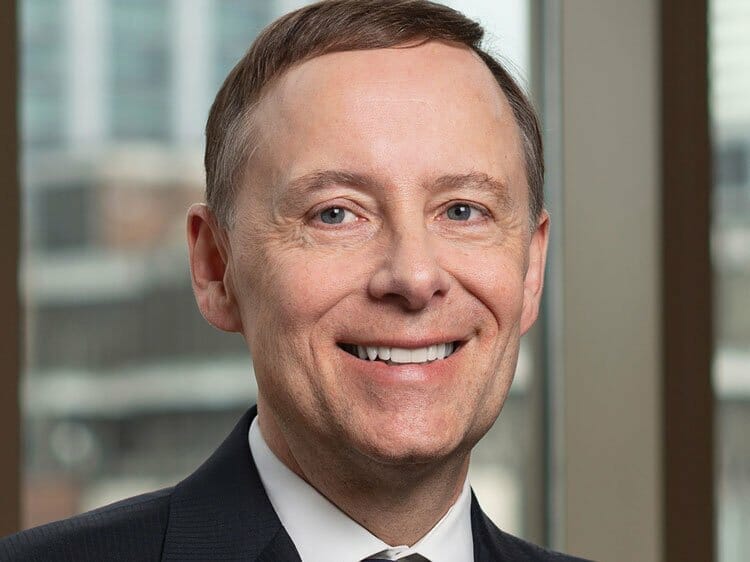

Investors are entering challenging return environment underscored by levels of geopolitical risk unprecedented in a 30-year career, says Jeff Wendling, outgoing president and chief executive of Canada’s $113 billion Healthcare of Ontario Pension Plan (HOOPP).
Investors have been supported by a benign geopolitical environment since the Berlin Wall fell in 1989 and China came into the global economy. But Wendling said this has now been replaced by wars in the Middle East, Ukraine and China’s growing show of force around Taiwan.
Indeed, as two separate geopolitical blocs emerge, Wendling questions if investors will be able to get their money out of China long-term.
“Is China even investable for an investor like us?” he questions, speaking to Top1000funds.com following the announcement of his retirement from HOOPP next year.
HOOPP’s exposure to China has fallen over time and is currently only 1 per cent. Investment strategy has always been titled much more to developed markets in Canada – where HOOPP’s $60 billion portfolio includes large real estate and fixed income portfolios – the US and Europe. The pension fund also has a 7 per cent exposure to emerging markets in Asia.
Ideally HOOPP would be invested in China, but he says the fund’s healthy long-term returns endorse a strategy that has never invested very much in the country.
“I think we can do well regardless,” he says.
Wendling’s observations of the investment climate carry particular resonance given his weight of experience – something he believes there is no subsidy for. He joined HOOPP in 1998 and has experience of the tech bubble and the subsequent wreck and was head of public equities during the GFC.
He recalls this period as the most challenging in his career. Mostly because the viability of public equities as an asset class for long term investors seemed to disappear before his eyes.
“That was a very hairy time,” he recalls. “That was a time, literally, when some folks were questioning the usefulness or the appropriateness of public equities as an asset class for pension funds.”
The experiences engrained a set of beliefs that have gone on to shape his career: investment is a cycle; nothing goes straight down (or up) for ever and the darkest points in a cycle also offer the greatest opportunities.
In the depths of the GFC when the S&P 500 was down 60 per cent, HOOPP took on considerable equity risk at unprecedented valuations in a strategy repeated during Covid when the fund snapped up Canadian banks at rock bottom valuations.
“We had Canadian banks selling off 20-30 per cent, trading at 6-7-8 per cent yields. We’re long-term investors and we often invest in those extreme market environments where the opportunities are really exceptional. It doesn’t actually mean you’re going to do well right away. You’ve got to be prepared to hold those things.”
Markets are generally efficient, and investors should be fully invested most of the time, he continues. But there are key moments, every decade or so, when markets become inefficient and characterised by extreme optimism or pessimism. This is when the opportunity for active management and long term investors really shines.
In it for the long term
Holding positions for the long-term has always been the most compelling corner of the investment world for Wendling. He was put off by the marketing component of asset management and believes it’s difficult to create long-term value from trading.
Pension fund investment was a natural fit, particularly as he was drawn to the purpose of helping create retirement security for healthcare workers and a conviction in the role of defined benefit funds in creating that security where around 75-80 per cent of pension payments come from investment returns.
Long term investors are ideally positioned to benefit from the once in a decade dislocation that markets typically experience, he continues. Only they have the ability to buy at these critical junctures because they are backstopped by patient approach that will allow the asset to recover over time without an eye on quarterly numbers.
“If I’m focused on a short-term performance, it’s got to work basically right away. That doesn’t help you make good decisions. If you’re focused on short-term performance, you’re almost trying to figure out how to call the bottom, which is really impossible to do. We’re just trying to figure out where we can make good investments and make good returns for the long term.”
He goes back to Canadian bank stocks bought during COVID to illustrate the point. The team believed it was a great price, and they would be great investments over the long term. They didn’t know when they would recover but they were prepared to hold them. As it turned out, they immediately went up when the stimulus came out.
He says long term investors don’t take a view on whether the market has reached its top or bottom. During the GFC when the S&P was sharply lower the team didn’t know if it was going to fall further or start to climb back up. But they were convinced it was a good time to buy.
Wendling says the internal and external search for his replacement is well under way.
“We’ve got some very strong folks here. But for something like the CEO, the organization is going to do a wide search, both internal and external,” he says.
The fact that he has been able to fulfil so many of his career ambitions at one organization by opportunities to rise up the ranks is a source of enduring gratitude.








Leave a Comment
You must be logged in to post a comment.
Login