
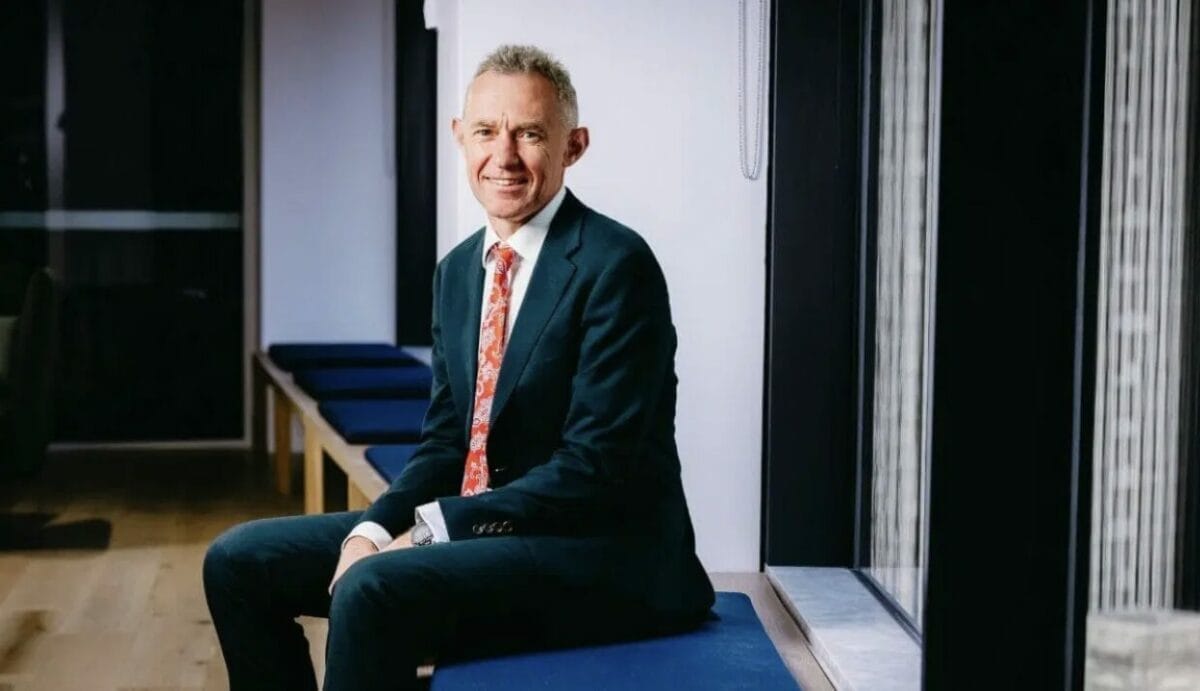

The $171 billion (A$260 billion) Australian Retirement Trust, which sets itself apart from its Australian peers with the identifying investment features of lower infrastructure allocations and less internal management, is looking to opportunities in digital infrastructure and the energy transition.
Head of investment strategy, Andrew Fisher says his biggest concern for this year is whether central banks, particularly the US Federal Reserve Board, can deliver the transition to lower inflation with a soft economic landing.
But he sees digital infrastructure and the transition to a low carbon economy as potential new areas of investment for the fund.
“Digital infrastructure wasn’t a thing five to 10 years ago, but it is possibly the biggest opportunity set we see at the moment,” he says.
He sees the transition to a low carbon economy is another area which will be a “huge opportunity in the infrastructure space and, in an economic sense more generally, over the coming decades.”
Fisher says ART historically had a lower exposure to infrastructure as it was not structurally tied to the $216 billion industry super investment vehicle, IFM Investors.
ART’s Queensland origins have seen it partner in some investments with the state’s sovereign wealth fund QIC, and ART has more money invested in private equity and private debt compared with many other Australian funds.
“There’s a tendency in most of our peer universe to be a little bit more heavily weighted in the unlisted asset space,” he says. “We have tried to be a bit more diversified. We certainly have large allocations to real assets, but we try to offset that with reasonably sized allocations in private equity and private debt,” he says. “We’ve probably not moved as quickly and as aggressively into infrastructure as some other funds.”
In a wide-ranging interview with Top1000funds.com sister publication, Investment Magazine, Fisher, who has been with ART and its predecessor fund Sunsuper for more than 13 years, says returns of 8-9 per cent were still possible over the longer term – a much more optimistic scenario than expected given many funds have warned members to be prepared for larger falls in investment returns.
“We have a more constructive forward-looking view looking out than we have had for some time, in terms of expected returns,” he says. “10 per cent is probably high relative to our long term expectations, but 8-9 per cent is not.”
Fisher’s role includes responsibility for managing strategy, asset allocation and investment risk at ART, working closely with the fund’s chief investment officer, Ian Patrick.
He says ART, which has its origins in the merger of major Queensland-based funds QSuper and Sunsuper in 2022 was delivering its returns through a different approach to investing than other funds – including relatively less investment in infrastructure and more in both listed equities and private equity.
Keeping it external
Unlike some other big industry funds, such as the $310 billion AustralianSuper, ART has no great plans to bring its investment management in-house beyond the current level of around 36 per cent, despite the fact that it is now the country’s second-largest fund.
“It is always something we will always question [whether to take more investment in-house], but we are not necessarily thinking of doing more today,” he says.
“At a certain size and scale there is arguably less benefit to internalisation in some areas because you are so big, you can’t be active.”
“I think our reticence, or lack of enthusiasm for internalisation, relative to some other funds probably gives us a bit of an advantage in terms of being quite tactical around where we think internal management will work best for us and our members.”
“We’re much more focussed on building the best external partnerships we can, and using them in the best ways we can, as opposed to the prioritisation of internal management just for the sake of being internal.”
Some industry fund chief investment officers have argued that one of the benefits of internalisation means funds are approached at an earlier stage about coming into big deals, potentially on more attractive terms.
But Fisher points out that the two funds which formed ART were invited to be part of two major deals – QSuper in the $25 billion bid for Sydney airport and Sunsuper in the $10 billion takeover of AusNet – in 2021, before the merger went ahead in February 2022.
He says the two deals were so large that they were not ones which ART would consider doing on its own these days despite its larger size.
“If you think about our participation in the [Sydney airport] consortium- even if we doubled our participation, we would not be doing it on our own.”
Fisher says the increasing size of the fund has meant that ART is being approached with “a different style of inbound inquiry” on potential investment deals.
He says ART was willing to work with external managers including paying the higher fees needed to invest in private equity.
“We certainly don’t like paying fees, but we think we can be adequately rewarded for the fees we are paying. We think that diversification is worth it.”
ART has about 51 per cent of its assets in equities, a factor which was behind the 10 per cent returns it was able to deliver in 2023 for its balanced option.
This helped counter the writedowns in commercial office blocks last year which occurred at ART and most of the rest of the super fund sector.
Fisher says the returns of 2023 had come in higher than expected because of the stronger than expected performance of equities.
“Equities have outperformed a lot of people’s expectations,” he says. “We have underestimated the capacity for equities to be a reasonably good inflation hedge. We have underestimated the capacity of earnings to capture inflation and offset [inflation].”
Origin story
ART’s different approach to investing to some other industry funds was highlighted in its decision to vote in favour of the bid for Origin Energy by Canadian investment giant Brookfield Asset Management and its US partner, last year.
But its support was not enough to see the deal go through following strong opposition by AustralianSuper, which boosted its stake in Origin to 17 per cent, with its vote supported by several other industry fund investors.
This meant the bidders were unable to garner the 75 per cent of shareholders to succeed despite the support of the Origin board. (Origin’s shares have continued to trade below the offer price since the bid was rejected.)
ART did not make its view on the bid known before the vote, in contrast to AustralianSuper which actively opposed it, staying out of the public arena during the bid where its voice could have been influential had it chosen to speak out.
“It’s a matter of public record that we did vote in support of the bid,” Fisher says.
“It was our view that it was in the best interests of our members to accept the offer. We thought it was a good price,” he says. “But these things happen all the time- some takeovers get up and some don’t.”
Fisher says ART is “relatively neutrally positioned in equities” at the moment.
“There’s always reasons not to want to invest in equities,” he says. “But (at the moment) we are not underweight, we are not overweight [in equities]. What we are increasingly focussed on is trying to be as diversified as possible. If you take bond yields for example, they seem relatively evenly poised. They’re probably a little bit lower than we think is fair but not low enough to take a position on it.”
He says ART’s appointment of former Australian Reserve Bank deputy governor Guy Debelle as an external adviser to its investment committee in March 2023 was an example of a high-quality personnel investment the fund could make given its larger size.
Debelle has had a long interest in the economics of climate change and green energy, leaving the Reserve Bank in early 2022 to join Andrew Forrest’s green energy arm, Fortescue Future Industries. He left the full-time role at FFI a few months later and the FFI board last year, and is now a company director and adviser specialising in green energy.
Fisher says the global economic outlook is “delicately poised in terms of whether inflation is well and truly finished or not.”
“There is certainly a growing body of evidence that the inflationary challenge is under control, particularly in the US,” he says. “The concern we have is that there is still a sizeable elevated geopolitical uncertainty around the world. It doesn’t take much for something to happen to create some sort of supply side impact on inflation. We are seeing it now with regards to shipping costs.”
His biggest concern for this year is whether central banks, particularly the US Federal Reserve Board, can deliver the transition to lower inflation with a soft economic landing.
“Soft landings are really hard [to engineer],” he says. “The Fed has done a really good job to this point, but the US is still facing a difficult election year, an insane fiscal situation. I don’t think it will be as easy as the market thinks for the Fed to deliver a soft landing in the next 12 months.”








Leave a Comment
You must be logged in to post a comment.
Login