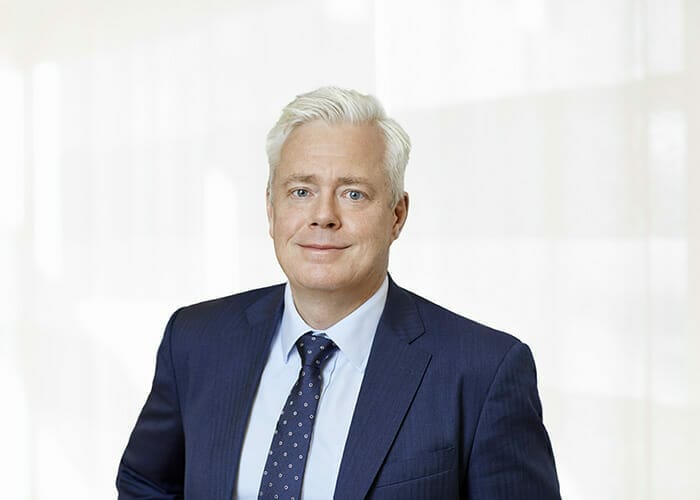

AP4 chief targets yield, alternatives

Since Niklas Ekvall took over at the helm of SEK334 billion ($37.8 billion) Swedish buffer fund AP4 last October, he has immersed himself in finding ways to further develop the fund’s investment processes and portfolio.

Pushing change is challenging when a fund has as celebrated a track record as AP4, where core strengths such as a strong domestic equity allocation, ground-breaking environmental, social and governance (ESG) integration and dynamic internal management already set it apart from peers.

Ekvall believes, however, that current investment strategy could better connect with AP4’s liabilities.

The new chief executive of the fund plans to introduce more long-term strategic investments to broaden its risk strategy. Listed shares account for more than half of assets, and in what he calls a “stronger, top-down grip” he wants to make more of AP4’s unique long-term mandate by adding more long-term diversifying assets.

“We want to extend our investment horizon, adding more diversity and capturing the opportunity we have been given by our mandate,” he says. “It is about furthering our risk taking and diversifying our risk on a strategic level to make sure we capture the potential we have to be long term.”

Under his leadership, the fund will review its approach to alternatives, where it allocates just 2 per cent of assets under management, with a focus on infrastructure, private equity and private debt. However, he does emphasise caution.

Sponsored Content

“Alternative investments are stressed; we won’t chase investments now,” he says. “It is more about reviewing this for the long term.”

Unique fund structure

Ekvall inherits a fund structure put in place in 2013, whereby investment falls into three horizons: 40 years, three-15 years and up to three years.

The 40-year “normal” portfolio is the reference; it comprises several different indices. Equities, because of their high long-term returns, and more volatile short-term returns, account for 66 per cent of the Normal portfolio, with the rest in bonds.

A third of the fund’s assets are in the “strategic” three- to 15-year portfolio. Here, investment includes real estate, Swedish equities including the small-cap portfolio, fixed income and various sustainability initiatives, such as AP4’s low-carbon strategies.

Tactical three-year management invests primarily in fixed income, along with global and Swedish equities, targeting returns above the index. Swedish equity is one of AP4’s standout portfolios, returning 12.4 per cent in 2016 and 14.1 per cent in 2015. It’s an allocation that has benefited from strong internal expertise over the years.

“We have developed an active stock-picking ability and we are close to companies and the best investment opportunities,” says Ekvall, who adds that the breadth, diversity and efficiency of the Swedish market have helped ensure strong returns. Investment decisions are made on the basis of long-term fundamental company analysis, with corporate governance and sustainability integrated into the strategy.

The aim is to outperform the index by identifying companies with good long-term growth value and revaluation potential.

Similarly, corporate analysis in the Swedish small-cap portfolio is fundamental and manual. There is no ready-made template; analysis is complex and differs from company to company. It requires reading and meeting with representatives of companies, and includes focusing on company structure and governance because of their impact on long-term development.

By law, 30 per cent of fund assets have to be invested in highly liquid and highly rated bonds.

“It gives the portfolio diversity and stability,” Ekvall says. “But it is also challenging in the current market.”

Recent strategies have included broadening the allocations to corporate and mortgage bonds, which give a slightly higher rate of interest than government bonds.

Another recent tactic has been increasing the proportion of short-term bonds to slightly reduce the risk of the fund losing capital when interest rates increase to more normal levels.

Ekvall is also considering how to increase allocations towards yielding assets, like emerging-market debt and high-yield debt. These assets sit outside the 30 per cent restriction on the fixed-income portfolio.

“We are in the process of reviewing our allocation to emerging-market debt,” he says. “One of the challenges is managing the foreign exchange risk, which is cumbersome and costly.”

AP4’s currency exposure – the proportion of assets in foreign currencies not neutralised by hedges – amounted to 27 per cent of assets at the end of last year.

Greater ESG integration

AP4 has just been awarded a ‘AAA’ rating in the Asset Owners Disclosure Project (AODP) Global Climate 500 Index, coming eighth out of 500 institutional investors. Under Ekvall’s watch, the fund will continue to extend its sustainability reach even further. It is now looking into how to integrate a number of themes into its investment strategy, including water scarcity and resource efficiency.

Reviewing how to increase the amount of global equity in low-carbon strategies from today’s 24 per cent of the allocation, is another priority.

“We want to increase our low-carbon strategies and are currently developing ways to put more pressure on, and incentivise, companies to de-carbonise further,” Ekvall says, adding that the fund is also going to increase efforts to make sure all investment decisions take enough consideration of the risk/return impact of climate change.

Asset Owner:AP Fonden 4 (AP4)

Leave a Comment

Nest favours institutional-first managers as retail exodus pressures private credit

Nest favours institutional-first managers as retail exodus pressures private credit

Nest, the largest workplace pension in the UK, says that private credit managers who prioritise institutional clients will be more favourably viewed. The £61 billion ($82 billion) fund has awarded a £450 million ($605 million) US direct lending mandate to Crescent Capital this month, citing the manager's institutional-client-first approach as a key attraction.

Sort content by

Does it pay to pay performance fees?

A new study finds no statistical evidence that returns of pension funds that pay performance fees for active investing are significantly higher or lower than the returns of pension funds that don't.

Infrastructure prices don’t show bubble

A decade of price increases in unlisted infrastructure raised fears of an “infrastructure bubble”. On the contrary, this period was one of price discovery for a nascent asset class, research by EDHECinfra finds.

Tough times greet new CalPERS CIO

Ben Meng isn’t easing into his role. The new CIO of CalPERS faces three new board members, a stressed private equity program and executive turnover, all under the pressure of a 70 per cent funded status and a maturing membership at the $340 billion fund.

Value lies where precious data is stored

Organisations across the globe are collecting data, analysing and re-analysing it more and more every day. As this trend continues, data infrastructure – tangible or intangible – becomes increasingly attractive. Canada’s OPTrust cites this reality as the rationale behind the EdgeCore partnership. It thinks data is its own asset class.

Northern LGPS forges own pooling path

The UK’s £45 billion Northern LGPS pool has eschewed creating a separate FCA-regulated entity, seeing it as an unnecessary expense. Moves in infrastructure and private equity have also reflected the asset pool’s laser-like focus on keeping costs down.

LUCRF’s member profile drives strategy

Leigh Gavin, CIO at Australian industry-fund pioneer LUCRF Super, takes care to match portfolios and costs with the needs of the fund’s low-balance membership. In recent years, this has meant taking on additional risk and questioning fee models in private equity.

Previous



