
SDG asset owner platform launches

Investors in Canada and Australia have joined the Dutch funds, APG and PGGM, in making their intention of an AI-driven SDG investment platform a reality.

The two Dutch funds set out in September last year their intention to establish the platform which allows asset owners and their managers to connect around the shared objective of measuring and understanding their investments’ contributions to the sustainable development goals (SDGs).

Now British Columbia Investment Management Corporation and AustralianSuper have joined the Dutch funds to jointly established the Sustainable Development Investments Asset Owner Platform (SDI AOP).

Claudia Kruse, the managing director of global responsible investment and governance at APG, said in an interview that the platform uses the definitions and taxonomy defined by the asset owners, which feeds into Entis, the technology platform, which turns those rules and methodology into classifications for 8,000 companies. The standard in the underlying data gets distributed by Qontigo and will be available for asset owners to use, like other data services.

“The benefit for asset owners is they are aligned with others with a standard definition. Asset owners can integrate this data across all investment processes – quantitative and fundamental – and monitor, map and steer their portfolios.”

Kruse said investors can also use the data to monitor external managers, and for asset allocation.

Sponsored Content

“This is a data source and a standard that truly aligns with the SDGs, based on financial data rather than sustainability data – and is auditable,” she said.

Rather than measure a corporate’s conduct or progress on sustainability, the platform looks through a different lens. It rates companies on the extent to which their core business activity helps create, for example, sustainable cities (SDG 11) or generate clean energy (SDG 7) in a novel approach that brings a new level to standardisation and efficiency to SDG portfolio management.

“Our definition is not based on company conduct such as an energy efficient oil refinery, but the products and services that contribute to SDGs. So we have to look at a company’s core business and how it is composed, what parts of the business contribute to the SDGs. One good example is Acardis  which we have been engaging with on disclosures, they report on products and services that contribute to SDGs,” Kruse said.

“Some companies are very straight forward, such as in renewable energy, but there are others for example in the pharma or consumer goods sectors that you need to get the contextual information to understand the products and services and what contributions to the SDGs they make. This is why AI is so important because it can process vast amounts of data and patterns.”

APG has set target of 20 per cent of its AUM to be aligned to the SDGs by 2025 and Kruse said that sustainable development investments also have to meet risk/return requirements and there are no concessions made for that.

“The data can help to inform such requirements,” she said.

Going forward Kruse said the intention is to have a stronger emphasis on forward-looking metrics to get insight into how well positioned a portfolio company is for the future.

“We don’t call ourselves an impact investor even though we want to make positive contributions. Measuring “outcomes” is more descriptive.”

The AI SDG platform will be broadly available in the market and a virtual event on September 10 will provide interested investors with additional insight into the workings of the platform.

“This is not open source because we have put substantial resources towards it. Our goal to define a standard to contribute to and invest in the SDGs.”

Leave a Comment

China ESG risk: the next unknown

China ESG risk: the next unknown

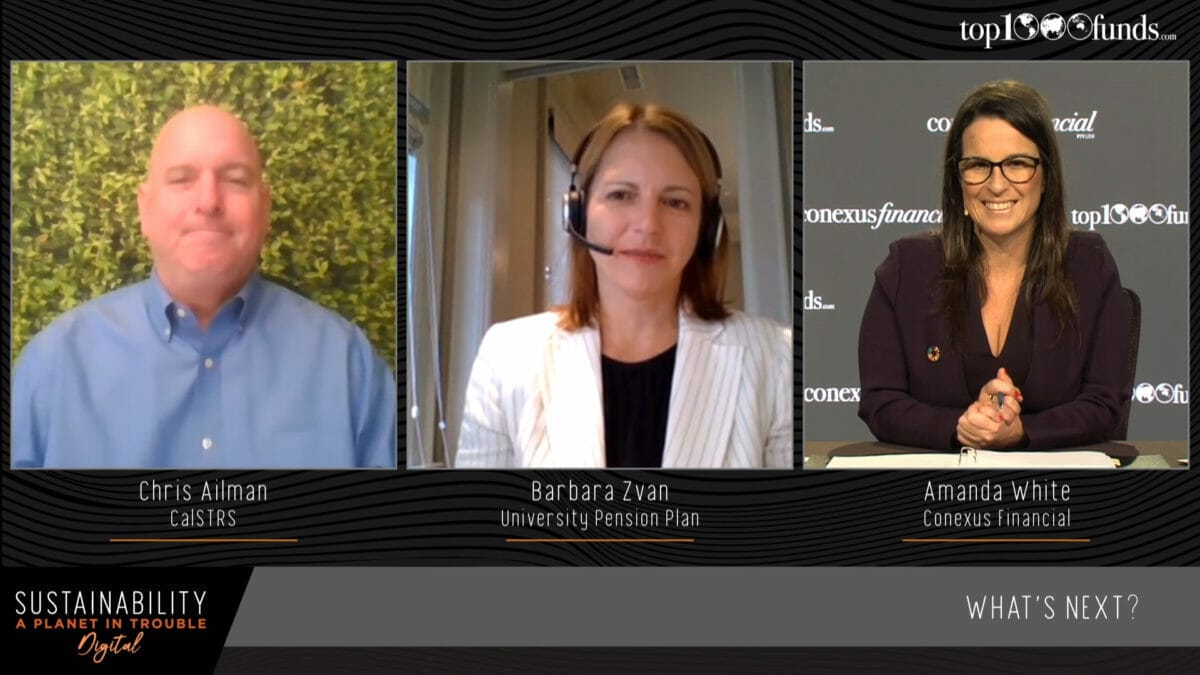
One of the most important, upcoming challenges at CalSTRS is how the fund should evaluate Chinese investments from a human capital and environmental standpoint, says Chris Ailman, chief investment officer at the giant pension fund.

Sort content by

Investors debate engagement priorities

Should investors collectively prioritise engagement issues, and if so what is at the top of the list? This was one of the topics delegates discussed at the 8th Sustainable Finance Forum run by the Oxford University Smith School of Enterprise and the Environment together with The Rothschild Foundation and the KR Foundation.

Sensitive intervention points

Sensitive intervention points in the post-carbon transition. We must exploit socioeconomic tipping points and amplifiers

The big book of SI

It is with great pleasure that we present to you our Big Book of SI. We firmly believe in sustainability investing, and think all the stars are aligned for this investment discipline.

Principles to guide investment

Investors will play a major role, whether active or passive, in climate change mitigation. To enable prudent decision-making, we propose three physically based engagement principles that could be used to assess whether an investment is consistent with a long-term climate goal.

The power of engagement

It is called the “CalPERS’ Effect” but it could easily be called the asset owner effect, or the institutional investor effect, or the power of engagement effect. Wilshire, which is a consultant to the $300 billion Californian fund CalPERS, has provided an update on its study measuring the effect of engagement on a targeted list of companies called the Focus List.

Previous